

Introduction: Why Automation Has Become the Core Cloud VDI Requirement
By 2026, automation is no longer a “nice to have” in Cloud VDI. It is the foundation that determines whether virtual desktop environments remain manageable as they scale.
Most enterprises running Cloud VDI today are not limited by performance or capacity. They are limited by operational friction: too many manual steps, too many control planes, and too much effort required to keep environments consistent.
As a result, Cloud VDI platforms are increasingly evaluated on a simple question:
How easily can desktop workflows be automated, governed, and operated from a single place?
This article examines Cloud VDI through that automation lens, comparing Thinfinity VDI on OCI with Thinfinity Cloud Manager, Azure Virtual Desktop, and Amazon WorkSpaces, focusing on Windows and Linux VDI workflows rather than infrastructure mechanics.
Cloud VDI Automation in Practice: What Enterprises Actually Need
In theory, all Cloud VDI platforms can be automated. In practice, the location and complexity of automation matter more than the tools themselves.
Enterprises expect Cloud VDI automation to cover:
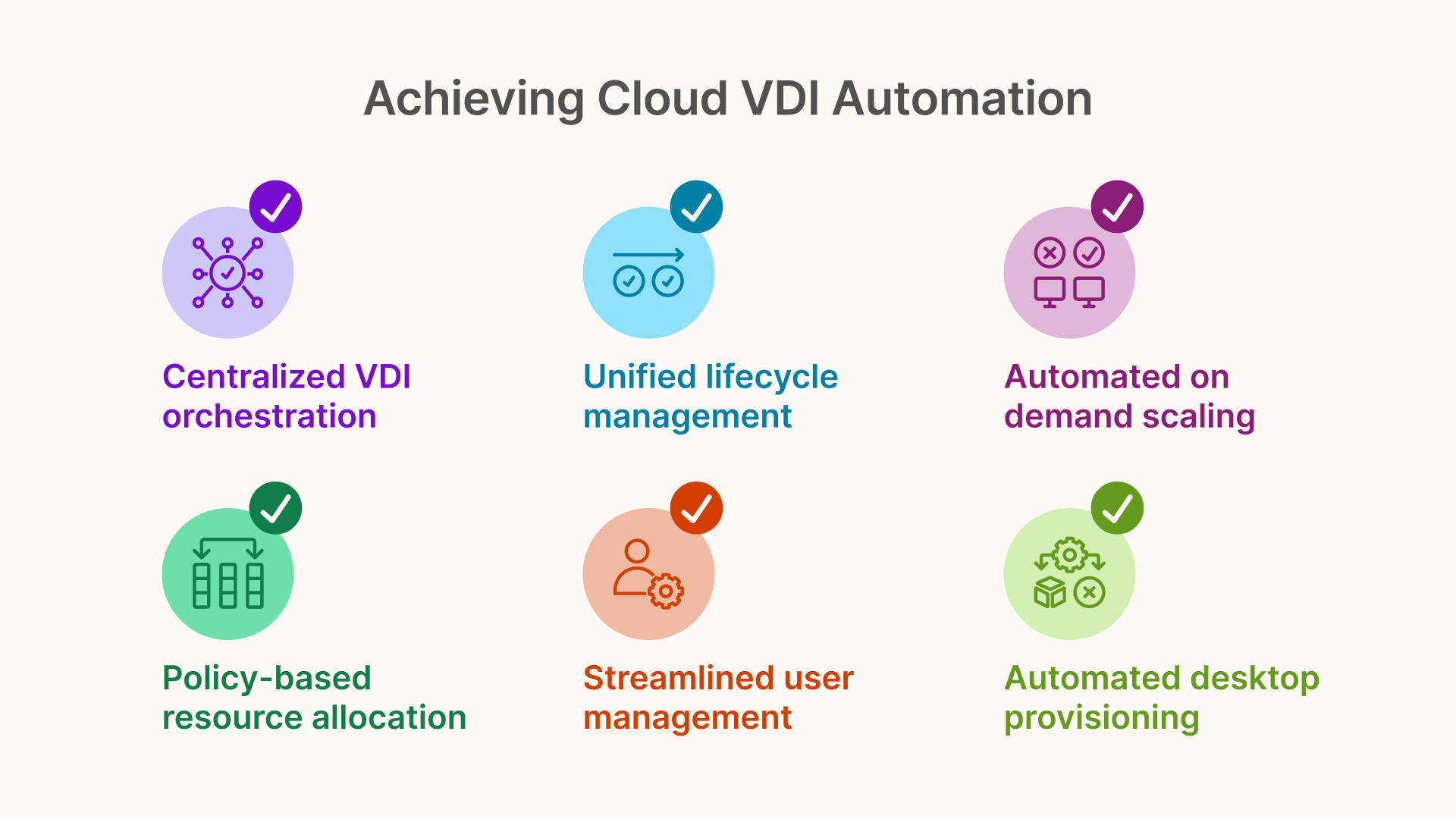
- desktop provisioning and deprovisioning,
- user onboarding and offboarding,
- policy-based assignment of resources,
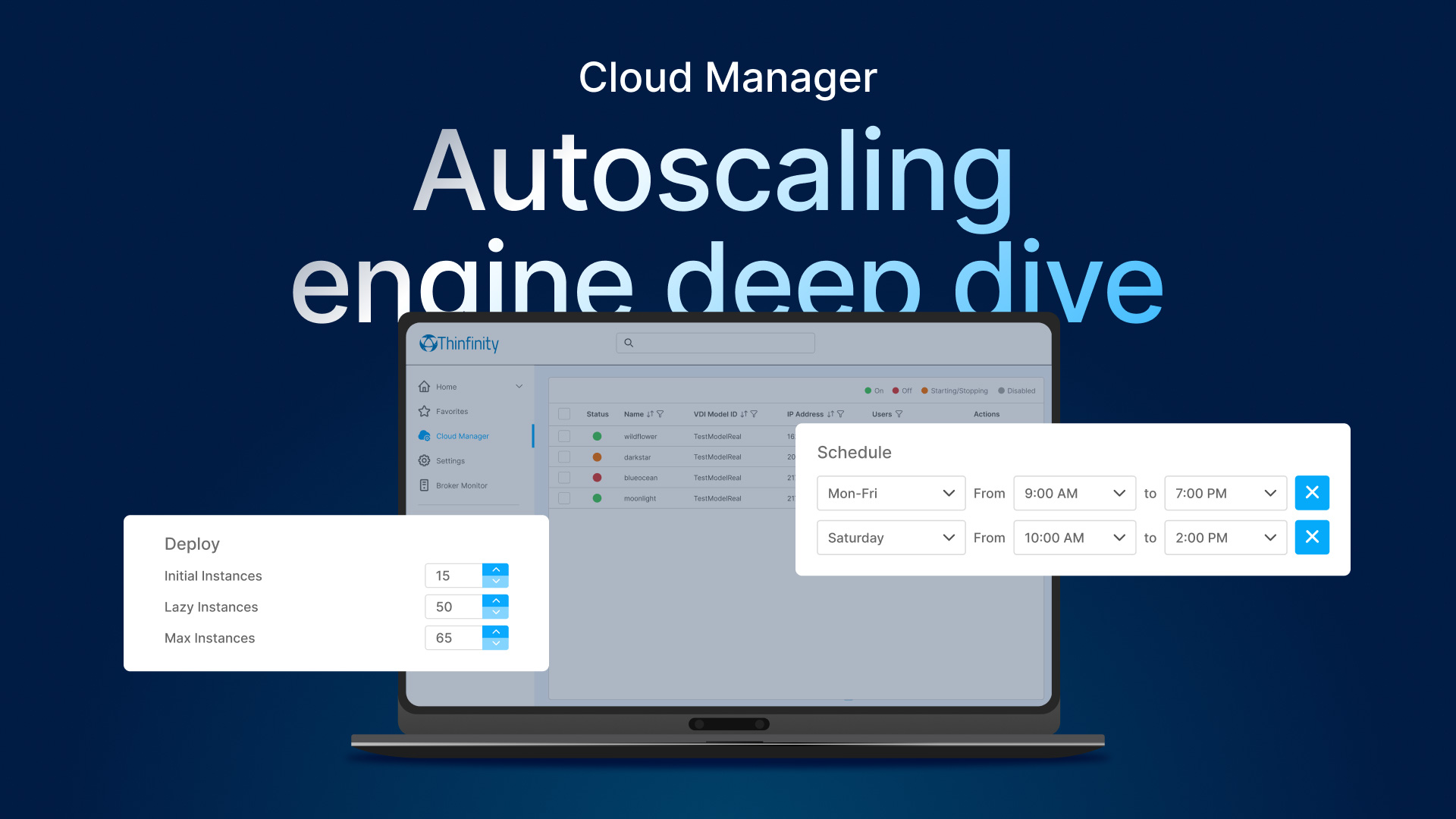
- scaling based on demand,
- and lifecycle consistency across environments.
The challenge is not whether automation is possible, but how fragmented it is.
Azure Virtual Desktop: Powerful Automation, High Cognitive Load
Azure Virtual Desktop is highly automatable, but that automation lives across multiple layers of the Azure ecosystem.
Infrastructure as Code templates define compute and networking. Identity policies control access. Scaling logic relies on scripts or automation accounts. Monitoring and remediation live elsewhere. Each component works well, but only when carefully orchestrated.
For organizations with strong Azure expertise, this model offers flexibility. However, from an operational perspective, automation is distributed rather than centralized. VDI administrators often need to reason about infrastructure, identity, scaling, and monitoring as separate concerns.
By 2026, many enterprises running AVD report that automation is achievable but difficult to standardize, particularly when managing multiple VDI environments or hybrid scenarios.
Amazon WorkSpaces: Automation Through Constraint
Amazon WorkSpaces simplifies operations by constraining them. Many lifecycle decisions are predefined by the service, reducing the need for automation logic.
This model works well for environments with consistent requirements and limited variation. However, because WorkSpaces abstracts most infrastructure and workflow decisions, customization is limited.
From an automation standpoint, WorkSpaces is simple, but rigid. Administrators trade flexibility for ease of use, which can become restrictive as requirements evolve.
Thinfinity Cloud Manager: Automation as the Operating Model
Thinfinity Cloud Manager takes a different approach by abstracting infrastructure complexity without hiding control.
Rather than requiring administrators to build and maintain Infrastructure as Code directly, Cloud Manager operates as an automation layer on top of native OCI services, purpose-built for VDI workflows.
This creates a model where:
- infrastructure provisioning,
- desktop lifecycle management,
- access policies,
- and scaling behavior
are all orchestrated from a single control plane, while still relying on native cloud primitives underneath.
For VDI administrators, this significantly reduces cognitive load. They interact with VDI concepts, not raw infrastructure components.
Infrastructure as Code, Without the Infrastructure Burden
One of the most important distinctions in 2026 Cloud VDI automation is who consumes Infrastructure as Code directly.
In Azure Virtual Desktop, teams often write and maintain IaC templates themselves. In Amazon WorkSpaces, IaC is mostly irrelevant because the service abstracts it away.
Thinfinity Cloud Manager sits in between. It uses Infrastructure as Code internally, but exposes it through higher-level workflows designed specifically for VDI operations.
This allows organizations to benefit from repeatability and consistency without forcing VDI teams to become cloud infrastructure specialists.
Single Pane of Glass for VDI Workflows
A recurring challenge in Cloud VDI environments is fragmentation. Provisioning happens in one place, access policies in another, scaling logic elsewhere.
Thinfinity Cloud Manager addresses this by acting as a single pane of glass for:
- desktop pools,
- user assignments,
- lifecycle events,
- access control,
- and operational status.
This does not remove the need for governance or change management, but it centralizes decision-making. Automation becomes easier to reason about because workflows are visible and manageable in one place.
Compared to Azure Virtual Desktop’s multi-console model, this simplifies day-to-day operations. Compared to Amazon WorkSpaces, it provides significantly more flexibility.
Automation for Windows and Linux VDI at Scale
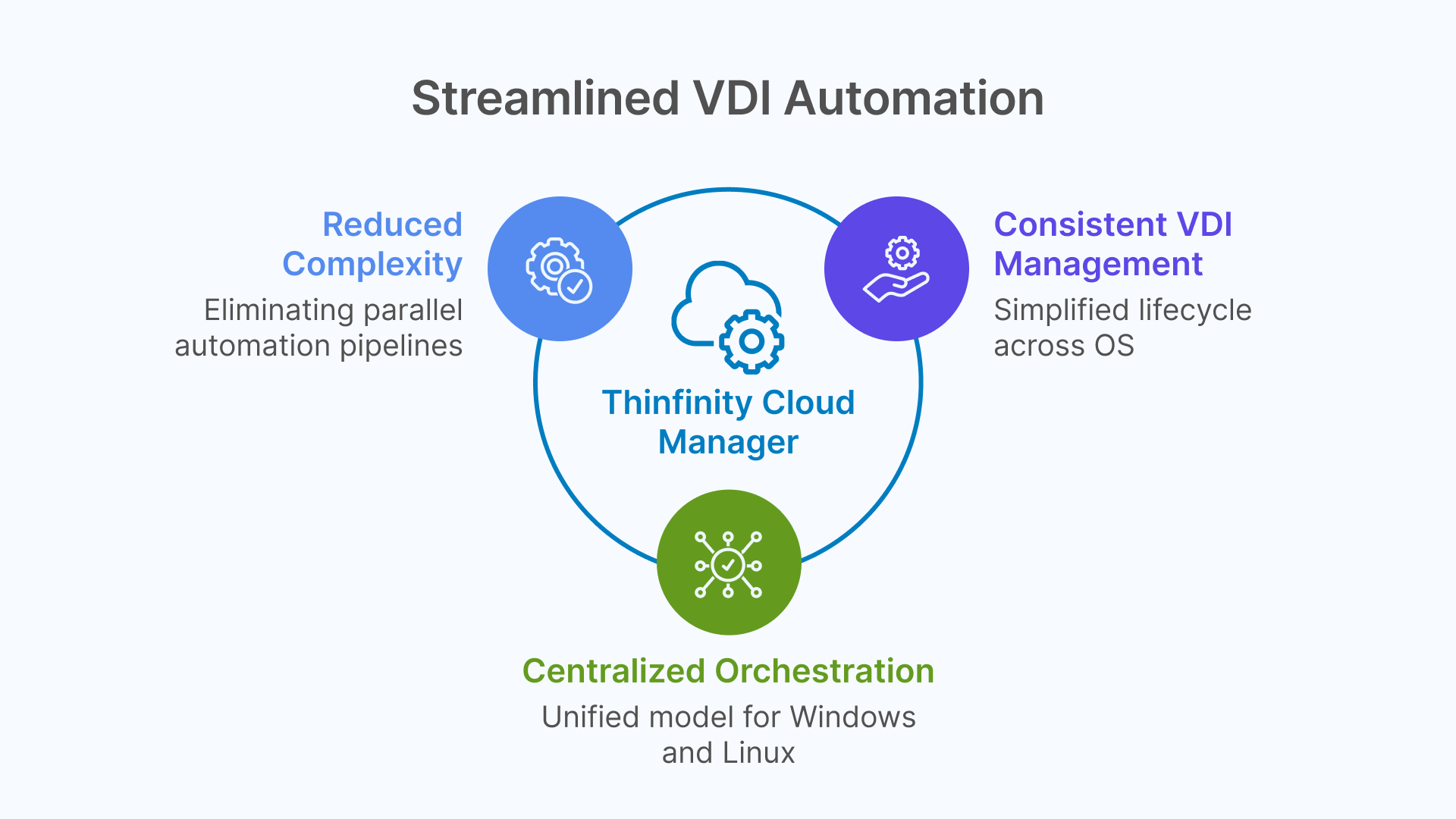
Managing both Windows and Linux desktops is common in modern enterprises. Automation complexity increases when workflows diverge across operating systems.
Thinfinity Cloud Manager enables consistent lifecycle management for standard Windows and Linux VDI workloads, using the same orchestration model regardless of OS. This reduces the need for parallel automation pipelines and custom tooling.
By contrast, AVD environments often require different templates and policies per workload type, while WorkSpaces offers fewer customization options overall.
Operational Impact Over Time
Automation value compounds over time. The more environments, users, and workflows an organization manages, the more important centralized automation becomes.
- Azure Virtual Desktop offers maximum flexibility but requires disciplined automation practices.
- Amazon WorkSpaces minimizes effort but limits adaptability.
- Thinfinity Cloud Manager aims to balance simplicity and control, abstracting infrastructure complexity while preserving customization.
For many enterprises in 2026, this middle ground aligns well with operational reality.
Conclusion: Automation Determines Cloud VDI Sustainability
In 2026, Cloud VDI automation is no longer about scripting deployments. It is about operating desktops as a controlled, repeatable service.
Azure Virtual Desktop, Amazon WorkSpaces, and Thinfinity VDI on OCI approach automation from different philosophies. The distinguishing factor is not tooling, but how closely automation aligns with VDI workflows themselves.
By abstracting Infrastructure as Code into a centralized, VDI-aware control plane, Thinfinity Cloud Manager positions automation as an operating model rather than an engineering project.
For organizations seeking Cloud VDI that is simpler than Azure Virtual Desktop, yet more customizable than Amazon WorkSpaces, this approach offers a compelling balance between control and operational simplicity.