

Introduction: Why VDI Migration in Education Is About Risk, Not Speed
For most universities, moving from traditional campus-based VDI to cloud VDI is not a greenfield initiative. It is a transition that must occur while teaching continues, research deadlines remain fixed, and institutional risk tolerance stays low.
As a result, successful cloud VDI adoption in education depends less on aggressive timelines and more on migration strategies that prioritize continuity, reversibility, and architectural optionality.
This article outlines a pragmatic, low-risk approach to migrating from traditional VDI to cloud VDI in higher education.
Why “Lift-and-Shift” Fails in Academic VDI
The Illusion of Simplicity
Many institutions begin cloud VDI projects with the assumption that existing desktops can be lifted from on-prem infrastructure and redeployed unchanged in the cloud. While technically feasible, this approach often carries hidden risks.
Academic VDI environments typically include:
- Desktops sized for peak lab usage
- Tight coupling between access, identity, and infrastructure
- Legacy applications with implicit network trust assumptions
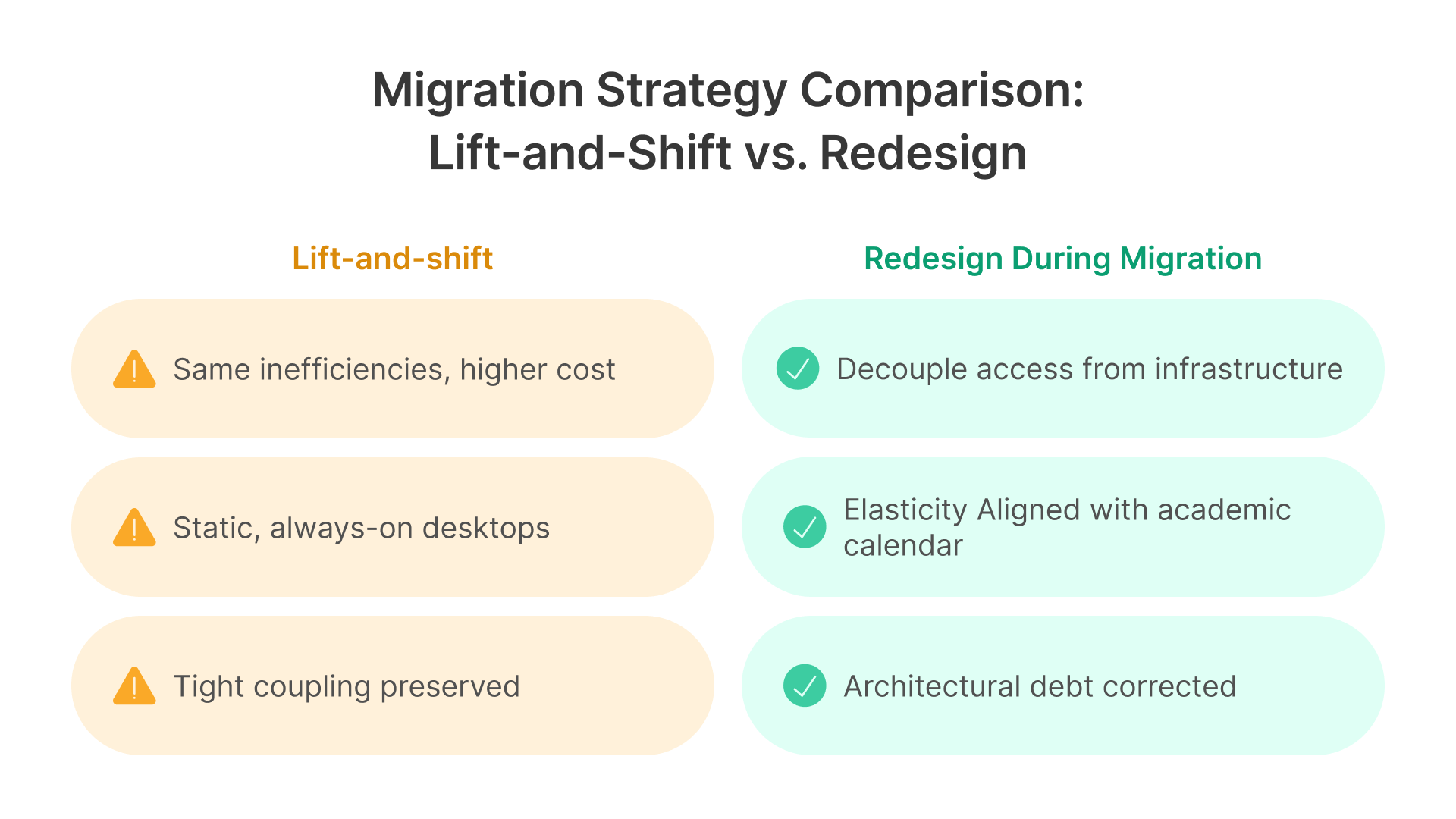
When these patterns are moved directly to the cloud, institutions inherit the same inefficiencies—often at higher operational cost and with less room for error.
Migration Is an Opportunity to Correct Architectural Debt
Cloud migration should not replicate existing constraints. It should provide an opportunity to:
- Decouple access from infrastructure
- Introduce elasticity aligned with academic schedules
- Reduce dependence on static, always-on desktops
Institutions that treat migration as a redesign rather than a relocation achieve better long-term outcomes.
Phased Migration as the Safest Strategy
Why Incremental Change Matters in Education
Academic environments rarely tolerate large-scale cutovers. A phased migration allows universities to move selectively, validate assumptions, and retain rollback options.
Common low-risk entry points include:
- New virtual classrooms or courses
- Temporary labs for specific programs
- Pilot faculty desktops
- Disaster recovery or overflow capacity
These scenarios limit blast radius while providing real-world feedback.
Coexistence Is a Feature, Not a Failure
For extended periods, on-prem VDI and cloud VDI often coexist. This is not a sign of incomplete migration—it is a reflection of institutional reality.
Architectures that assume coexistence from day one reduce pressure on timelines and enable more thoughtful modernization.
Simplify Your Migration with Thinfinity Cloud Manager
Orchestrate on-prem and cloud workloads from a single plane with 40-50% more gateway capacity and 90% less manual cost reconciliation.
Identity and Access as the First Migration Step
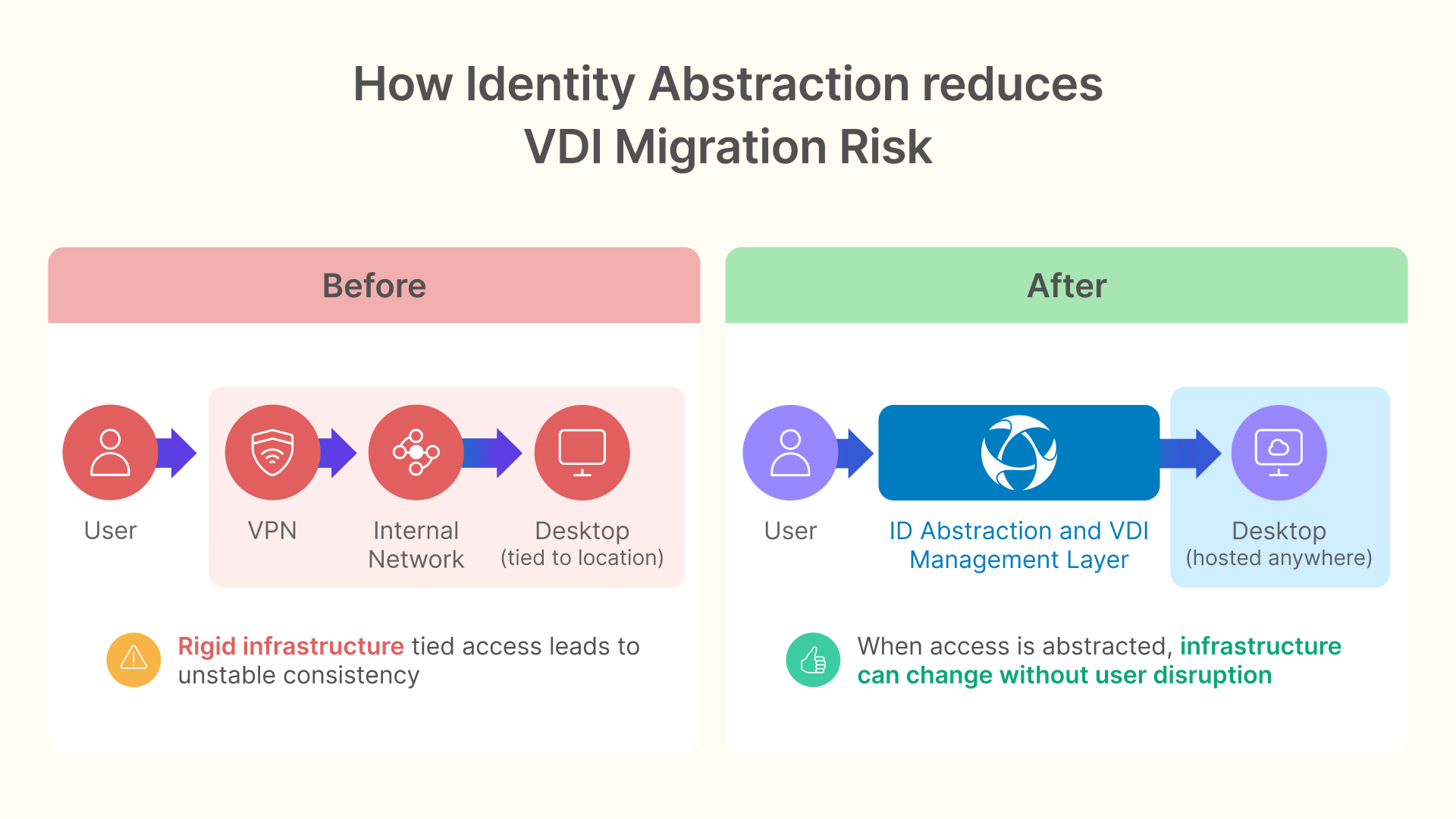
Why Access Should Move Before Desktops
One of the most effective ways to reduce migration risk is to standardize access before moving workloads.
By introducing a unified access and orchestration layer early, institutions can:
- Normalize authentication flows
- Apply consistent access policies
- Abstract where desktops are hosted
- Minimize user-visible change
From a user’s perspective, access remains stable even as infrastructure shifts underneath.
Reducing VPN Dependency During Migration
VPN-based access complicates migration by tying users to network location. Identity-driven access models allow cloud and on-prem resources to coexist without exposing internal networks or reconfiguring client devices repeatedly.
Managing Faculty, Staff, and Student Transitions Differently
| User Type | Complexity | Migration Order | Key Consideration |
|---|---|---|---|
| Students | Low | First | Non-persistent, elastic |
| Staff | Medium | Second | Some persistence, admin workflows |
| Faculty | High | Last | Full persistence, rollback critical |
Hybrid VDI as the Migration Destination—Not Just a Phase
Why Many Universities Remain Hybrid by Design
Even after successful cloud adoption, many institutions intentionally retain hybrid architectures due to:
- Specialized on-prem hardware
- Data residency requirements
- Research infrastructure dependencies
- Financial amortization of existing assets
Migration strategies should therefore optimize for hybrid sustainability, not cloud absolutism.
Designing for Long-Term Optionality
Cloud VDI architectures that preserve optionality allow institutions to:
- Shift workloads between providers
- Introduce new cloud regions
- Rebalance cost and performance over time
This flexibility is particularly valuable in education, where funding models and regulatory environments change frequently.
Thinfinity’s Role in Low-Risk Academic VDI Migration
Access and Orchestration as a Stabilizing Layer
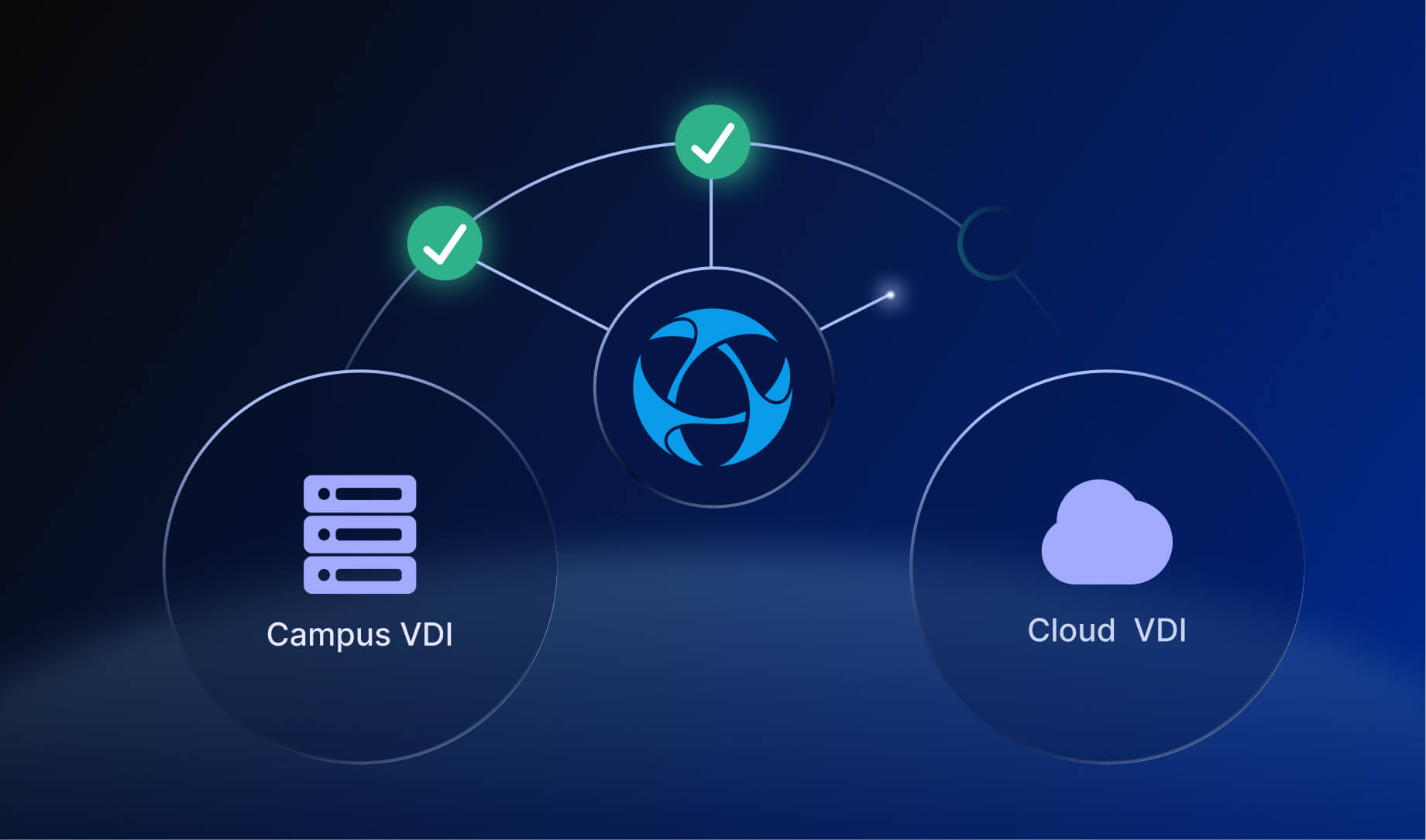
In many university migrations, Thinfinity Workspace is introduced early as an access and orchestration layer that sits above both on-prem and cloud environments.
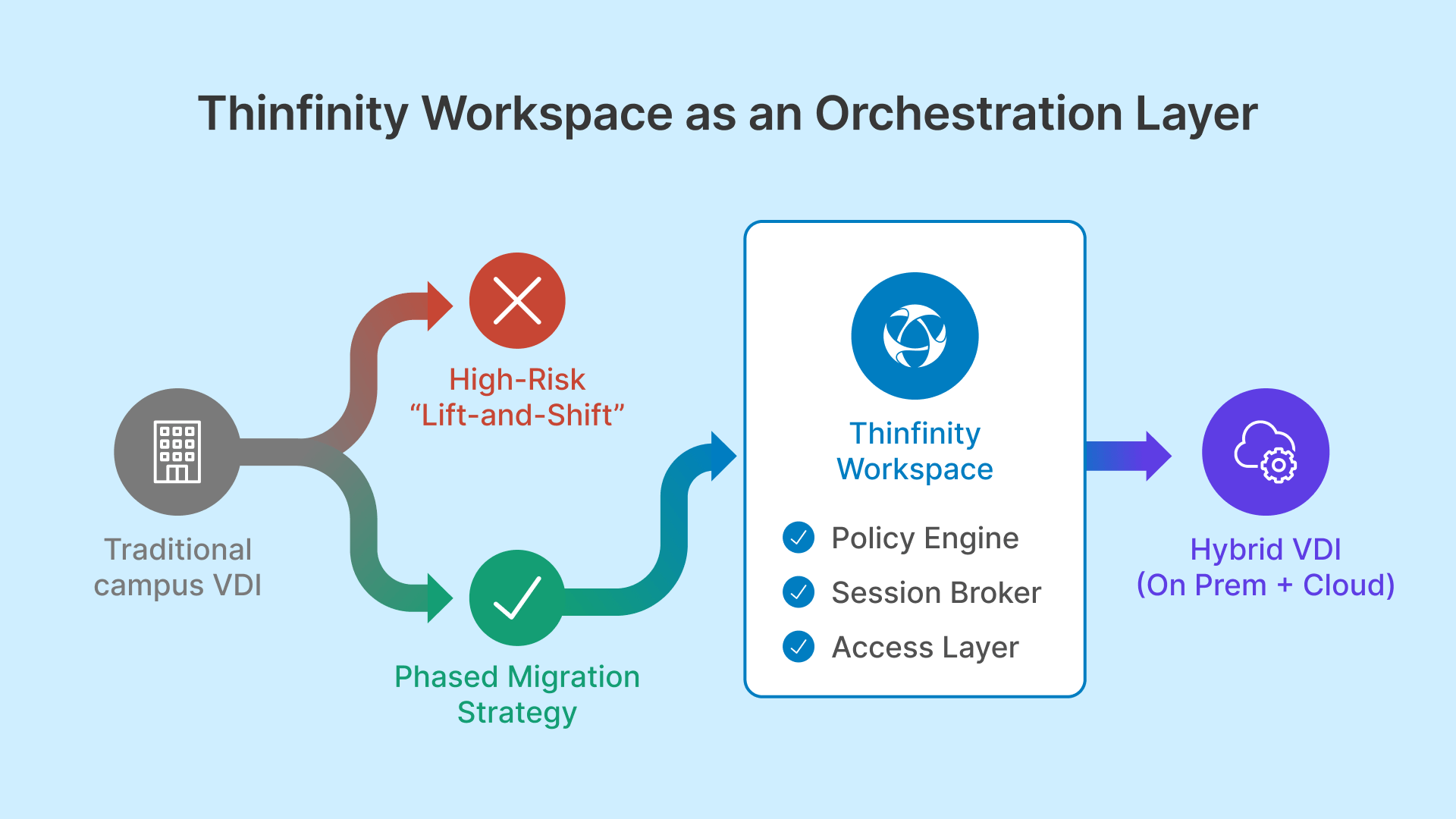
This allows:
- Users to access resources consistently during migration
- IT teams to move desktops incrementally
- Policies to remain stable across environments
- Hybrid and multi-cloud strategies to coexist
Because Thinfinity integrates with OCI through native KVM support while also supporting Azure-based environments, institutions can migrate toward OCI without forcing an all-or-nothing decision.
Migration Without Lock-In
Perhaps most importantly, this approach avoids binding the institution’s access model to a single cloud provider. Migration becomes a controlled process rather than a one-way commitment.
Governance and Change Management in Academic Migrations
Migration Is as Much Organizational as Technical
Successful VDI migration requires coordination between:
- IT infrastructure teams
- Academic departments
- Security and compliance stakeholders
- Faculty leadership
Clear governance structures and staged communication reduce resistance and unexpected disruption.
Measuring Success Beyond Cutover
Migration success should be measured by:
- Reduced incident frequency
- Improved utilization
- Better cost predictability
- User satisfaction across semesters
These indicators matter more than migration speed.
Conclusion: Migration as an Ongoing Capability, Not a One-Time Project
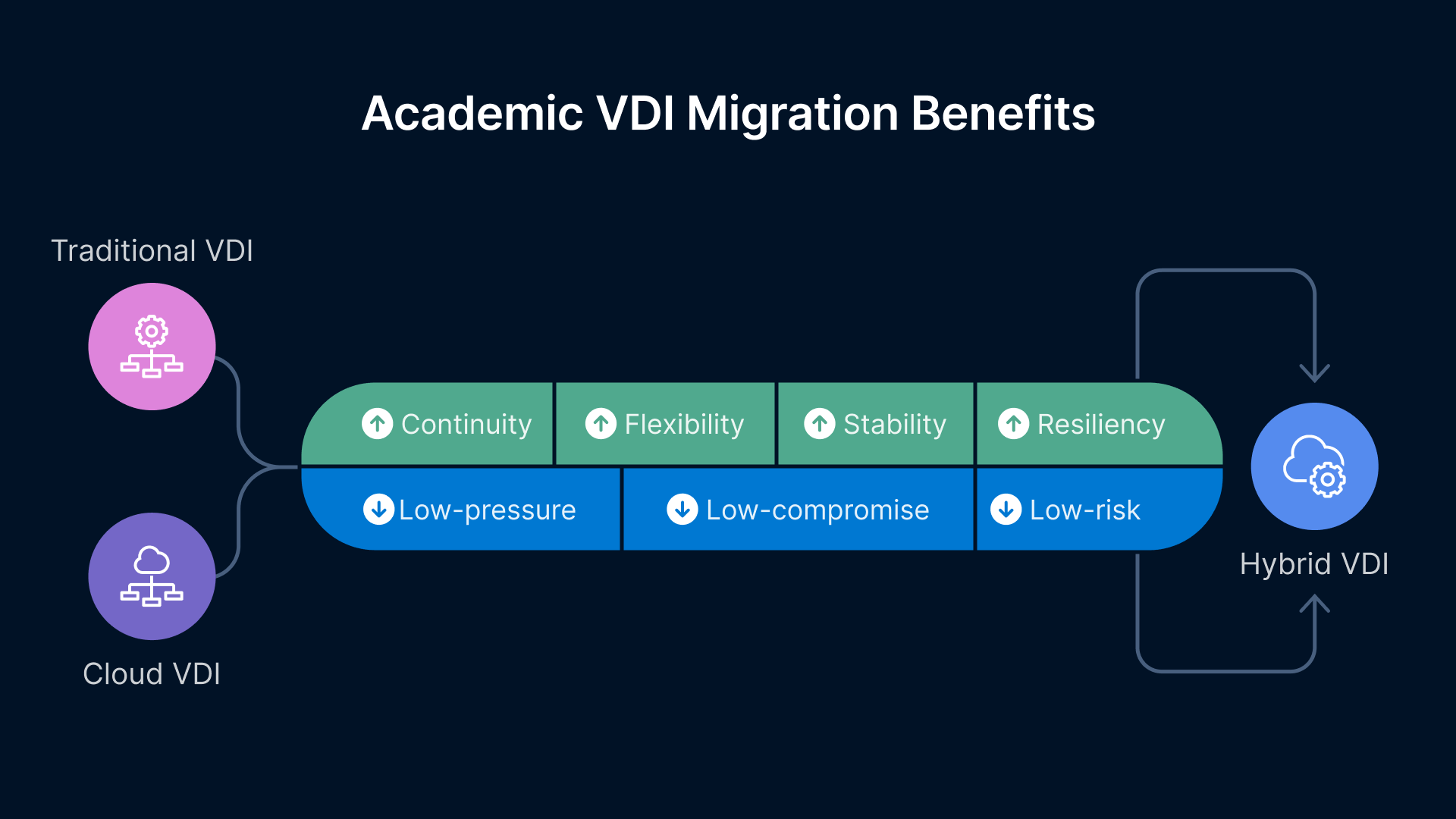
For universities, migrating from traditional VDI to cloud VDI is not a single event. It is a capability that supports continuous modernization.
Institutions that adopt phased migration strategies, unify access early, and preserve architectural flexibility reduce risk while increasing long-term resilience.
As emphasized throughout “Traditional VDI vs Cloud VDI for Education: Where Each Model Actually Works”, the most successful academic VDI programs treat migration as a strategic discipline—one that evolves alongside education itself.