

April 15, 2026: The Citrix License Cliff
On April 15, 2026, Citrix file-based licenses (.lic files) stop working. This is not a negotiation. This is not a grace period. This is an embedded cutoff written into Citrix product code. Every instance of CVAD (Citrix Virtual Apps and Desktops), NetScaler, XenServer, PVS (Provisioning Services), WEM (Workspace Environment Manager), and XenMobile that still relies on legacy .lic file validation will lose functionality when the License Administration Services (LAS) transition completes. For organizations that have not migrated to subscription licensing by April 15, the impact is immediate and severe: virtual desktops no longer boot, application delivery stops, and client access is severed.
This deadline marks the forced transition from Citrix’s traditional perpetual and pooled licensing model to Cloud Software Group’s subscription-only, cloud-connected licensing architecture. And behind that transition lies a corporate ownership story that explains the pricing trajectory that has devastated Citrix’s customer base: in September 2022, Vista Equity Partners and Evergreen Coast Capital acquired Citrix for $16.5 billion, merged it with TIBCO Software to form Cloud Software Group, and immediately initiated a pricing escalation strategy that has resulted in 100% price increases on monthly licenses and 50%+ renewal hikes with only 90 days’ notice.

The failure mode (if migration isn’t complete by April 2026) is a systemic outage affecting end-user computing or application delivery infrastructure.

The April 15 deadline is now the most consequential date on IT directors’ roadmaps. Organizations that have been delaying migration are running out of time. Those that haven’t started are facing panic mode. And those that are evaluating alternatives are discovering that Citrix’s new ownership model and cloud-dependent licensing architecture have created an unprecedented window for next-generation VDI platforms.
Section 1: What Stops Working on April 15, 2026
The Hard Cutoff — No Grace Period, No Fallback
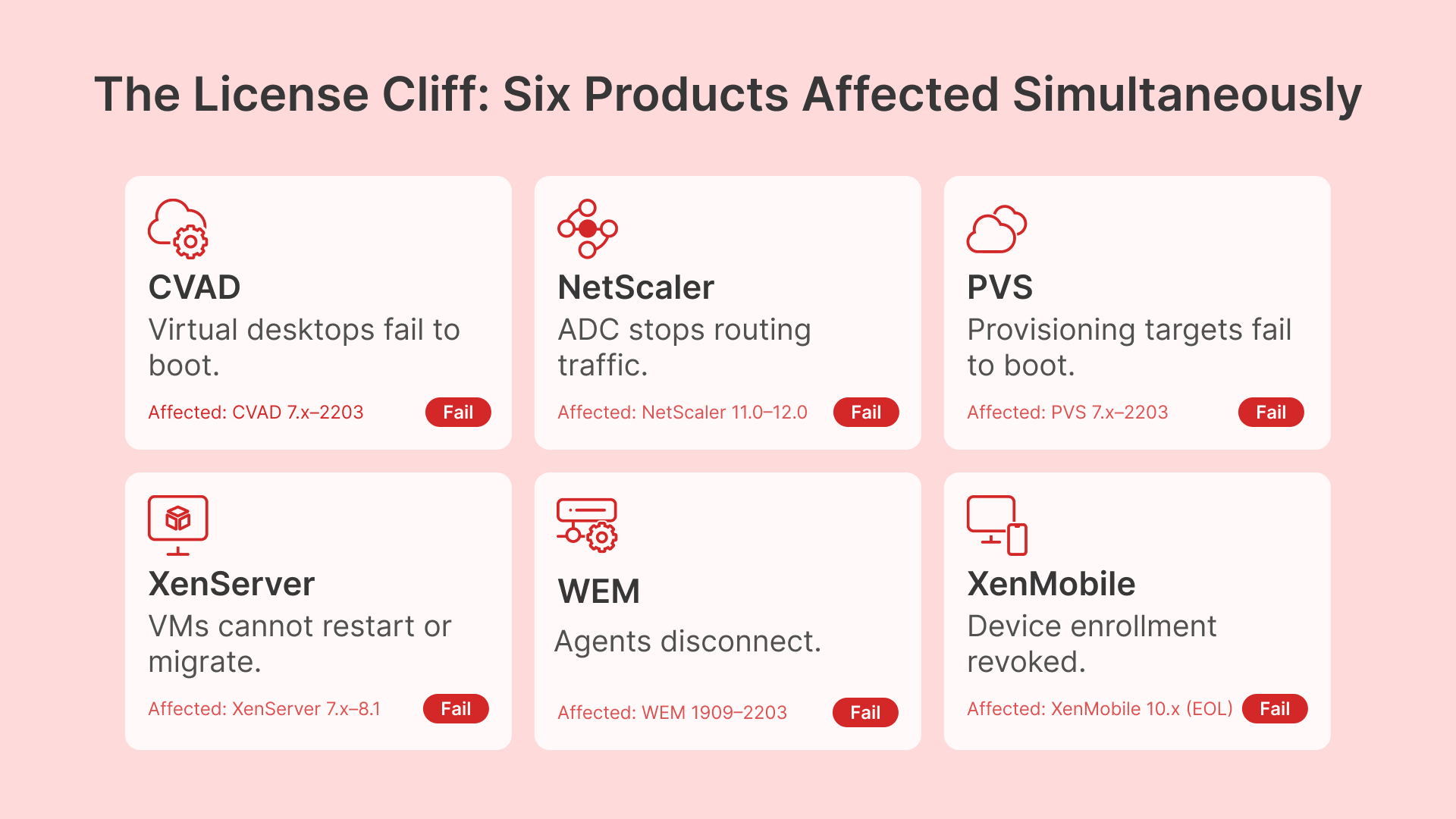
Citrix’s LAS transition is engineered as a hard cutoff, not a phased migration. When April 15, 2026 arrives, .lic files cease to be validated by any Citrix product. The mechanism is simple: Citrix products check their license validity against the LAS server, which communicates to a cloud-based entitlement system. On April 15, the LAS system stops accepting legacy .lic file tokens. When a session initiates a license check and the .lic file is rejected, the product denies access. For end users, this manifests as:
- CVAD virtual desktops: Boot failures with ‘License validation failed’ error. Users cannot log in.
- NetScaler instances: ADC cease responding to requests. Traffic cannot be routed.
- XenServer hypervisors: VM start failures. Existing VMs may continue running, but cannot be restarted or migrated.
- PVS (Provisioning Services): PVS targets cannot boot. Virtual desktops become inaccessible.
- WEM (Workspace Environment Manager): WEM agents disconnect. User experience management ceases.
- XenMobile: Mobile device management revocation. Enrolled devices lose compliance status.
The only safety net Citrix provides is a 30-day cached entitlement grace period: if an environment loses connectivity to the LAS cloud for up to 30 days, cached entitlements allow sessions to continue. However, once the 30-day window expires—or when the LAS server explicitly revokes entitlements on April 15—there is no fallback. Air-gapped environments, isolated networks, and any infrastructure unable to reach las.cloud.com:443 over HTTPS for 30+ consecutive days will lose access entirely.
Affected Products and Minimum Compatible Versions
Not all Citrix products are impacted equally. The transition applies to products released before the LAS architecture became standard. Here’s the definitive table of what breaks and when:
| Product | Affected Versions | Minimum Compatible | Impact if Not Updated |
|---|---|---|---|
| CVAD (XenDesktop) | 7.x, 2003–2203 | 2303 LTS or later | Virtual desktops cannot boot; sessions denied |
| NetScaler ADC | 11.0–12.0 | 13.0 or later | Traffic routing fails; ADC unresponsive |
| XenServer | 7.x, 8.0–8.1 | 8.2 or later | VM management unavailable; boots may fail |
| PVS (Provisioning Services) | 7.x–2203 | 2303 or later | PVS targets fail to boot; desktops inaccessible |
| WEM (Workspace Environment Manager) | 1909–2203 | 2303 or later | Agent disconnection; user policies unenforced |
| XenMobile | 10.0–10.x | EOL (deprecated) | Mobile enrollment revoked; compliance lost |
License Types That Don’t Transition
Not every legacy Citrix license converts cleanly to Cloud Software Group’s subscription model. Four critical license types present migration challenges:
- Pooled vCPU licenses: Legacy pooled licensing counted compute resource consumption, not user seats. The LAS model is strictly user-seat-based. Organizations with pooled licenses must repurchase as per-user subscriptions, eliminating licensing flexibility.
- CICO (Concurrent Instance Count) licenses: NetScaler CICO licenses permitted a fixed number of concurrent connections. CICO has no direct equivalent in LAS; organizations must convert to per-user NetScaler subscriptions or per-throughput licensing tiers.
- Perpetual NetScaler licenses: Many organizations hold perpetual NetScaler ADC licenses purchased 5–10 years ago. These cannot be migrated; organizations must purchase subscription licenses under Cloud Software Group’s new pricing model (50%+ higher than legacy perpetual cost on a 5-year amortized basis).
- Educational and non-profit discounts: Citrix’s educational licensing program (EDU) is not carried forward into Cloud Software Group’s subscription model. Organizations must pay full commercial rates or renegotiate agreements, with no grandfather pricing available.
LAS Architecture and Infrastructure Requirements
The License Administration Services (LAS) system is cloud-native and requires continuous outbound connectivity. Here’s what every organization must architect:
Required Infrastructure Components
- License Server minimum version: Citrix License Server 11.17.2 or later. Earlier versions cannot communicate with LAS.
- Network connectivity: Outbound HTTPS (port 443) from all product instances to las.cloud.com. No proxying, no packet inspection, no latency tolerance. TLS 1.2 minimum.
- DNS resolution: DNS must resolve las.cloud.com with <100ms response time. CDN failover is automatic, but local DNS caching can cause stale entries and authentication failures.
- Firewall egress rules: All Citrix products must be able to reach Citrix’s cloud entitlement servers. This cannot be proxied through HTTP proxies (breaks TLS certificate pinning). Organizations must allow direct outbound HTTPS.
- Certificate pinning: LAS implements certificate pinning to prevent man-in-the-middle attacks. Organizations cannot intercept traffic with SSL inspection appliances; connection failures will occur.
The 30-Day Connectivity Grace Period
When a Citrix product checks into LAS, the entitlements are cached locally on the License Server. If connectivity to las.cloud.com is lost, Citrix products can continue operating for up to 30 days using cached entitlements. However, this grace period only applies if:
- The initial check-in was successful: If a License Server never successfully connects to LAS, there is no entitlement cache to fall back on.
- The grace period has not expired: On day 31 of no connectivity, cached entitlements are invalidated and sessions are denied.
- The entitlements have not been revoked: If Cloud Software Group explicitly revokes an entitlement in the LAS cloud (due to non-payment, license expiration, or subscription cancellation), the 30-day grace period is bypassed and access is immediately denied.
Air-Gapped Environments: Complexity and Approval Barriers
The April 15 deadline creates severe complications for air-gapped environments—isolated networks without outbound internet connectivity. Many government agencies, financial institutions, and utilities operate VDI infrastructure in air-gapped networks for security and compliance reasons. For these organizations, LAS creates an impossible situation: Citrix products cannot reach the cloud, so entitlements cannot be refreshed, and the 30-day grace period simply delays the inevitable cliff.
Citrix provides an ‘offline activation workflow’ for air-gapped environments. However—and this is critical—the offline activation process is, in Citrix’s own terminology, ‘significantly more process-intensive’ and requires multiple conditions:
- Pre-activation requirement: Organizations must export activation requests from their air-gapped License Server, send them to Citrix support, and receive activation payloads before the April 15 deadline. This is not automated; it requires ticket submission and manual approval.
- Periodic export/import cycles: The offline activation is not permanent. Entitlements must be periodically exported from the air-gapped License Server, transported via secure courier or removable media to an external system connected to the internet, uploaded to Citrix’s cloud system for re-authorization, and then imported back into the air-gapped environment. Citrix’s documentation is vague about the frequency, but industry interpretation suggests monthly or quarterly cycles.
- Citrix exception approval: Not every organization requesting offline activation is granted it. Citrix requires justification, compliance documentation, and security review. Small to mid-market organizations often have requests denied and are directed to implement outbound cloud connectivity instead.
- January 2026 deadline for exception requests: Organizations seeking offline activation must submit requests to Citrix before January 31, 2026. Any requests submitted after January 31 will not be approved, leaving organizations two months to implement connectivity or face the April 15 cliff without a workaround.
For organizations operating in truly isolated ‘dark site’ environments (no external connectivity, even with courier handoff), Citrix requires direct engagement with their licensing team to negotiate custom arrangements. The process is opaque, timeline is uncertain, and approval is not guaranteed.
Section 2: The Real Cost of Staying on Citrix
Vista Equity Partners’ Ownership Model and Pricing Philosophy
Understanding Citrix’s pricing escalation requires understanding the corporate structure. In September 2022, Vista Equity Partners and Evergreen Coast Capital completed a leveraged buyout of Citrix for $16.5 billion. Vista is a leading private equity firm with expertise in software consolidation and margin extraction. The acquisition was structured as a leveraged transaction, meaning Vista funded much of the purchase with debt. To service that debt and generate returns, Vista’s playbook is straightforward: consolidate products, eliminate customer choice, lock in pricing power, and extract maximum revenue per customer.
This acquisition was immediately followed by a merger of Citrix with TIBCO Software (also backed by Vista Equity), creating Cloud Software Group—a unified platform combining Citrix, TIBCO, and dozens of smaller acquired products. The merger unified the user base and eliminated competitive pricing pressure between Citrix and other platforms. From Vista’s perspective, the consolidation was a success: Citrix customers had nowhere else to go within the Cloud Software Group ecosystem, and customers who had been using best-of-breed tools now had to standardize.
The pricing strategy has been ruthless and transparent:
- 2024 monthly license doubling: Citrix doubled prices for partners and customers who do not pay annually upfront. Monthly-pay customers saw immediate 100% increases on renewal.
- 2024-2025 renewal increases: Multi-year agreements renewing saw 50%+ price increases with only 90 days’ notice. The short notice window prevented customers from budgeting alternatives or negotiating effectively.
- Bundled subscription lock-in: Cloud Software Group shifted from à la carte licensing (choose CVAD, choose NetScaler, choose WEM independently) to bundled ‘Citrix Universal’ subscriptions. Customers can no longer cherry-pick products; they must buy the bundle, increasing TCO for organizations that don’t use all components.
- 2025 continuation fund extension: In 2025, Vista Equity raised a $5.6 billion continuation fund specifically to extend its hold on Cloud Software Group and accelerate debt paydown through further revenue extraction. This signals Vista’s commitment to maintaining aggressive pricing for the foreseeable future.
Customers currently using file-based licensing are required to upgrade to a compatible release and complete this technology transition before April 15, 2026.
Hidden Costs of LAS Migration
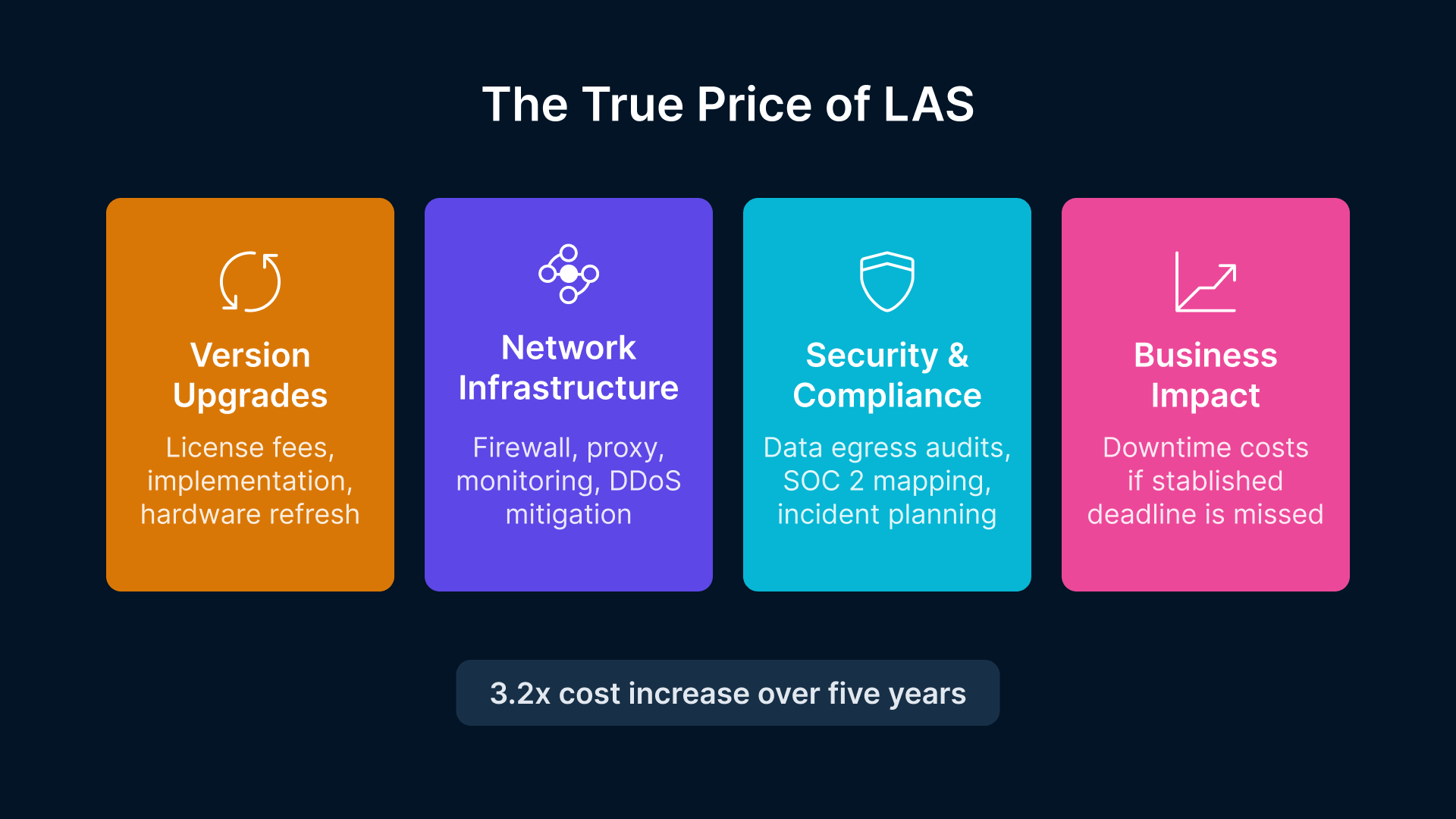
The April 15 transition is not a simple license swap. Organizations face substantial hidden costs:
Version Upgrade Costs
Migrating to LAS-compatible versions often requires upgrading CVAD from 2203 or earlier to 2303 LTS or 2403. These upgrades are not free. Organizations must budget for:
- License upgrade fees: $150–$400 per user depending on product and license type
- Professional services: $10K–$50K for migration planning, testing, and rollout
- Hardware refresh: Newer Citrix versions impose higher system requirements; virtualization hosts may need upgrades
Network Infrastructure Changes
LAS requires outbound HTTPS connectivity to the cloud. Organizations with restricted egress, air-gapped networks, or legacy firewall configurations must invest in:
- Firewall rule changes: $5K–$15K in firewall/proxy configuration, testing, and security review
- Network monitoring: New observability for cloud connectivity; $3K–$10K for tools and configuration
- DDoS and WAF protection: Organizations with strict security policies may require DDoS mitigation or WAF rules; additional $5K–$20K
Security and Compliance Review
Transitioning from on-premises licensing to cloud entitlements triggers security and compliance reviews:
- Data egress audits: $10K–$30K to audit what data (if any) is shared with Citrix’s cloud systems
- Compliance mapping: $5K–$15K to document how cloud licensing aligns with SOC 2, HIPAA, PCI-DSS, or other compliance frameworks
- Incident response planning: New incident response procedures for cloud entitlement failures; $5K–$10K
| Cost Category | Low Estimate | High Estimate | Notes |
|---|---|---|---|
| Version upgrades + licenses | $15K | $80K | Per 100 users; includes license fees and implementation |
| Network infrastructure | $5K | $50K | Firewall, proxy, monitoring, DDoS mitigation |
| Security and compliance | $20K | $55K | Audits, mapping, incident response planning |
| Training and documentation | $5K | $15K | IT staff training on new licensing model |
| Downtime and business impact | $10K | $100K | If April 15 deadline is missed; emergency migration costs |
| Total per organization | $55K | $300K | Varies by size and complexity |
5-Year Total Cost of Ownership (TCO) Projection
Consider a mid-size organization with 500 CVAD users, currently paying $45/user/year under legacy perpetual licensing ($22,500/year). After April 15 transition, here’s the realistic 5-year TCO:
Year 0 (2026): Transition Year
- License upgrade + implementation: $80K
- Network and security costs: $20K
- Cloud Software Group subscription (Year 1): $35K
Year 0 Total: $135K (net $100K increase vs. legacy)
Years 1–5: Steady-State Cloud Subscription
- Year 1 subscription: $35K
- Year 2 (10% increase): $38.5K
- Year 3 (15% increase): $44.3K
- Year 4 (15% increase): $51K
- Year 5 (15% increase): $58.6K
Years 1–5 subscription cost: $227.4K
5-Year Total: $362.4K (vs. $112,500 if perpetual licensing had continued). This represents a 3.2x cost increase over five years. Even if legacy perpetual licensing had modest 5% annual increases, the 5-year cost would be $142,250—still 2.5x lower than the new cloud subscription model.
And this projection assumes no additional price increases beyond the modeled 10–15% annual growth. Given Vista Equity’s $5.6 billion continuation fund and stated intent to further monetize Cloud Software Group, organizations should expect accelerated pricing escalation in years 3–5.
The Bundled Subscription Trap
Cloud Software Group’s ‘Citrix Universal’ bundled model compounds the problem. Organizations that historically licensed only CVAD now find themselves required to purchase bundles that include NetScaler, XenServer, WEM, and other products they don’t need. Bundled pricing is higher on a per-user basis than best-of-breed alternatives for individual products.
Example: An organization that only needs CVAD for 500 users formerly paid $22.5K/year. Under Citrix Universal bundled model, the same 500 users cost $35K/year—even if they never touch NetScaler, WEM, or other bundled components.
Section 3: The Alternative — Thinfinity Works Online and Air-Gapped
Key Differentiator: Thinfinity Works Everywhere Citrix Can’t
Here’s the critical insight that organizations are discovering in March 2026: Thinfinity Workspace is purpose-built to work in both fully connected cloud environments and completely air-gapped, offline scenarios. This is a fundamental architectural advantage that Citrix, with its cloud-dependent LAS licensing, cannot offer.
Thinfinity does not require cloud connectivity for licensing. There is no daily check-in, no activation payload imports, no special exceptions needed. Thinfinity’s licensing model is simple: purchase a subscription or perpetual license, install Thinfinity on your infrastructure (on-premises or in your cloud), and run. If your environment is air-gapped, Thinfinity works offline—fully, completely, with no special arrangements.
This capability addresses the exact use case that is breaking Citrix customers in 2026: organizations with air-gapped, isolated, or highly restricted networks now have a clear migration path. They don’t need to retrofit their networks to cloud connectivity. They don’t need to negotiate with vendors for offline activation exceptions. They can migrate to Thinfinity and maintain their existing network architecture.
Thinfinity Architecture: Browser-Native, No Client Agents
Thinfinity Workspace runs as a browser-native HTML5 virtual desktop solution on Oracle Cloud Infrastructure, on-premises VMware, Hyper-V, or any standard hypervisor. The key differentiator is the technology stack:
- Browser-native protocol: Thinfinity uses standard HTTP/HTTPS and WebSocket protocols, not proprietary compression codecs. This means Thinfinity works through corporate proxies, WAF appliances, and standard network inspection tools without requiring special configuration.
- No client agent installation: End users do not install any software on their endpoints. They open a web browser, authenticate, and connect to their desktop. No client-side agents means no endpoint trust required, no software licensing, no agent version compatibility issues.
- Stateless sessions: Each desktop session runs in a container on the server; when the user logs out, the session is discarded. Zero persistent data on endpoints means air-gapped environments don’t face data exfiltration risks or compliance violations from data stored on client devices.
- On-premises or cloud deployment: Thinfinity runs on your infrastructure. You control the licensing server, entitlement system, and all authentication. Cloud connectivity is optional—for backup, redundancy, or disaster recovery—not mandatory for core functionality.
Air-Gapped Deployment: No Citrix-Style Exceptions Needed
Thinfinity’s architecture makes it ideal for air-gapped environments:
- No offline activation payloads: Thinfinity licensing is enforced locally, on a server under your control. You do not need to periodically export entitlements, upload them to a cloud system, and re-import them. The licensing check happens on your infrastructure, instantly.
- No 30-day grace period nightmare: If you lose network connectivity (unlikely in an air-gapped environment with proper configuration), Thinfinity sessions continue without interruption. There is no ticking clock waiting for entitlements to expire.
- No vendor approval delays: Unlike Citrix’s air-gapped exception process, Thinfinity simply works. Deploy on your infrastructure, configure your network, run. No tickets, no approval processes, no surprise denials.
- Periodic updates are optional: Thinfinity can be updated on a schedule you control. Updates are not forced, not required for licensing validation, and not dependent on cloud connectivity.
For government agencies, defense contractors, critical infrastructure operators, and financial institutions that operate air-gapped networks, Thinfinity removes the licensing burden entirely.
Performance and Licensing Cost Comparison
Thinfinity on OCI delivers competitive performance with significantly lower total cost than Cloud Software Group’s Citrix subscriptions:
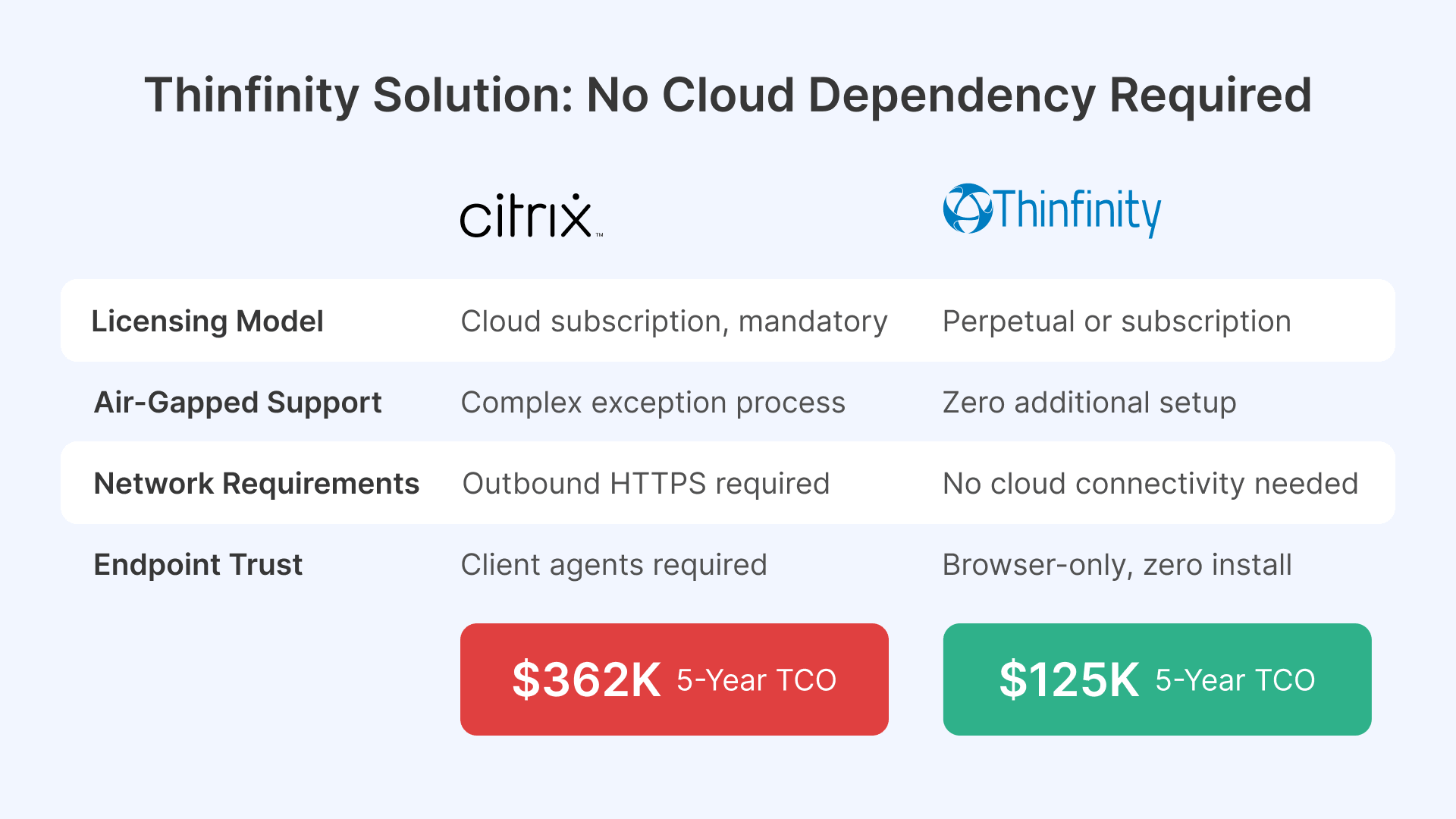
| Dimension | Citrix (Cloud Software Group) | Thinfinity on OCI |
|---|---|---|
| Licensing model | Cloud subscription (user-seat), mandatory cloud connectivity | Perpetual or subscription, local licensing, works offline |
| Per-user annual cost (500 users) | $70/user ($35K/year) | $45/user ($22.5K/year) |
| Air-gapped deployment support | Complex exception process, offline activation, quarterly re-sync | Full support, zero additional setup, works instantly |
| Network requirements | Outbound HTTPS to las.cloud.com required | No cloud connectivity required (optional for updates/backup) |
| Latency to desktop | 40–80ms over VPN/proxy | 20–40ms on OCI, <10ms on-premises |
| Endpoint trust requirement | High (clients install agents, cache data) | None (browser-only, stateless sessions) |
| Feature lock-in (bundling) | Citrix Universal bundle mandatory (includes unused products) | Choose à la carte products (CVAD, NetScaler, WEM separately) |
| 5-year TCO (500 users) | $362K (3.2x increase vs. perpetual) | $125K (includes OCI infrastructure) |
| Migration complexity from Citrix | High (version upgrade, LAS infrastructure) | Medium (session migration, user retraining) |
Migration Timeline: Weeks, Not Months
Organizations migrating from Citrix to Thinfinity typically complete deployment in 4–8 weeks:
- Week 1–2: Environment assessment, infrastructure planning, capacity sizing (2 weeks)
- Week 3–4: Thinfinity lab deployment, pilot with 10–20 users, performance validation (2 weeks)
- Week 5–6: Production deployment to 25% of user base (Week 5), progressive rollout to remaining 75% (Week 6)
- Week 7–8: Optimization, monitoring, legacy Citrix decommission (2 weeks)
By Week 8, the organization is fully migrated, Citrix environments are shut down, and subscriptions can be cancelled. Organizations that begin now (early April 2026) can complete migration before the fiscal year ends, capturing cost savings immediately.
Citrix migration timelines, by contrast, typically require 12–16 weeks due to complexity of LAS infrastructure configuration, network changes, and security reviews.
Proof of Concept Approach
Smart organizations are using the April 15 deadline as a trigger for a Thinfinity POC:
- POC scope: 5–10 pilot users (a mix of knowledge workers, power users, and developers) for 2–3 weeks
- Success criteria: Desktop performance, application compatibility, user feedback, cost comparison
- Timeline: Can be completed in 2 weeks, allowing organization to decide migration strategy before April 15
- Investment: $15K–$25K for POC infrastructure and professional services
If the POC is successful, organizations can proceed with phased rollout. If issues are discovered, they can evaluate alternatives. The POC de-risks the decision and prevents panic migrations that often fail.