
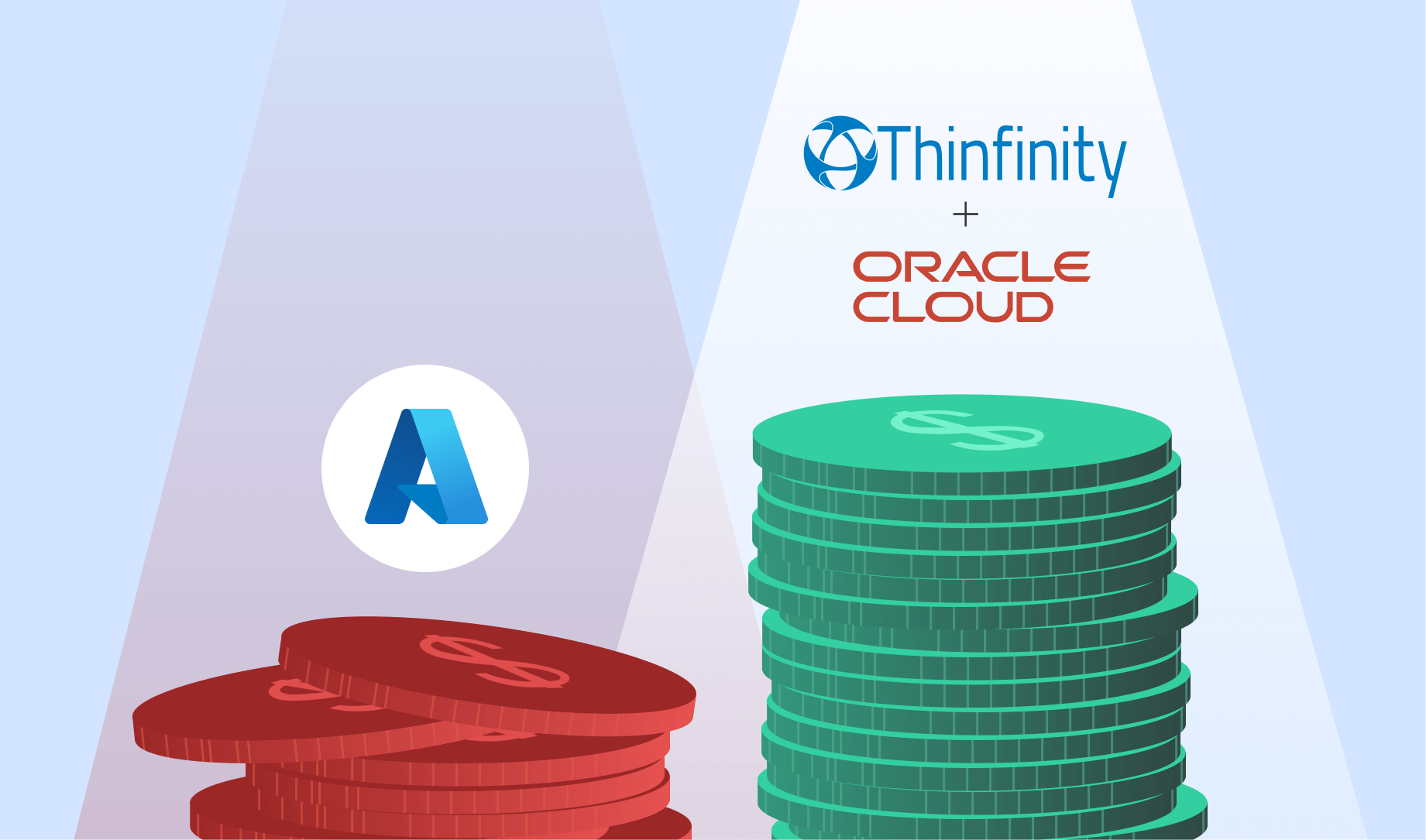

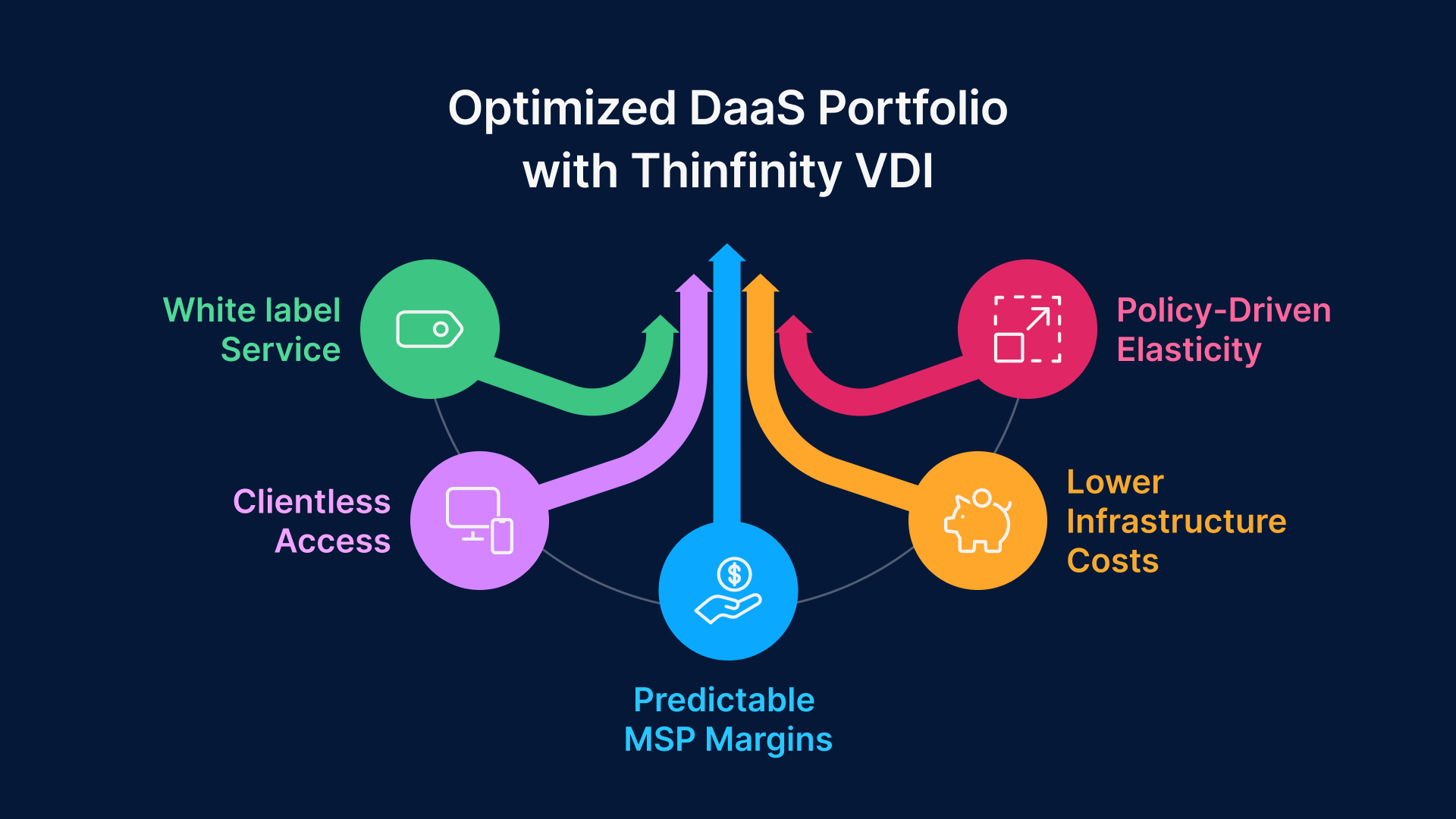
In 2025, MSPs are optimizing their DaaS portfolios around three things: predictable margins, Zero Trust access, and a brandable service that doesn’t disappear behind a hyperscaler logo. Azure Virtual Desktop (AVD) remains a capable enterprise platform, but its operating model (per-tenant Azure dependencies, cost volatility, and specialist skill requirements) can compress MSP margins. Thinfinity VDI on Oracle Cloud (OCI) approaches the same outcomes with a different economic profile: lower infrastructure costs, policy-driven elasticity, clientless access, and a service you can fully whitelabel.
What changes for MSPs when you move from AVD to Thinfinity on OCI
Operating model and skill intensity
- AVD: Powerful but DIY-oriented. You assemble image management, autoscaling, networking, and profile tooling across separate Azure services and scripts. That flexibility costs engineering time and consistency across customers.
- Thinfinity on OCI: Automation (provisioning, lifecycle, scaling) is built into the broker layer, reducing the number of custom scripts and third-party add-ons you need to maintain. This lowers ongoing delivery cost per seat.
Cost drivers and margin predictability
- AVD: Consumption pricing can work but is highly sensitive to optimization quality (rightsizing, reserved instances, scaling policies). Mis-tuned estates often carry idle VM and egress costs that erode MSP margins.
- Thinfinity on OCI: Leverages OCI’s price-performance advantage (often up to ~50% lower infra vs. other hyperscalers) and powers down idle capacity at the broker layer—reducing “zombie” VM spend and smoothing COGS. OCI’s generous egress tier further stabilizes the network line item.
Service differentiation (avoid commoditization)
- Brand & packaging: With Thinfinity you can whitelabel the workspace experience end-to-end, package tiers (RemoteApps vs. full desktops; pooled vs. persistent; GPU shapes), and price around outcomes—not just VM hours. This keeps your value visible and defendable.
- Clientless Zero Trust: Browser-based access (no VPN, no RDP client) plus identity-centric controls turns secure access into a productized add-on—an upsell narrative that’s harder to build around AVD without extra components.
OCI adjacency: follow the data, win the workload
Many customers already run Oracle databases, ERP, or line-of-business systems in OCI. Keeping desktops on AVD creates a split-cloud pattern (compute in Azure, data in OCI) that can add latency, duplicate egress, and complicate governance. Placing desktops beside data—Thinfinity on OCI—simplifies design and strengthens your cross-sell with Oracle-aligned partners.
Capability highlights
| Azure Virtual Desktop | Thinfinity VDI on OCI | |
|---|---|---|
| Architecture | Azure IaaS with customer-assembled components and scripts | Broker-level automation for provisioning, policy scaling, image lifecycle |
| Cost posture | Variable; expertise-dependent to avoid idle/egress surprises | Lower OCI infra costs + autoscaling that eliminates idle VM spend |
| Access model | Primarily RDP client; browser options via add-ons | Clientless HTML5, Zero Trust by design (no VPN) |
| Profiles & apps | Full flexibility; RemoteApps, FSLogix (setup required) | RemoteApps + desktops with template automation; FSLogix supported |
| Brand control | Microsoft-forward experience | Whitelabel-ready experience for MSP brand equity |
| Where it fits | Enterprise IT teams with deep Azure skill and per-tenant builds | MSPs prioritizing margin predictability, branding, and OCI adjacency |
Economics in practice
- Idle capacity: Thinfinity’s policy-driven autoscaling starts/stops desktops based on demand windows and thresholds—so you sell “ready capacity” without paying for “always-on” VMs.
- Network charges: OCI’s free egress tier materially reduces per-seat network costs at scale, which helps MSPs publish price lists with fewer caveats.
- License stacking: Thinfinity licensing covers RemoteApps, full desktops, and GPU use cases under one umbrella—simplifying your catalog and avoiding multi-SKU surprises for sales ops.
Strategic takeaway for MSP owners
If your growth plan depends on repeatable delivery and brand differentiation, the shift isn’t “AVD vs. Thinfinity” on features—it’s an economic model choice. AVD favors enterprise IT autonomy; Thinfinity on OCI favors MSP productization: brandable, clientless, Zero Trust, and margin-predictable. For partners already close to Oracle workloads, it also aligns desktop delivery with where customer data lives.