

TL;DR
- CVE-2026-8451 is the latest CitrixBleed-class, pre-authentication memory-overread flaw in internet-facing NetScaler appliances, and it fits a recurring pattern rather than being a one-off bug.
- Thinfinity Workspace on OCI takes a different posture: a double-reverse, zero-inbound-port architecture with no public appliance terminating unauthenticated traffic, so there is no exposed memory to over-read.
- Across three pillars it is more secure (Universal ZTNA, identity brokering, MFA/SSO/SAML, RBAC, session recording), simpler (one browser-delivered platform, less to patch), and lower TCO (concurrent-user licensing, predictable OCI economics, fewer appliances).
- You can migrate gradually with coexistence, moving high-risk and externally exposed workflows first, while still patching everything you run.
If you are searching for a NetScaler alternative in the wake of CVE-2026-8451, you are not overreacting. On June 30, 2026, Citrix disclosed another round of NetScaler ADC and NetScaler Gateway vulnerabilities (six CVEs in bulletin CTX696604) headlined by a pre-authentication memory-overread flaw that security researchers quickly labeled “CitrixBleed-class.” Within days, multiple vendors reported active, in-the-wild exploitation. The uncomfortable takeaway for security leaders is that the problem is not one bad bug: it is an architecture. This article uses that news as a starting point, then makes the case, across three pillars (security, simplicity, and total cost of ownership) that Thinfinity VDI on Oracle Cloud Infrastructure (OCI) is a better way to deliver remote access than an internet-facing gateway appliance.
Key Takeaways
- What happened: Citrix disclosed CVE-2026-8451 on June 30, 2026: a pre-auth memory overread (CVSS 4.0 score of 8.8, per NVD) that can leak memory when NetScaler acts as a SAML identity provider. Fixed builds are 14.1-72.61 and 13.1-63.18 (bulletin CTX696604); the interim mitigation is to disable the SAML IdP.
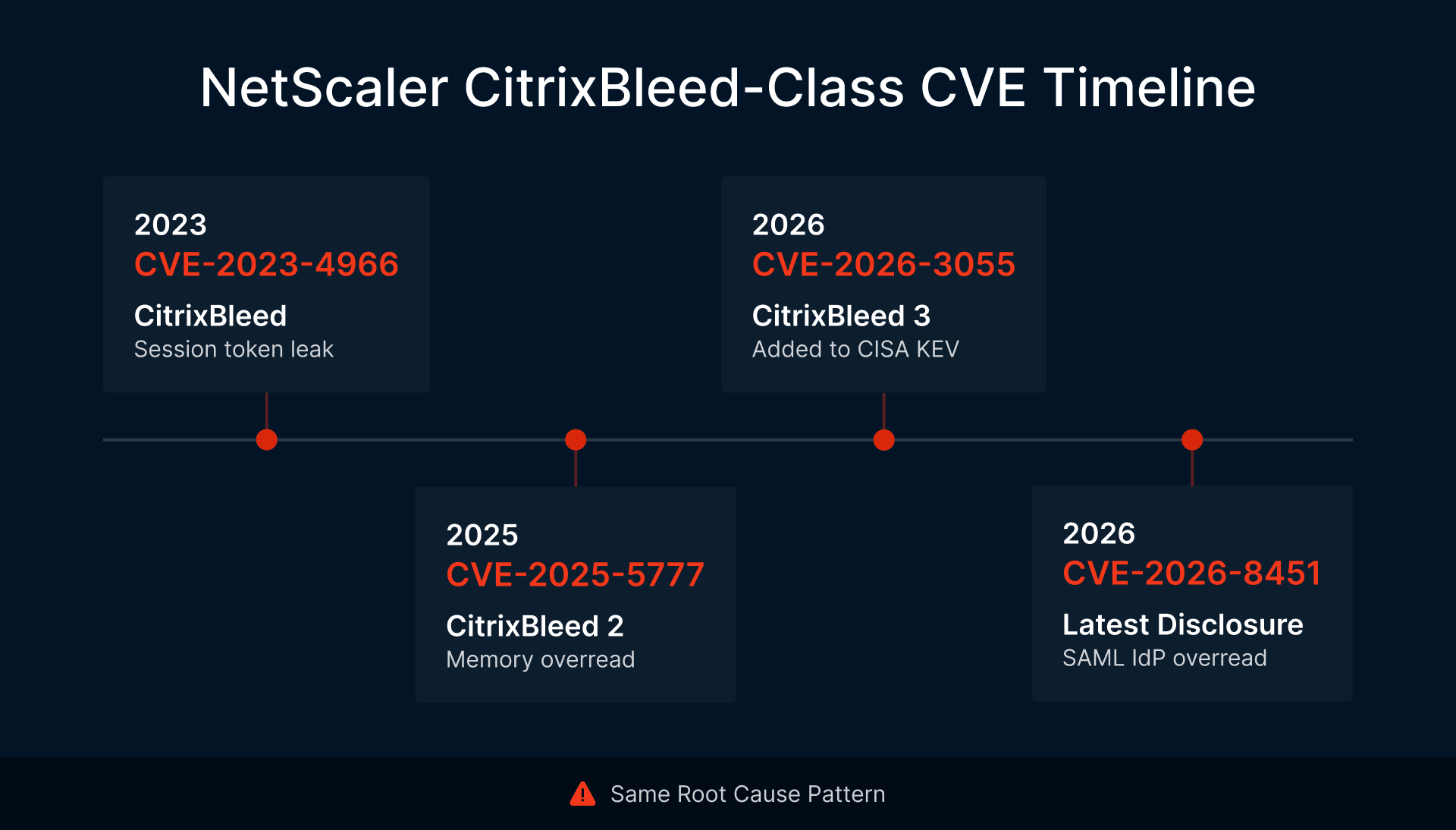
- Why it matters: This is the latest in a recurring pattern (CVE-2023-4966 “CitrixBleed,” CVE-2025-5777 “CitrixBleed 2,” CVE-2026-3055 (dubbed “CitrixBleed 3” and added to CISA’s KEV catalog in March 2026) and now CVE-2026-8451), and NetScaler has a long history in the CISA Known Exploited Vulnerabilities catalog.
- The better model: Thinfinity Workspace delivers VDI, DaaS, applications, and Universal ZTNA through any HTML5 browser on a double-reverse, zero-inbound-port architecture (a Gateway holds the public TLS endpoint while Brokers and Agents inside the protected network connect outbound), so there is no internet-facing appliance memory to over-read.
- Three pillars: On OCI, Thinfinity is more secure (smaller pre-auth attack surface, identity brokering, MFA/SSO/SAML, RBAC, session recording), simpler (browser-delivered, single platform, less to patch), and lower TCO (concurrent-user licensing, predictable OCI economics, fewer appliances).
- The honest caveat: No architecture removes the need to patch and practice defense in depth. The point is to shrink what an attacker can reach before authentication in the first place.
What Happened With NetScaler in 2026?
CVE-2026-8451 is an out-of-bounds read that surfaces when NetScaler ADC or Gateway is configured as a SAML identity provider. As documented in the NVD entry and analyzed by watchTowr Labs (the researchers who discovered the flaw), a crafted request to the SAML login endpoint can cause the appliance to read past the intended buffer and return adjacent memory to the attacker, with no valid credentials required. That is the defining characteristic of a “CitrixBleed-class” bug: a pre-authentication flaw that can leak session tokens or other secrets from an internet-facing device. Citrix’s June 30 bulletin (CTX696604) shipped fixed builds 14.1-72.61 and 13.1-63.18 and offered disabling the SAML IdP as an interim mitigation.
The single CVE is less important than the pattern around it. CVE-2023-4966 (the original CitrixBleed) and CVE-2025-5777 (CitrixBleed 2) followed the same script, as did CVE-2026-3055 earlier this year: a CVSS 9.3 flaw in the same SAML IdP path that the security community nicknamed “CitrixBleed 3” and that CISA added to the Known Exploited Vulnerabilities (KEV) catalog within a week of disclosure. CVE-2026-8451 follows the same trajectory: multiple security vendors, including Lupovis and CrowdSec, reported active exploitation attempts within 24 hours of disclosure, though it has not yet been added to CISA’s KEV catalog as of this writing. Each time, an appliance that must sit on the public internet to do its job becomes the exact thing adversaries scan for and exploit within hours of disclosure. Because the KEV catalog changes, teams should check the current catalog rather than rely on a snapshot. The structural lesson is simple: if your remote-access front door is an always-listening appliance that terminates authentication at the edge, every memory-safety bug in that code path is a potential enterprise breach.

NetScaler appliances are often crucial parts of authentication and remote access processes, and their internet-facing nature makes weaknesses in these components even more dangerous.

Why Is Thinfinity VDI on OCI More Secure?
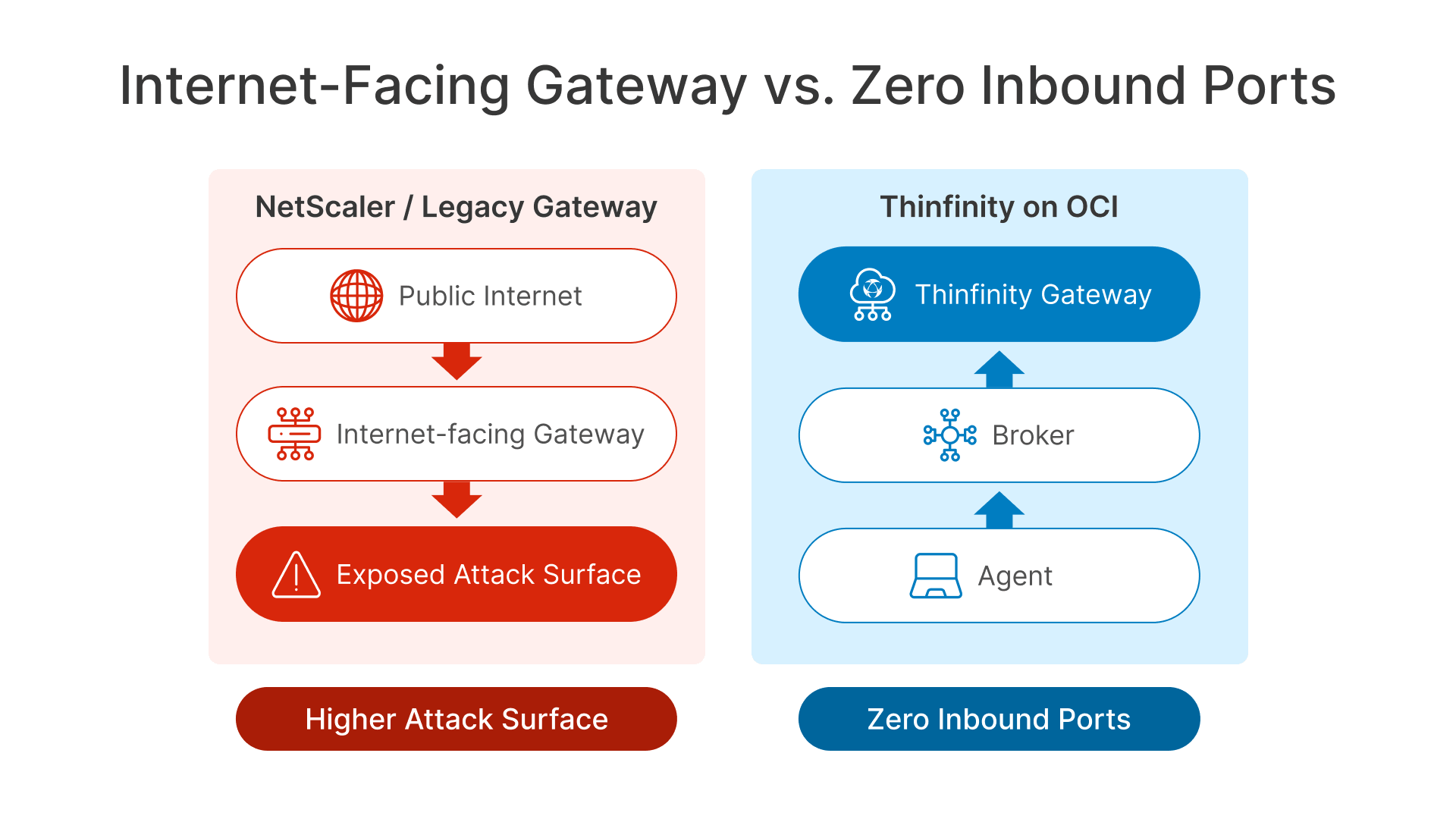
The most direct answer: there is no internet-facing appliance to leak memory. Thinfinity Workspace is built on a double-reverse, zero-inbound-port architecture. A Gateway in the DMZ or cloud holds the public TLS endpoint; inside the protected network, a Broker establishes a persistent outbound connection up to the Gateway, and an Agent on each target host connects outbound to the Broker. Zero inbound ports are opened to the protected network, so the classic pattern that memory-disclosure bugs exploit (a public listener terminating pre-auth traffic) is simply not part of the model. You cannot over-read the memory of a device that is not exposed and accepting unauthenticated requests.
On top of that architecture, Thinfinity provides Universal ZTNA: access is brokered per user and per session rather than by dropping a device onto the network. Identity and IdP brokering integrates with your existing directory and supports MFA, SSO, and SAML, so authentication is enforced at a hardened broker with modern controls rather than inside an edge appliance’s parsing code. Role-based access control (RBAC) narrows what each identity can reach, and session recording gives security and audit teams a durable record of privileged activity. For a deeper dive into how this applies to remote desktop specifically, see our definitive guide to Zero Trust RDP.
NIST SP 800-207 defines a zero-trust architecture that relies on identity verification, least-privilege access controls, and continuous monitoring to counter modern threats and the failure of perimeter security.
The net effect is a much smaller pre-authentication attack surface. When Thinfinity runs on Oracle Cloud Infrastructure, you also inherit cloud-native segmentation and security: private subnets, security lists and network security groups, Web Application Firewall, and identity-and-access management can wrap the workload so the Gateway itself is not needlessly exposed. To be fair, this is not a claim of immunity. Any software can have vulnerabilities, and you still must patch Thinfinity, your OCI configuration, and your desktops. The difference is that defense in depth starts from a posture where far less is reachable before a user proves who they are.
Why Is Thinfinity Simpler to Run?
Access is delivered through any HTML5 browser. There are no thick clients to package, no per-endpoint agents to keep current, and no VPN concentrators or gateway appliances to publish and maintain. For end users, “the client” is the browser they already have; for administrators, that removes an entire tier of software distribution and version-drift headaches.
It is also one platform instead of a stack of them. Thinfinity Workspace covers VDI, DaaS, published applications, and ZTNA together, and it includes built-in z/Scope terminal emulation (TN3270, TN5250, VT, and SSH) so mainframe and AS/400 access lives in the same browser workspace as everything else. That consolidation means a single pane of glass for provisioning, policy, and monitoring, and dramatically less surface to patch than a portfolio of edge appliances, connectors, agents, and separate emulation tools. Thinfinity supports both persistent and non-persistent desktops, so you can right-size the experience per role without adding another product.
Simplicity has a security dividend, too. Fewer moving parts means fewer components with their own CVE streams, fewer emergency patch windows, and fewer integration seams where misconfiguration hides. Deployment is fast because you are standing up a Gateway and a Broker and connecting resources rather than architecting an internet-facing DMZ appliance tier, and the white-label capability lets service providers and enterprises present the workspace under their own brand without extra plumbing.
Why Does Thinfinity on OCI Lower Total Cost of Ownership?
Cost follows architecture. The figures below are illustrative (your actual numbers depend on scale, region, and workload), but the structural drivers are real.
Concurrent-user licensing. Thinfinity is licensed by concurrent sessions, not per named user. Organizations with shift workers, contractors, seasonal staff, or large occasional-user populations often pay for a fraction of their headcount because they license peak concurrency rather than every individual who might log in. That is materially different math than per-named-user gateway and add-on licensing.
Predictable OCI economics. Oracle Cloud Infrastructure is known for low, comparatively flat egress pricing and right-sizable compute, and Thinfinity’s OCI partnership means you can autoscale desktops and apps to match demand instead of provisioning for peak year-round. Predictable egress in particular matters for remote-desktop workloads, where pixels stream continuously and unpredictable bandwidth bills are a common cloud surprise.
Fewer appliances and add-ons. Consolidating VDI, DaaS, apps, ZTNA, and terminal emulation into one platform removes appliance refresh cycles, redundant HA pairs, and stacks of add-on licenses. It also cuts the softer costs: less administrative and patching overhead, fewer vendors to manage, and fewer 2 a.m. emergency-patch nights when the next edge-appliance CVE lands.
Longer endpoint life. Because the workspace runs in a browser, you can embrace BYOD and inexpensive thin endpoints, extending hardware refresh cycles and reducing device spend. A five-year-old laptop that can run a modern browser can run a modern desktop.
NetScaler vs. Thinfinity VDI on OCI: Side-by-Side Comparison
| Dimension | Internet-facing NetScaler / legacy gateway | Thinfinity VDI on OCI |
|---|---|---|
| Internet-facing attack surface | Appliance listens publicly and terminates pre-auth traffic; a prime scan-and-exploit target | The Gateway is the only exposed component; no appliance on the protected network terminates pre-auth requests |
| Inbound ports | Inbound ports opened to DMZ/protected network | Zero inbound ports on the protected network; Brokers and Agents connect outbound |
| Access model / ZTNA | Network- or gateway-centric; often broad session access | Universal ZTNA, per-user and per-session brokering |
| Client / agents | Thick clients, agents, and/or VPN concentrators to deploy and update | Any HTML5 browser; no thick clients to publish on endpoints |
| Patching & maintenance | Frequent emergency patching of internet-facing appliances | Fewer components; less internet-facing code to patch (patching still required) |
| Licensing model | Per-named-user plus add-on licenses | Concurrent-user licensing (peak simultaneous sessions) |
| Cost predictability | Appliance refresh cycles and variable egress add surprises | Predictable OCI economics with low/flat egress and autoscaling (illustrative) |
| Endpoint strategy | Managed endpoints tuned to the client software | BYOD and thin endpoints; longer hardware life |
| Legacy host access | Separate terminal-emulation tooling | Built-in z/Scope emulation (TN3270 / TN5250 / VT / SSH) |
How Do You Migrate From NetScaler Without a Rip-and-Replace?
You do not have to flip a switch overnight. Most teams start with coexistence: stand up Thinfinity Workspace on OCI, point it at a defined set of resources (a high-risk application, a contractor population, or a business unit) and route those users through the zero-inbound-port deployment while NetScaler continues to serve the rest. Because access is browser-based, onboarding a pilot group is largely a matter of policy and identity configuration rather than endpoint software rollouts.
From there, expand by use case. Move privileged or externally exposed workflows first, since those benefit most from the reduced pre-auth attack surface and session recording. Fold in legacy mainframe and AS/400 access using the built-in z/Scope emulation so you can retire a separate terminal-emulation product in the same motion. As concurrency shifts to Thinfinity, you can decommission gateway appliances and their add-on licenses, converting a capital-and-emergency-patch cost center into predictable OCI consumption. Keep patching everything you still run in the meantime; coexistence is not an excuse to ignore CTX696604. And if the NetScaler question is part of a broader move off the Citrix stack, our guide to the #1 Citrix Virtual Apps and Desktops alternative covers the full platform comparison.