

TL;DR
- Verizon’s 2026 DBIR found vulnerability exploitation overtook stolen credentials as the #1 initial access vector — the first time in the report’s 19-year history.
- Edge devices and VPNs jumped from 3% to 22% of exploitation-driven breaches: a 7x increase in a single year.
- You can’t patch your way out — exploit windows are now measured in days, far faster than any appliance maintenance cycle.
- The durable fix is architectural: zero inbound ports, with desktops and apps delivered through the browser over outbound-only connections.
- Credentials still matter — 73% of ransomware victims had prior infostealer activity, so enforce MFA at the gateway with short-lived sessions.
For the First Time in 19 Years, Attackers Prefer Your Appliances to Your Passwords
Verizon’s 2026 Data Breach Investigations Report landed in late May with a finding that should reframe every remote-access roadmap: vulnerability exploitation overtook stolen credentials as the #1 initial access vector for the first time in the report’s 19-year history. The driver is specific — edge devices and VPNs went from 3% to 22% of exploitation-driven breaches. That’s a 7x jump in a single year.
The ‘so what’ is architectural, not operational. You cannot patch your way out of a category where the appliance itself is the attack surface and exploit windows are measured in days. The DBIR is telling you that the box you bought to provide secure remote access is now the most likely place your breach begins.
The Four Numbers That Matter
| Finding | Number | Why it matters |
|---|---|---|
| Edge/VPN share of exploitation breaches | 3% → 22% (7x YoY) | The access appliance is the fastest-growing breach class |
| Exploitation vs stolen creds | #1 vector, first time in 19 years | Patching cadence now loses to exploit cadence |
| Ransomware presence in breaches | 48% of confirmed breaches | Finance ransomware rose 30% in 2025 |
| Prior infostealer activity | 73% of ransomware victims | Credential leakage precedes the breach by months |

The 2026 DBIR makes clear that attackers continue to prioritize the most reliable paths to compromise, such as exploiting unpatched vulnerabilities, leveraging compromised or weak credentials, and scaling social engineering with speed and efficiency.

Why the Concentrator Became the Target
A traditional VPN or remote-access appliance has three properties attackers love. It is reachable by design — an inbound listener on the public internet. It is privileged by design — successful exploitation lands you inside the perimeter, often with the appliance’s service-level access. And it is slow to patch by design — it sits in the critical path of every remote worker, so maintenance windows are negotiated, not immediate. Stack the 2024–2026 CVE record of major SSL VPN and gateway products against average enterprise patch latency and the DBIR’s 7x jump stops being surprising.
RDP exposure tells the same story from a different angle: millions of directly exposed RDP endpoints remain on the public internet, and honeypot studies routinely log the first brute-force attempts within a minute of exposure. Whether the listener is 3389 or a VPN portal on 443, the lesson is identical — inbound listeners attract industrialized attack.
The Architectural Response: Remove the Inbound Listener
The defensible pattern in 2026 is zero inbound ports: no appliance listening on the edge, no 3389, no VPN portal. VDI session hosts and app servers sit on private subnets in your cloud tenancy (OCI in our reference builds); a lightweight agent makes an outbound-only TLS connection to a gateway or broker; users reach their desktops and apps through the browser after authenticating — MFA at the front door, identity-based authorization per app. We documented a concrete migration in our FortiGate SSL VPN replacement architecture (FortiOS 7.6.3), and the general model in the ZTNA: A CISO’s Guide.
Patch Velocity Lost to Exploit Velocity. Permanently.
The instinctive response to the DBIR numbers is to patch faster. It’s the wrong lesson, and the report’s own data shows why. The median time from CVE disclosure to mass exploitation of edge devices is now measured in days — for several 2025 appliance CVEs, scanning began within hours of the advisory, before many vendors had even shipped fixed firmware. Meanwhile the operational reality of a VPN concentrator hasn’t changed: it serves every remote worker you have, so taking it down for emergency maintenance requires a change window, a rollback plan, and a tolerance for help-desk volume that most organizations only find after they’ve been breached.
Vulnerability exploitation topped the DBIR because AI-accelerated attacks outrun patching. AI did not create that gap. AI erased the head start defenders used to have.
Run the comparison honestly. Exploit side: automated, global, begins the moment a proof-of-concept lands on GitHub. Defense side: a human reads the advisory, schedules a window, tests the firmware against the org’s authentication stack, and rolls out — call it days to weeks at best, quarters at worst. The DBIR’s 3%-to-22% jump is what it looks like when one side of that race industrializes and the other doesn’t. No amount of process maturity makes a listening appliance keep up; the only durable move is to stop having one.
There’s also an asymmetry of consequence worth naming. When an endpoint is exploited, you lose an endpoint. When the remote-access appliance is exploited, the attacker inherits its position: a trusted, privileged device with sightlines into the internal network and, frequently, cached credentials or session tokens for everyone who recently connected. The appliance is not just another asset on the patch list — it is the single asset whose compromise converts directly into enterprise-wide access.
Don’t Skip the Other Half: 73% Had an Infostealer Problem First
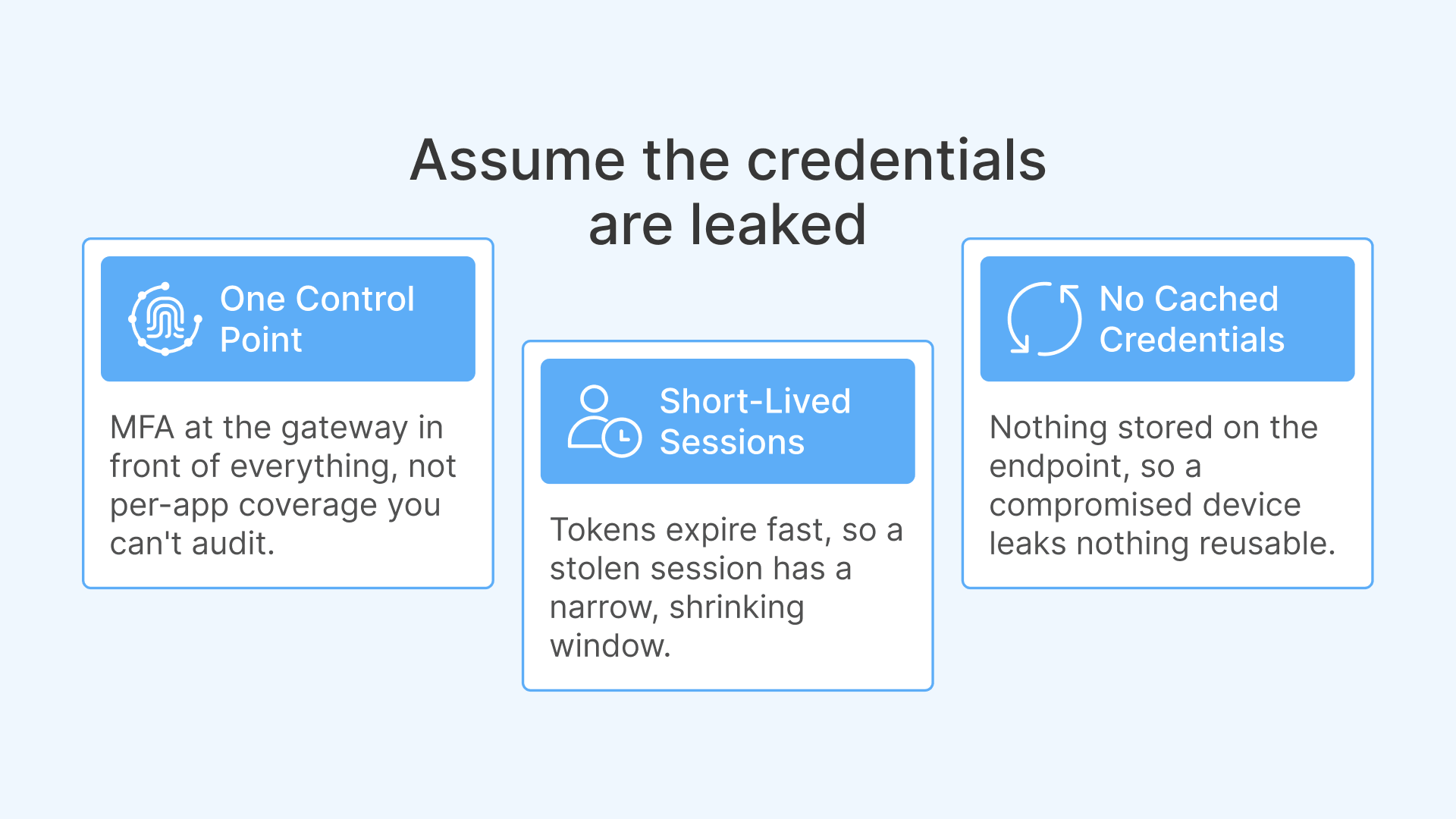
Exploitation took the #1 spot, but credentials remain the patient half of the threat. Seventy-three percent of ransomware victims showed infostealer or credential-leak activity in the year before the breach. The implication for remote access: assume some valid credentials are already for sale. MFA enforced at the gateway — not per-application, where coverage is always partial — plus short-lived sessions and no cached credentials on endpoints is what turns a leaked password into a non-event.
What to Do This Quarter
- Inventory inbound listeners: Every public IP answering on VPN, RDP, or gateway ports. Each one is now a DBIR statistic waiting to happen.
- Pick your highest-CVE appliance and plan its exit: Don’t renew hardware whose security model is ‘patch faster than the exploit.’ Pilot an outbound-only, browser-delivered path for one user population.
- Move MFA to the gateway: One enforcement point in front of everything beats per-app MFA coverage you can’t audit.
- Brief the board with the DBIR’s own numbers: 22%, 7x, 48% ransomware — examiners and insurers are reading the same report. Banks should fold this into their FFIEC/NIST CSF control narrative.
Retire the Appliance, Keep the Access
Thinfinity Workspace delivers full VDI — desktops and applications — through the browser with outbound-only connectivity, MFA at the gateway, and zero inbound ports, hosted on Oracle Cloud Infrastructure or the cloud of your choice. Nothing sits on the edge for the next CVE to hit. Architecture review available on request.