
Summary
- Thinfinity VDI on Oracle Marketplace is a PaaS model: the platform runs inside your OCI tenancy, not on a multi-tenant service someone else operates.
- Your desktops, apps, golden images, identity, and data stay in your tenancy. Cybele supplies and licenses the software; you (or your partner) deploy and operate it.
- You can procure it through Oracle Cloud Marketplace, including by private offer, which can route the spend through your existing Oracle agreement and commitments.
- Thinfinity is licensed on a concurrent model, separate from your Microsoft and OCI costs; Windows VDA still needs Microsoft RDS CALs, while Linux targets need none.
- This is not hands-off SaaS: you run the Thinfinity control plane (Gateway, Broker, Cloud Manager), and OCI resources are billed by Oracle.
Thinfinity VDI on Oracle Marketplace is a PaaS model: you run Thinfinity Workspace entirely inside your own OCI tenancy rather than on a vendor-operated multi-tenant service. Your desktops, apps, golden images, identity, and data stay in your tenancy, and you procure the software through Oracle Cloud Marketplace, including by private offer.
What does “PaaS in your own tenancy” mean, and how is it different from multi-tenant SaaS?
When people say “VDI in the cloud,” they usually picture one of two very different arrangements. In a multi-tenant SaaS model, a provider stands up the control plane, pools infrastructure across many customers, and hands you an account inside their environment. You get convenience, but your sessions, broker, and often your identity integration live on platform you do not own or control. Thinfinity VDI on Oracle Marketplace takes the other path. It is platform-as-a-service that you deploy and operate inside your own Oracle Cloud Infrastructure (OCI) tenancy. The Thinfinity Workspace components (the Gateway, the Broker, and Cloud Manager) are installed on compute you own, in a compartment you define, behind networking you govern. There is no shared control plane sitting between your users and your desktops. The software is Cybele’s; the tenancy, the boundary, and the operational keys are yours. That distinction matters most for teams with data-residency, sovereignty, or audit obligations. “PaaS in your own tenancy” means the platform is a tenant of nothing but your own cloud account. You decide the region, the subnets, the identity provider, and the retention rules, and you can point an auditor at resources that sit squarely inside your perimeter rather than at a third party’s shared estate.

You can think of the tenancy as your account, but it is also a secure and isolated partition within Oracle Cloud Infrastructure where you can create, organize, and administer your cloud resources.

What exactly stays in your tenancy?
The short answer: everything that carries your risk. The Thinfinity platform is deployed into your OCI tenancy, and the assets that matter to a security or compliance review never leave it.
- Desktops and applications. Your Windows and Linux session hosts, published apps, and RemoteApp-style workloads run on your OCI compute, in your compartments.
- Golden images. The images you build, patch, and version are your artifacts in your tenancy. You control the pipeline that produces them and the storage that holds them.
- Identity. Thinfinity integrates with your identity provider. Authentication and group mapping stay inside your governance model rather than being brokered by an outside platform.
- Data. Profiles, home directories, and anything users create live on storage you provision. No session data transits a shared service you do not control.
Users reach their sessions over a modern remote display path (RDC) delivered through the Gateway on TCP 443 only: a single, firewall-friendly port that keeps the ingress surface small. If you want the architectural detail on running this natively on Oracle’s cloud, the native OCI VDI solution page lays out how the pieces fit on OCI shapes and networking.
How do you buy Thinfinity VDI on Oracle Cloud Marketplace?
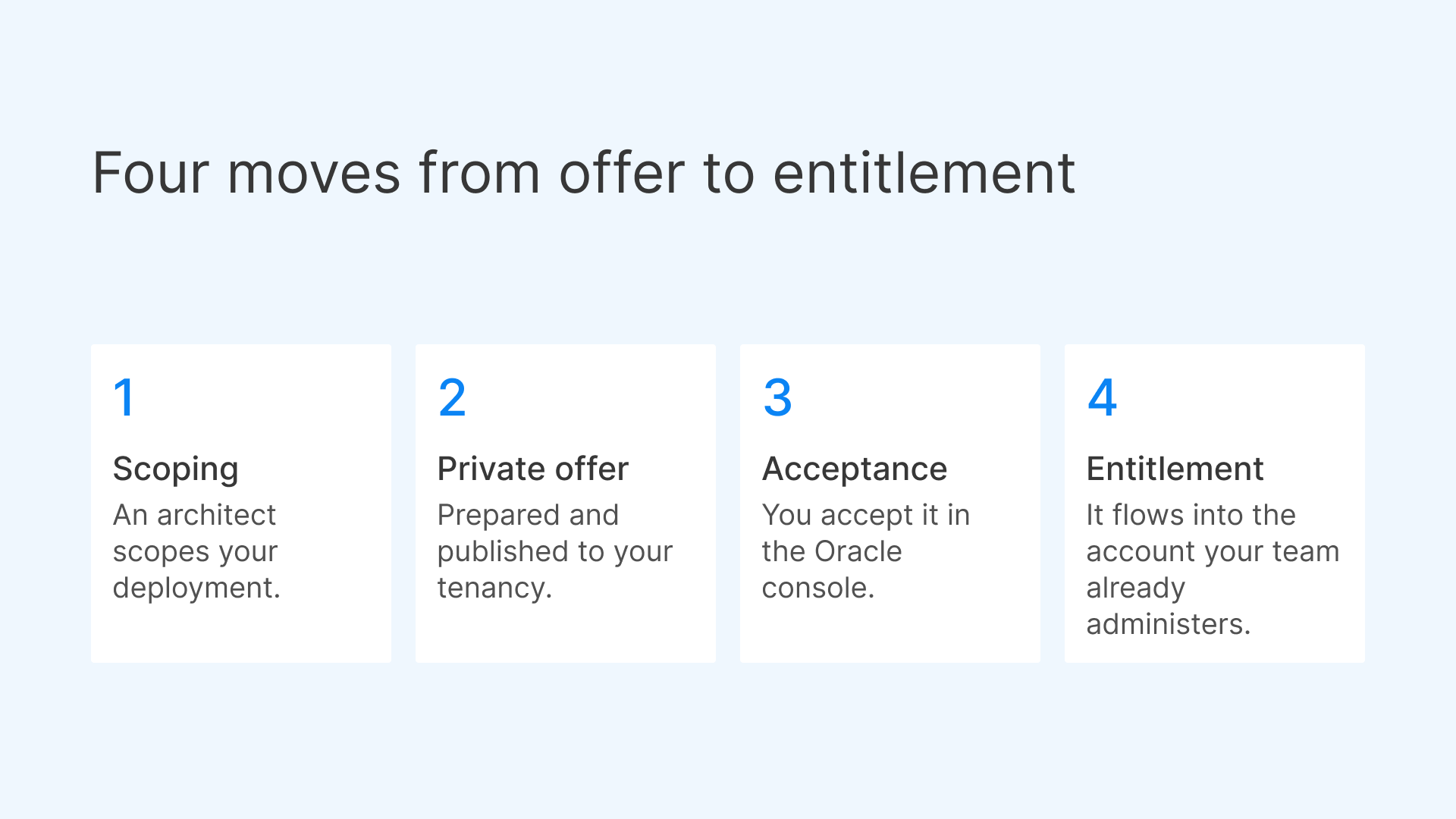
Procurement is where the Oracle Marketplace path earns its keep. Rather than setting up a separate software vendor relationship and a separate invoice stream, you can acquire Thinfinity through the Oracle Cloud Marketplace listing and keep the transaction inside the Oracle ecosystem you already use. For most enterprises, the more interesting route is the private offer. A private offer is a negotiated deal published to your specific tenancy, with terms arranged between you, Cybele, and the Oracle partner working the account. Because it transacts through Oracle, the spend can be routed through your existing Oracle agreement and, where applicable, draw down Oracle commitments, aligning the paperwork and the billing with purchasing you have already approved. A typical sequence looks like this: an architect scopes your deployment, a private offer is prepared and published to your tenancy, you accept it in the Oracle console, and the entitlement flows into the account your team already administers. According to Cybele, the Marketplace and private-offer path is designed to fit this motion; verify the current listing, availability in your region, and the specific private-offer terms before you rely on them, since Marketplace details change. You can review the official Oracle Cloud Marketplace and confirm current terms there. This is also a partner-led motion by design. Thinfinity is partner-sold with architect support, so you are not self-serving a complex deployment from a product page; you get help sizing the environment and structuring the offer. Cybele describes the broader relationship in its write-up of the Cybele and OCI partnership, and partners can find the commercial mechanics in the Oracle partner playbook.
Who is responsible for what: Cybele, Oracle, and you?
A PaaS-in-your-tenancy model only works if everyone is clear on the division of labor. The table below maps ownership across the three parties. The common thread: the assets that carry your risk are yours, the software is Cybele’s, and the underlying cloud is Oracle’s.
| Layer | Owner / operator |
|---|---|
| Desktops, apps, golden images | You |
| Identity & data | You (in your tenancy) |
| Thinfinity control plane (Gateway / Broker / Cloud Manager) | You or your partner operate |
| Thinfinity software & licensing | Cybele (concurrent) |
| OCI infrastructure & billing | Oracle |
| Procurement path | Oracle Marketplace / private offer |
Read the middle row carefully, because it is the one most often misread. The Thinfinity control plane runs in your tenancy, which means operating it (patching, scaling, monitoring, and recovering it) is your responsibility, or your managed-service partner’s. That is the trade you accept in exchange for keeping the platform inside your boundary.
How does Thinfinity’s concurrent licensing work?
Thinfinity is licensed on a concurrent model. Instead of buying a license for every named user who might ever log in, you license the number of sessions in use at the same time. For workforces with shift patterns, contractors, or seasonal peaks, concurrent licensing usually tracks real usage far better than per-named-user counts, and it makes the Thinfinity line item predictable. Keep the cost layers distinct. Thinfinity licensing is separate from Microsoft licensing and from your OCI consumption. The concurrent licenses cover the Thinfinity platform itself. Microsoft licensing for Windows session hosts is yours to hold, and OCI compute, storage, and networking are billed by Oracle. Buying through Oracle Marketplace aligns the Thinfinity procurement with your Oracle paperwork; it does not fold your Microsoft entitlements into that transaction.
Each user and device that connects to a Remote Desktop Services session host or Azure Virtual Desktop session host running Windows Server needs a Remote Desktop Services (RDS) client access license (CAL).
What are the honest limits, and who operates what?
This model is a strong fit for many teams, but it is not magic, and it is worth being plain about the trade-offs before you commit.
- You operate the control plane. PaaS in your tenancy means you, or your partner or MSP, run the Thinfinity Gateway, Broker, and Cloud Manager day to day. This is not a hands-off, vendor-run SaaS where someone else wakes up for the 2 a.m. incident. If you want that experience, plan for a managed-service partner to own operations.
- Windows VDA still needs Microsoft RDS CALs. Publishing Windows desktops and apps requires the appropriate Microsoft Remote Desktop Services client access licenses, licensed separately through your Microsoft channel. Linux session targets do not require RDS CALs. Thinfinity does not change Microsoft’s licensing rules; it works within them.
- OCI resources are billed by Oracle. Your compute, storage, and egress are Oracle consumption. Marketplace alignment helps with the Thinfinity spend, but your infrastructure bill is still driven by what you deploy and how you size it.
- Confirm Marketplace specifics before you rely on them. Listing availability, regional coverage, and private-offer terms can change. Treat any specific Marketplace detail in this article as subject to verification against the current Oracle listing at the time you buy.
Multi-tenant delivery for CSP, ISV, and MSP providers is available through a separate module; talk to an architect if that is your model. For a single organization running its own desktops, the PaaS-in-your-tenancy approach described here is the right frame.