


TL;DR
- Sovereign cloud VDI keeps regulated data in-region by hosting the desktop and its data inside a sovereign or dedicated cloud region and streaming only pixels to the endpoint.
- OCI offers a spectrum of in-region options: the dedicated EU Sovereign Cloud from Frankfurt and Madrid, the UK Sovereign Cloud for eligible government and defence customers, the Oracle Alloy partner model, dedicated regions, and conventional regions with residency controls.
- “Pixels, not data” is the residency control. Thinfinity Workspace streams the session over HTML5 and leaves no data on the endpoint, so the browser device can sit anywhere while the data stays in the sovereign region.
- A regional VDI cell pattern scales the model: standardize one desktop-delivery blueprint, then instantiate it per jurisdiction.
- Architecture is an enabler, not a compliance verdict. Remote access by your own staff and remote access by an external partner are treated differently under EU transfer rules, so map each case with counsel.
Sovereign cloud VDI is emerging as one of the cleanest answers to a hard question multinational security leaders now face daily: how do you give distributed users a full desktop and its regulated data without letting that data cross a border it is legally required to stay behind? The short answer is architecture. When you run virtual desktops inside a sovereign or dedicated cloud region and stream only pixels to the browser, the regulated data stays in-region by design. This guide explains why data-residency pressure is intensifying worldwide, what Oracle Cloud Infrastructure (OCI) sovereign and dedicated regions now offer, and how a browser-delivered VDI platform such as Thinfinity Workspace keeps sovereign desktops and sovereign data in the same jurisdiction.
Why is data sovereignty pressure intensifying in 2026?
Data sovereignty is the principle that data is subject to the laws of the country where it is collected or stored. Data residency is the narrower, operational requirement that data physically remain within a defined geographic boundary. For a CISO or compliance officer at a multinational, these two ideas have moved from legal footnotes to board-level design constraints.
The drivers are cumulative and increasingly specific. In the European Union, the General Data Protection Regulation (GDPR) governs the processing and transfer of personal data, and evolving guidance on international transfers has pushed many organizations toward keeping regulated workloads inside EU boundaries rather than relying on transfer mechanisms alone. Across the Gulf, national data-protection and cloud regulations in the UAE, Saudi Arabia, and neighboring markets increasingly expect certain categories of data to be stored and processed domestically. In Brazil, the Lei Geral de Proteção de Dados (LGPD) sets comparable expectations for personal data, and localization rules across the Asia-Pacific region continue to tighten. These frameworks differ in detail, so each should be assessed against its own text and local counsel rather than treated as interchangeable.
Two forces make 2026 different from earlier years. First, sovereignty now extends to artificial intelligence: regulators and customers increasingly want to know that AI training and inference happen inside the jurisdiction too, not just storage. Second, the workforce is permanently distributed. A regulated bank, hospital network, or public agency may have staff logging in from several countries while their data is bound to one. That gap between where people work and where data must live is exactly what sovereign cloud VDI is built to close.
What do OCI sovereign and dedicated regions offer?
Oracle Cloud Infrastructure has invested heavily in giving regulated organizations a place to run workloads without surrendering residency or operational control. Several distinct options matter for a sovereignty architecture.
Oracle EU Sovereign Cloud
Oracle EU Sovereign Cloud is a collection of OCI regions purpose-built for EU data-protection requirements. According to Oracle’s documentation, it is delivered from two EU data-center regions, in Frankfurt, Germany, and Madrid, Spain, that are logically and physically separate from Oracle’s commercial EU cloud. Oracle states the regions are owned and operated by separate EU-incorporated legal entities, with support and operations restricted to EU-based personnel, and that they offer a broad catalog of the same OCI services available in other regions. For an organization anchoring EU personal data, this provides an in-region home that supports GDPR-aligned residency goals.

The isolation of the Oracle EU Sovereign Cloud realm from the commercial public cloud realm allows Oracle to restrict support and operations personnel to EU residents, including physical and logical access to the realm.

Oracle UK Sovereign Cloud
For UK obligations, Oracle operates a separate UK Sovereign Cloud realm made up of two regions, London and Newport, physically isolated from other Oracle realms and interconnected over a private backbone. Oracle restricts operational access to UK-based authorised personnel and keeps control, monitoring, and logging systems in the UK. Eligibility is narrower than the EU realm: Oracle positions it for government and defence customers that require UK data and operational sovereignty, so confirm eligibility before designing around it.
Oracle Alloy and dedicated region models
Where a country or provider needs even tighter control, Oracle Alloy lets a partner operate a full OCI-based cloud region within their own data center, branding and running the services locally. Oracle positions Alloy as a way to address data-control and sovereignty requirements through partner-operated regions; public examples include telecom and technology providers building sovereign cloud capacity in the Gulf and in Japan. Dedicated Region options similarly bring OCI into a customer or partner facility. The common thread is local operation of a full cloud stack rather than a shared public region.
Expanding capability in the Gulf
Oracle has continued to expand OCI capability in the Middle East. Per Oracle’s June 2026 update, OCI generative AI became available in the UAE Central (Abu Dhabi) region, giving regional customers more flexibility to deploy AI workloads while addressing data-residency, latency, and deployment needs closer to their users. Oracle has also described supercluster and GPU expansions in Abu Dhabi tied to sovereign AI initiatives. Specific service availability changes over time, so teams should confirm current region and service status in Oracle’s official documentation before committing a design.
The practical takeaway for a security leader is that OCI offers a spectrum, from a dedicated sovereign realm in the EU, to a UK realm for eligible public-sector workloads, to partner-operated Alloy regions, to conventional regions with strong residency controls, so you can match the level of isolation to each jurisdiction’s demands. What OCI does not do on its own is solve the last-mile problem: how users actually reach and use a desktop in that region without pulling regulated data out to their devices. That is where the desktop-delivery layer becomes decisive.
How does “pixels, not data” VDI keep data in-region?
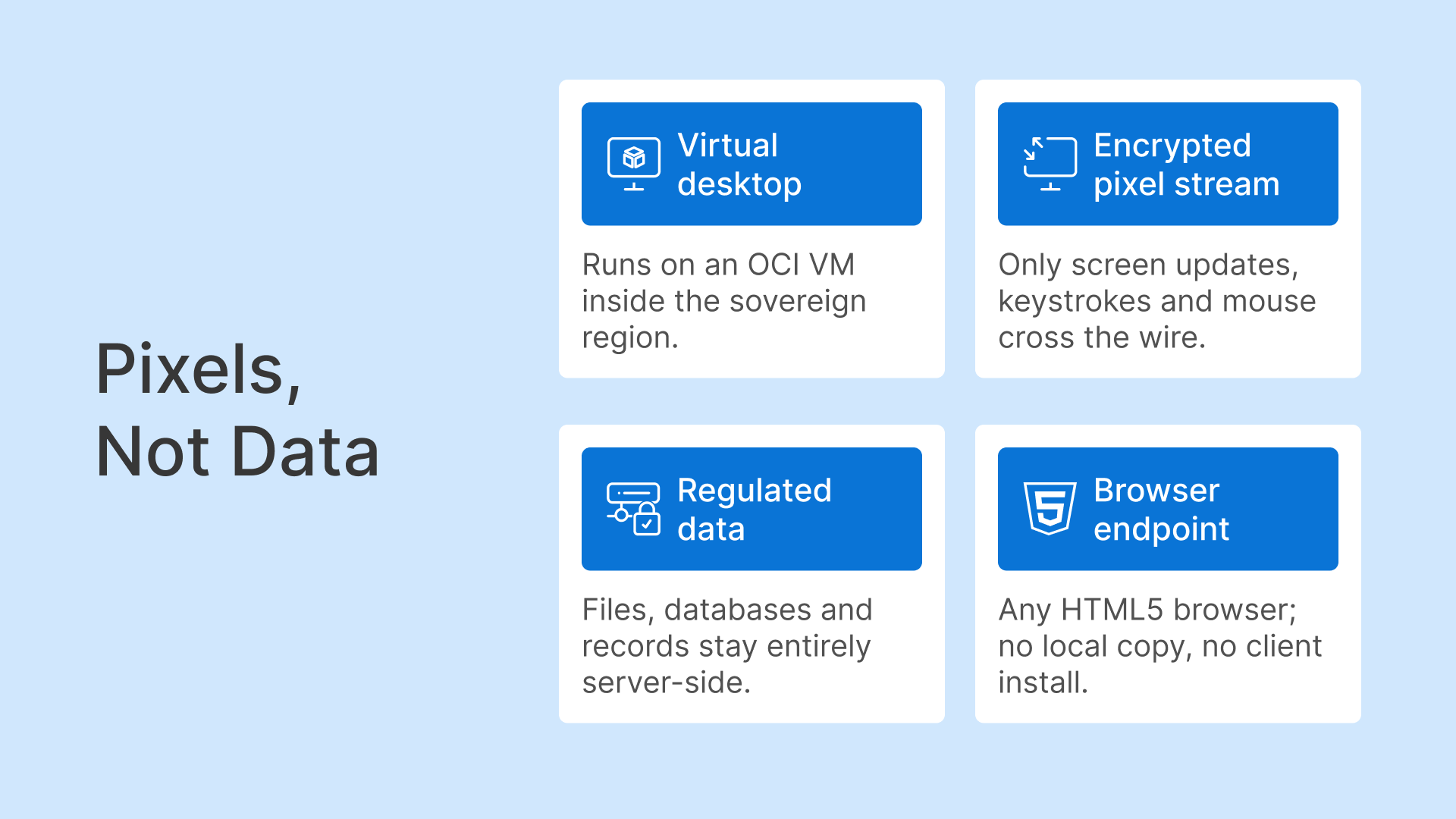
Virtual desktop infrastructure (VDI) runs the desktop, its applications, and its data on servers in a data center, then delivers the visual experience to the user remotely. The user interacts with what looks like a normal desktop, but the computing and the files stay on the server side. When that server side sits inside a sovereign or dedicated OCI region, the regulated data never leaves the jurisdiction during normal use.
Thinfinity Workspace is built around this model and delivers the desktop through any standard HTML5 browser. There is no persistent client installation required and no local copy of the regulated data on the endpoint. The session is transmitted as an encrypted stream of screen updates, keyboard input, and mouse movement, which is the essence of “pixels, not data.” The document a user edits, the database they query, and the records they view all remain on the OCI-hosted virtual machine inside the region. The endpoint, whether a managed laptop in one country or a contractor’s browser in another, sees only the rendered image. Clipboard, file transfer, and printing are governed by policy per role and per desktop, so what may cross back to the device is an explicit administrative decision rather than a side effect of the session.
This distinction is the control that makes sovereignty enforceable rather than aspirational. Residency is not something you promise in a policy document; it is a property of where the bytes actually rest. By keeping data server-side and streaming only pixels, sovereign cloud VDI turns a legal requirement into an architectural fact. It also shrinks the endpoint attack surface: a lost or compromised device holds no regulated files to exfiltrate, because none were ever there.
Thinfinity Workspace pairs this delivery model with security controls a CISO expects. It supports multi-factor authentication (MFA), single sign-on with SAML, and role-based access control (RBAC) so identity governs who can open which desktop. It provides Universal Zero Trust Network Access (ZTNA), treating every session as untrusted until verified rather than granting broad network reach. Its reverse-proxy and DMZ architecture means the internal desktop hosts require zero inbound ports open to the internet, removing a common avenue of attack. Session recording provides an auditable record of privileged activity. For teams still running legacy host applications, built-in z/Scope terminal emulation lets those green-screen systems be reached through the same browser-based, in-region session.
Where architecture stops and legal analysis starts
One caveat belongs here rather than in a footnote, because it is the question a data-protection officer will raise first. Keeping the bytes in-region is not, by itself, the whole of EU transfer analysis. Under the EDPB’s guidance on the interplay between Article 3 and Chapter V of the GDPR, whether remote access counts as a transfer depends on who is doing the accessing, not on what crosses the wire.
Access by your own employee travelling or based in a third country is generally not treated as a transfer, because the employee is part of the same controller rather than a separate importer. Access granted to an external organisation that is a separate controller or processor in a third country is a different matter: making personal data available to them can constitute a transfer and bring Chapter V obligations into play, even when nothing is downloaded and only pixels reach their screen. The EDPB also notes that processing which falls outside Chapter V can still carry elevated risk that must be addressed under the GDPR’s general obligations.
Of particular relevance is the clarification that it is sufficient for making available personal data (criterion 2) if, for example, personal data is accessed remotely from a third country or is stored in a cloud outside the European Economic Area (EEA), and the other criteria are met as well.
The practical consequence is a useful one rather than a discouraging one. Pixel-streamed, in-region VDI substantially reduces what crosses a border and gives you a strong technical and organisational measure to point to. It does not remove the need to classify each access relationship and apply the right transfer mechanism where one is required. Treat the architecture as the enabler and the mapping exercise as the compliance work.
What does a regional VDI cell reference pattern look like?
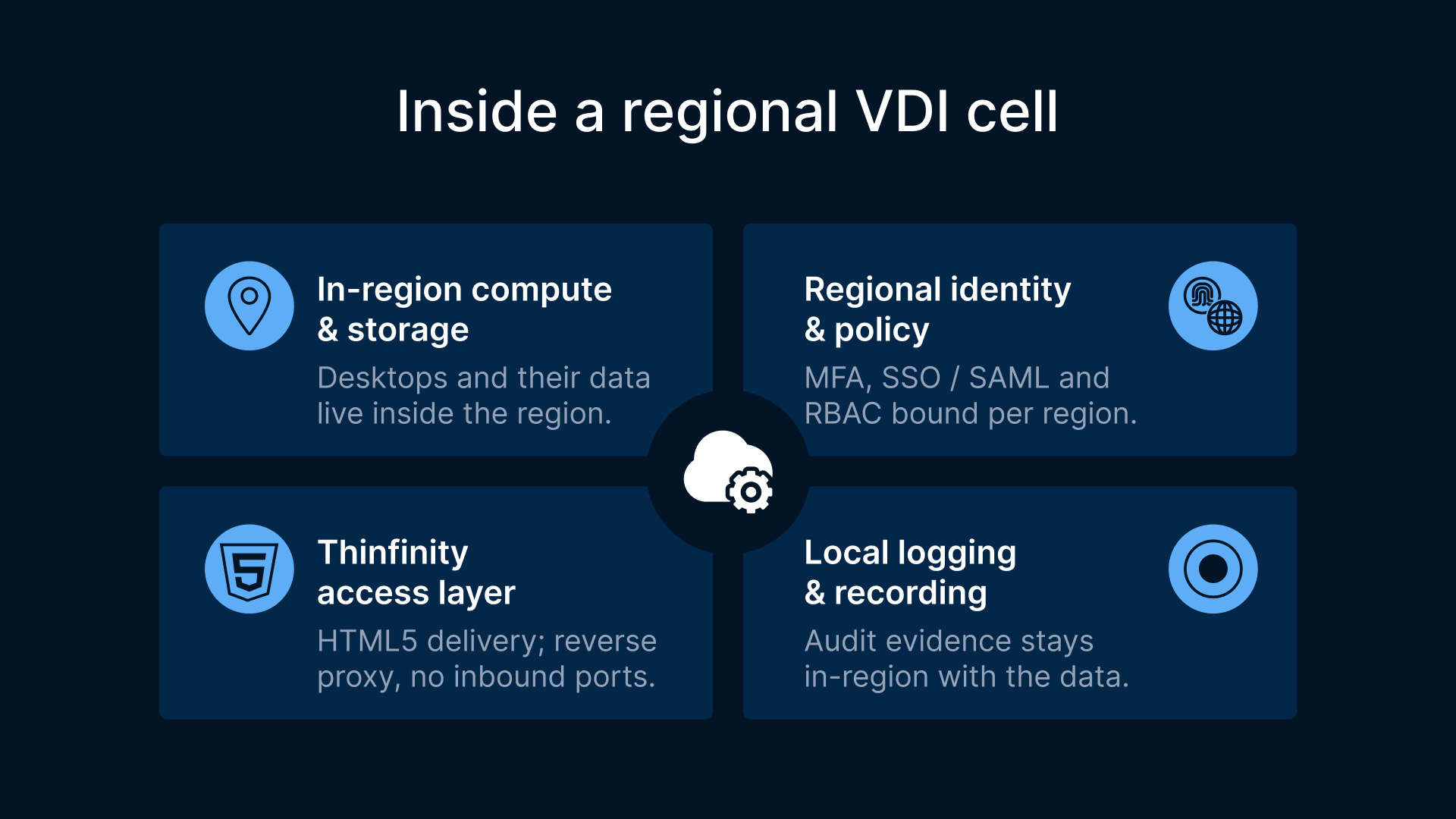
Multinationals rarely have the luxury of one jurisdiction. The scalable approach is to standardize a single desktop-delivery blueprint and then instantiate it per region as an independent “cell.” Each regional VDI cell is a self-contained unit of sovereign desktops that lives entirely inside the OCI region for its jurisdiction.
A reference cell typically includes:
- In-region compute and storage on OCI, where the virtual desktops and their data reside within the sovereign or dedicated region for that jurisdiction.
- Thinfinity Workspace as the access layer, delivering desktops and applications over HTML5 with the reverse proxy positioned so no inbound ports are exposed on internal hosts.
- Regional identity and policy binding, with MFA, SSO/SAML, and RBAC configured so that only authorized users, under that region’s rules, can reach that region’s desktops.
- Local logging and session recording, keeping audit evidence in-region alongside the data it describes.
Because every cell follows the same blueprint, security and platform teams operate a consistent model everywhere while each cell enforces its own residency boundary. An EU cell can anchor to Oracle EU Sovereign Cloud in Frankfurt and Madrid; a UK public-sector cell can anchor to the UK Sovereign Cloud realm where the customer is eligible; a Gulf cell can anchor to an OCI region or Alloy-based sovereign region in the UAE; other cells map to whichever in-region option satisfies local law. Users are routed to the cell that matches their data’s jurisdiction, not merely the one nearest to them. The result is a fleet of in-region virtual desktops that share one operating model but never share regulated data across borders.
How do you govern and audit sovereign desktops across regions?
Sovereignty is only credible if you can prove it. Governance for a multi-region VDI estate rests on a few disciplines.
- Identity as the perimeter. With ZTNA and RBAC, access decisions are tied to verified identity and role rather than network location. This lets you grant a user in one country access to a desktop whose data is bound to another, without granting broad network access or moving the data, and to revoke that access centrally.
- Evidence that stays in-region. Session recordings and access logs are most defensible when they live in the same jurisdiction as the data they document. Keeping audit trails inside each regional cell avoids inadvertently exporting sensitive metadata and simplifies responses to regional regulators.
- Minimized and mapped data flows. Because only pixels leave the region during a session, the set of cross-border data flows a compliance officer must document shrinks. Fewer flows mean a clearer data map, easier data-protection impact assessments, and fewer transfer mechanisms to maintain.
- Consistent controls, local enforcement. A standardized blueprint means the same MFA, access, and recording policies apply everywhere, while enforcement happens locally within each region. That combination is what lets a CISO answer “who accessed this regulated data, from where, and did it ever leave the jurisdiction?” with confidence.
How do you balance global standardization with local residency?
The tension every multinational feels is between one global operating model and many local legal realities. Fragmenting into bespoke per-country deployments is expensive and fragile; ignoring local law is not an option. Sovereign cloud VDI resolves the tension by separating the operating model from the data boundary.
The operating model, how desktops are built, secured, delivered, and audited, is standardized once. The data boundary is enforced regionally by where each cell runs. Because Thinfinity Workspace delivers the same browser-based experience regardless of which OCI region hosts the session, users get a consistent workspace, IT runs a consistent platform, and each region still keeps its data at home. Standardization lives in the delivery layer; sovereignty lives in the placement layer. Organizations get economies of scale and jurisdictional compliance at the same time, instead of trading one for the other.