

Summary
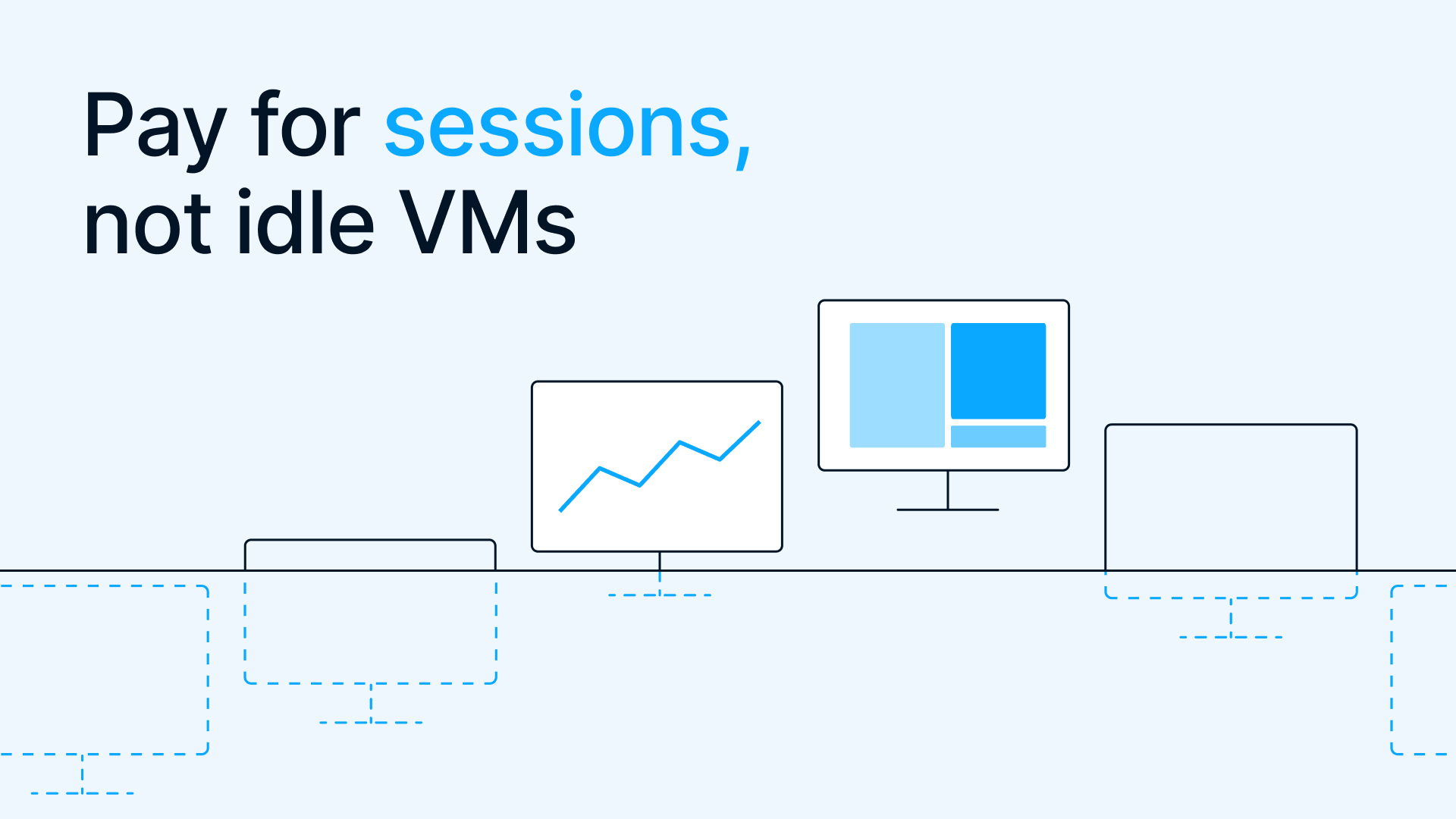
- Elastic VDI on OCI means desktops and published apps are provisioned when users actually connect and scaled down when they do not, so you pay for concurrency instead of a fleet of always-on virtual machines.
- Idle cost is the core problem in traditional VDI: pre-provisioned pools run 24/7 for a workforce that logs in only during shifts, leaving expensive compute burning money overnight, on weekends, and between seasons.
- The architecture combines Oracle Cloud Infrastructure flexible compute shapes and autoscaling, OKE pod-level elasticity for containerized apps and browser isolation, and Thinfinity Cloud Manager to automate host provisioning and golden images.
- Thinfinity Workspace delivers both full desktops (VDI) and published Windows apps (VDA) over the RDC protocol, reachable through any HTML5 browser or native client, with the host agent dialing outbound so no inbound ports are exposed.
- Concurrent single licensing (pay per simultaneous session, not per named user) is the commercial multiplier: pairing technical scale-down with a license model that also tracks concurrency is what turns elasticity into real savings.
Elastic VDI on OCI is a design pattern for running virtual desktops and published applications that expand and contract with actual demand on Oracle Cloud Infrastructure. Instead of keeping a static pool of desktops powered on around the clock, elastic VDI on OCI spins compute up when a user connects, streams the session, and releases or stops that capacity when the user disconnects. This article covers why idle VDI cost happens, what elastic VDI on OCI actually means, the reference architecture that makes it work with Thinfinity Workspace, the on-demand provisioning lifecycle, and an honest look at the limits you need to plan around.
The goal is strategy and architecture, not a click-by-click walkthrough. Where the deep mechanics matter, this pillar hands off by link to a dedicated companion piece so the page here stays at the decision level. The focus below is the framework: where the money leaks, which OCI and Thinfinity levers stop the leak, and where scaling to zero is the wrong answer.
Why does idle VDI cost happen?
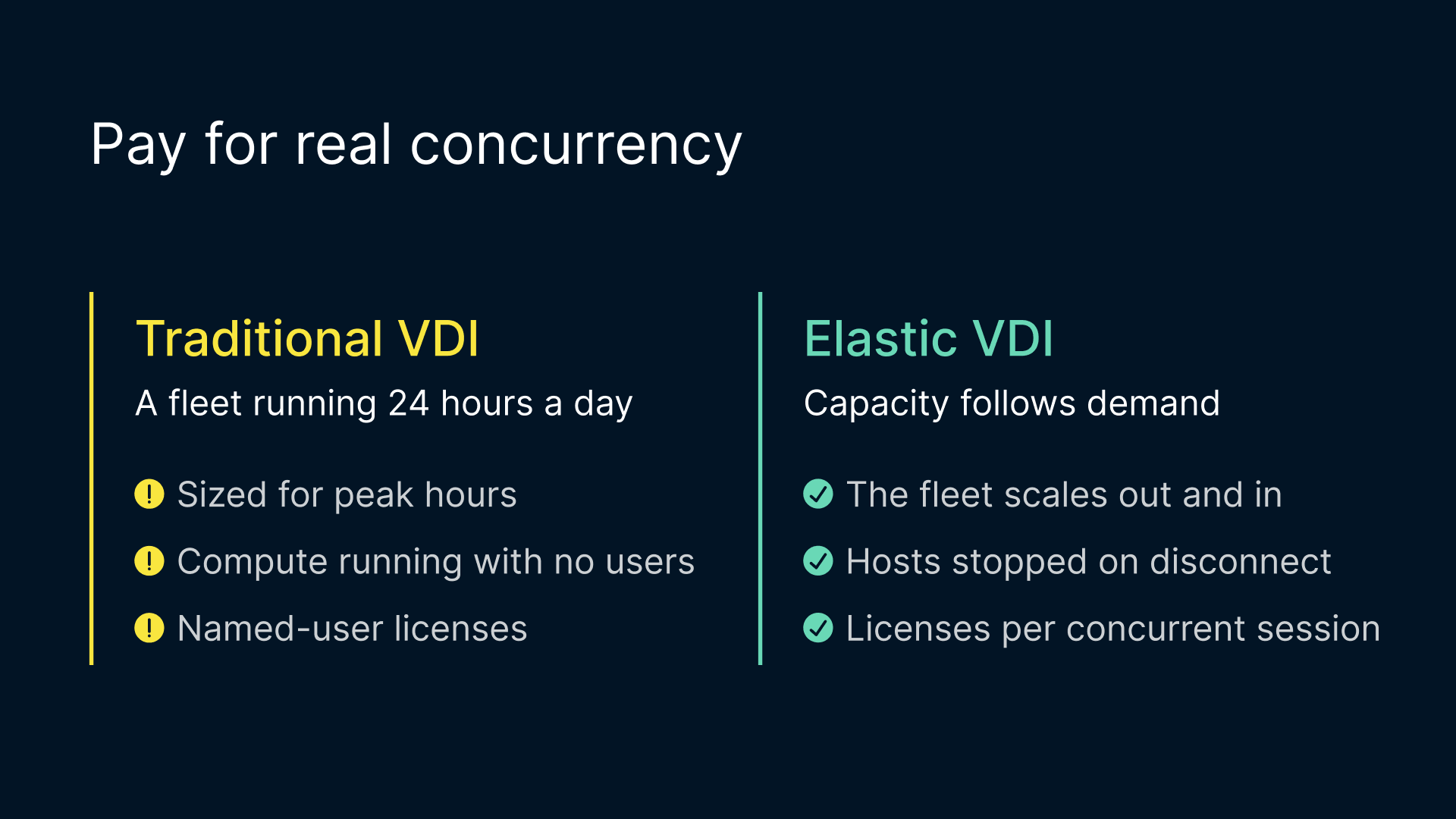
Most virtual desktop cost is not spent on work. It is spent on readiness. Traditional VDI sizing starts from a peak-concurrency estimate, adds headroom, and then provisions that entire capacity as persistent virtual machines that stay powered on so a desktop is always waiting. The result is a fleet sized for the busiest hour of the busiest day, running every hour of every day.
Consider the shape of real usage. A contact center runs two shifts and goes quiet overnight. A university computer lab is busy during term and empty over the summer. A finance back office peaks at quarter-end and idles between closes. A development team touches its Windows toolchain during working hours in one or two time zones. In every case, the number of desktops that are genuinely in use swings dramatically across the day, the week, and the year, yet the always-on model pays for the peak continuously.
Idle cost compounds in three ways. First, compute: powered-on instances accrue charges whether or not anyone is logged in. Second, over-provisioning: fear of a login storm pushes teams to size generously and leave it running. Third, licensing: named-user or per-seat models charge for people who may connect, not sessions that are actually live, so the license bill also tracks the peak rather than concurrency. Attack only the compute side and the license line still bloats; attack only licensing and the virtual machines still hum along overnight. Cutting idle cost meaningfully requires addressing both at once.

After five years of decline, wasted cloud spend increased slightly to 29%, reflecting growing cost complexity from AI and new IaaS and PaaS services.

What is elastic VDI on OCI?
Elastic VDI on OCI is the practice of matching virtual desktop and application capacity to live demand on Oracle Cloud Infrastructure, so resources are created or resumed on connection and reduced or stopped on disconnection. Elasticity here has two dimensions that work together: technical elasticity, where OCI compute and Thinfinity provisioning grow and shrink the desktop fleet, and commercial elasticity, where a concurrent license model bills for simultaneous sessions rather than a fixed roster of named users.
It is worth being precise about what elastic does and does not mean. It does not mean every desktop is destroyed the instant a user steps away for coffee. It means capacity policy is driven by demand signals rather than by a fixed, always-on baseline. Depending on the workload, that can look like launching a fresh VM on demand, resuming a stopped instance, drawing from a non-persistent pool, or scheduling capacity around known shift patterns. The unifying idea is that idle capacity is treated as a cost to be minimized, not a permanent fixture.
Capabilities can be elastically provisioned and released, in some cases automatically, to scale rapidly outward and inward commensurate with demand.
Oracle Cloud Infrastructure is a strong home for this pattern. Its flexible compute shapes let you tune OCPUs and memory to the desktop profile rather than forcing workloads into rigid instance sizes, and both x86 and Arm-based options give you room to right-size for cost and performance. Oracle also positions OCI with a favorable egress posture relative to other hyperscalers, which matters for pixel-streamed desktops that push display traffic outbound continuously; treat any specific pricing as Oracle positioning and verify current terms before you model it. Because this design runs directly on native OCI Compute, there is no third-party hypervisor layer to license, patch, or maintain; see why native cloud IaaS needs no third-party hypervisor for the architectural rationale. Cybele builds on this foundation as an Oracle partner, and you can read more about native OCI VDI for enterprises to see how the platform fit informs the elastic design.
How does the architecture for elastic VDI on OCI work?
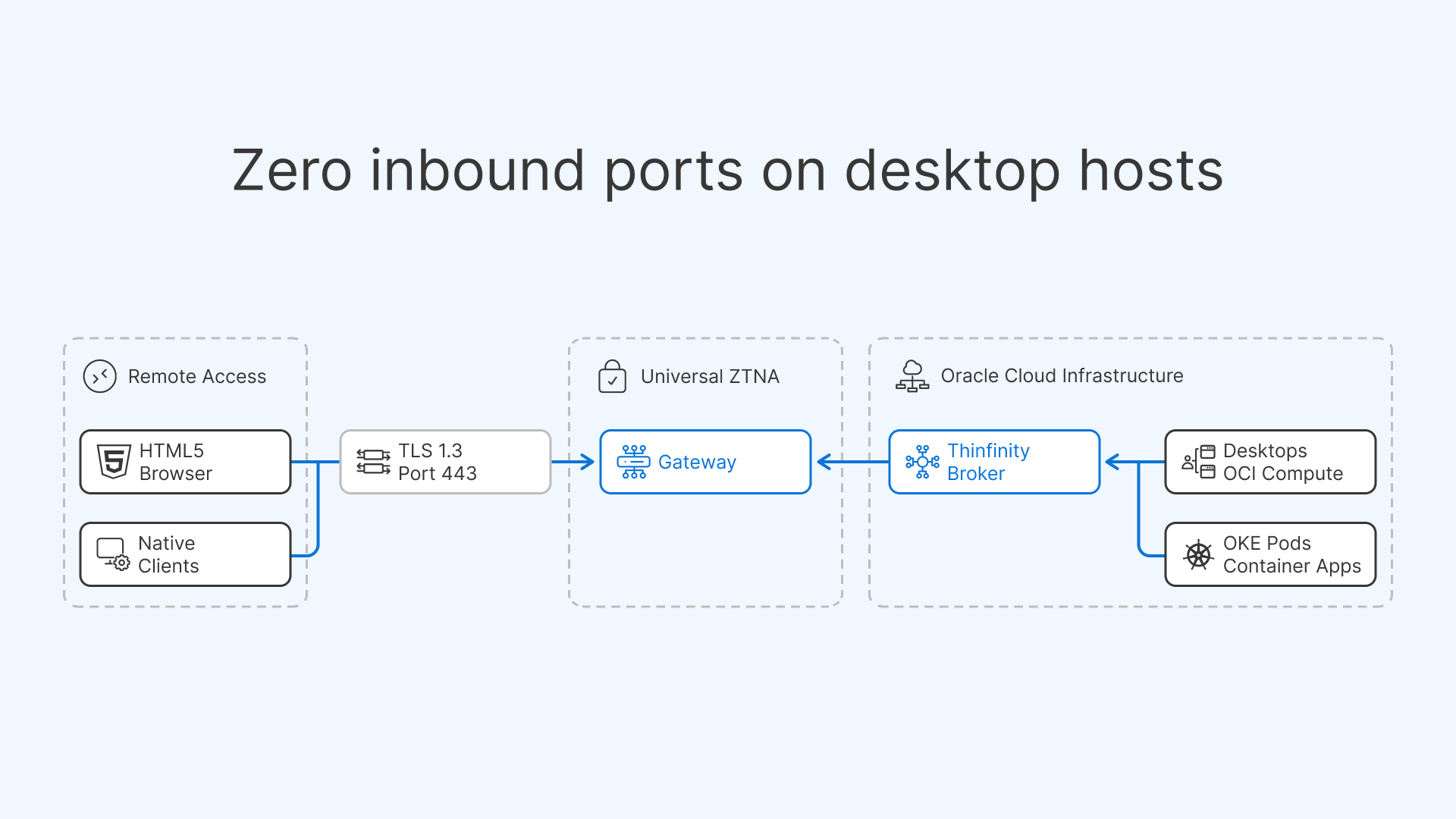
The architecture layers four capabilities: OCI compute and autoscaling for the desktop hosts, OKE pod-level elasticity for containerized apps and browser isolation, Thinfinity Cloud Manager to automate provisioning and images, and concurrent licensing to make the whole thing pay off. On top of all of it sits Thinfinity Workspace as the delivery and access plane.
Thinfinity Workspace delivers full desktops (VDI) and published Windows applications (VDA) over the RDC protocol, along with Linux and Java apps, Remote Browser Isolation, and containerized app and session delivery on Kubernetes and OKE. Users reach any of these through any HTML5 browser or through native Windows, Linux, and mobile clients, all under one Universal ZTNA. The connection model is what makes elasticity safe to operate: the client reaches a reverse Gateway on 443 over TLS 1.3, and each host agent dials outbound via RDC and streams the session up to the Gateway. That means zero inbound ports on the desktop hosts and no endpoint management overhead; what crosses the wire is pixel streaming, not network or resource access to the host.
OCI compute and autoscaling
The desktop hosts are OCI Compute instances. Using flexible shapes, you size each host to the desktop persona, then group hosts so capacity can grow and shrink. Oracle provides instance pools to manage identical instances as a unit and autoscaling for instance pools to add or remove instances based on performance metrics or a schedule. Schedule-based scaling maps cleanly onto shift and seasonal patterns, while metric-based scaling absorbs unplanned surges. Selecting the right compute family, including Arm-based options on the OCI Compute portfolio, is part of keeping the per-desktop cost honest.
OKE pod-level elasticity for apps and browser isolation
Not every workload needs a full Windows VM. For published applications, Linux and Java apps, and Remote Browser Isolation sessions, Thinfinity can deliver from containers running on Oracle Kubernetes Engine (OKE). Here elasticity happens at the pod level: a session spins up a pod, streams to the browser, and the pod is reclaimed when the session ends. This pay-per-pod granularity is finer than VM-level scaling and suits spiky, short-lived, or single-app use cases, where standing up an entire desktop would be wasteful. Browser isolation is a good example: giving a user a hardened, ephemeral browser as a pod is far cheaper than running full VDI just to open a web app.
Thinfinity Cloud Manager and golden images
Elasticity only pays off if provisioning is automated and repeatable. Thinfinity Cloud Manager orchestrates the lifecycle of hosts and images: it can provision and scale desktop and application hosts, manage golden images so every on-demand desktop is consistent, and coordinate the start, stop, and reclaim actions that implement scale-down. Golden images matter for cold-start economics too, because a well-built image boots faster and needs less post-launch configuration. Autoscaling shrinks and grows the fleet, but it does not by itself curate the image and storage layer that keeps those on-demand desktops lean and consistent, so treat image hygiene and storage strategy as a companion discipline. Once the fleet is elastic, you still need to operate and audit these VMs across clouds day to day (inventory, health, and access oversight), which Cloud Manager centralizes. Cloud Manager is where the operational patterns, launch on connect, stop on idle, refresh from image, become policy rather than manual work.
Why concurrent licensing multiplies the savings
Technical scale-down removes idle compute, but if your licensing still charges per named user, half the savings never materialize. Thinfinity uses concurrent single licensing: you pay for simultaneous sessions, not for every person who might one day log in. This is the commercial multiplier. When a two-shift operation of a thousand employees only ever has a few hundred people connected at once, concurrent licensing bills for the few hundred, and elastic compute powers only those hosts. The two levers reinforce each other: the license model tracks concurrency, and the infrastructure tracks concurrency, so the whole stack breathes with real demand instead of the peak headcount. This pillar stays at the strategy level; for the engine mechanics (Scale Sets, Deploy and Destroy modes, Graceful Drain, Terraform provisioning, and the quantified cost and ROI model), see how the Thinfinity Cloud Manager autoscaling engine works, hands-on.
| Dimension | Always-on / static VDI | Elastic VDI on OCI |
|---|---|---|
| Capacity model | Fixed pool sized for peak concurrency, powered on 24/7 | Capacity created, resumed, and released to follow live demand |
| Cost basis | Pay for provisioned capacity regardless of use | Pay for compute in use plus concurrent sessions |
| Provisioning | Manual, ahead of time, sized for the busiest hour | On demand or scheduled via Cloud Manager and OCI autoscaling |
| Scale-down | Rare; instances stay on to guarantee availability | Stop, reclaim, or shrink pools when sessions end (per policy you configure) |
| Licensing | Per named user or per seat, tracking the roster | Concurrent single licensing, tracking simultaneous sessions |
| Best-fit use cases | Small, stable teams; always-connected persistent desktops | Shift work, seasonal peaks, task workers, dev/test, app and browser bursts |
How do you provision desktops on demand and scale them down?
The on-demand pattern is a lifecycle: a user request triggers a launch, the session streams, and idle capacity is reclaimed. The sequence below describes the flow at an architectural level. Scale-to-zero and stop-on-idle behaviors are a policy you configure in the autoscaling engine (see how the Thinfinity Cloud Manager autoscaling engine works, hands-on), not a single toggle, so treat the specifics as guidance to confirm against your Thinfinity and OCI configuration.
- A user authenticates at the Thinfinity Gateway over 443 and TLS 1.3 and requests a desktop or published app.
- Thinfinity checks whether a suitable host is already available in a warm pool or running instance; if so, the session is assigned immediately.
- If no host is ready, Thinfinity Cloud Manager provisions or resumes an OCI Compute instance (or requests a pod on OKE for a containerized app or browser isolation session) from a golden image.
- The host agent boots, dials outbound via RDC, and registers with the Gateway; no inbound ports are opened on the host.
- The session streams to the user as pixels through the browser or native client under Universal ZTNA.
- Thinfinity tracks the session against the concurrent license count so commercial capacity matches live usage.
- On disconnect or idle timeout, policy decides the host’s fate: keep it warm for the next user, stop it to halt compute charges, or reclaim and rebuild it from the golden image for a clean non-persistent desktop.
- OCI autoscaling and Cloud Manager adjust the overall pool on a schedule or on metrics, so the baseline shrinks overnight and grows for the next shift.
For the hands-on companion to this architecture pillar, see how the Thinfinity Cloud Manager autoscaling engine works, hands-on: this page frames the strategy and the levers, and that piece goes deep on the engine that implements them. If cost predictability is a driver for your team, our analysis of predictable banking VDI cost on OCI versus Azure and AWS shows how the platform economics reinforce the elastic model.
What are the honest limits of elastic VDI on OCI?
Elasticity is powerful, but it is not free of trade-offs. Designing well means knowing where scale-down helps and where it hurts. Three limits deserve explicit planning.
Cold-start latency
Launching a virtual machine on demand takes time. Booting the OS, starting the host agent, and registering with the Gateway introduces spin-up latency that a user waiting for a desktop will feel. The mitigation is to avoid launching from truly cold state at the moment of connection: keep a small warm pool of pre-provisioned hosts sized to your expected arrival rate, pre-provision ahead of a known shift start, and invest in a lean golden image that boots quickly. The design goal is that most connections hit a warm host and only genuine surges pay the cold-start penalty.
Persistent desktops that should not scale to zero
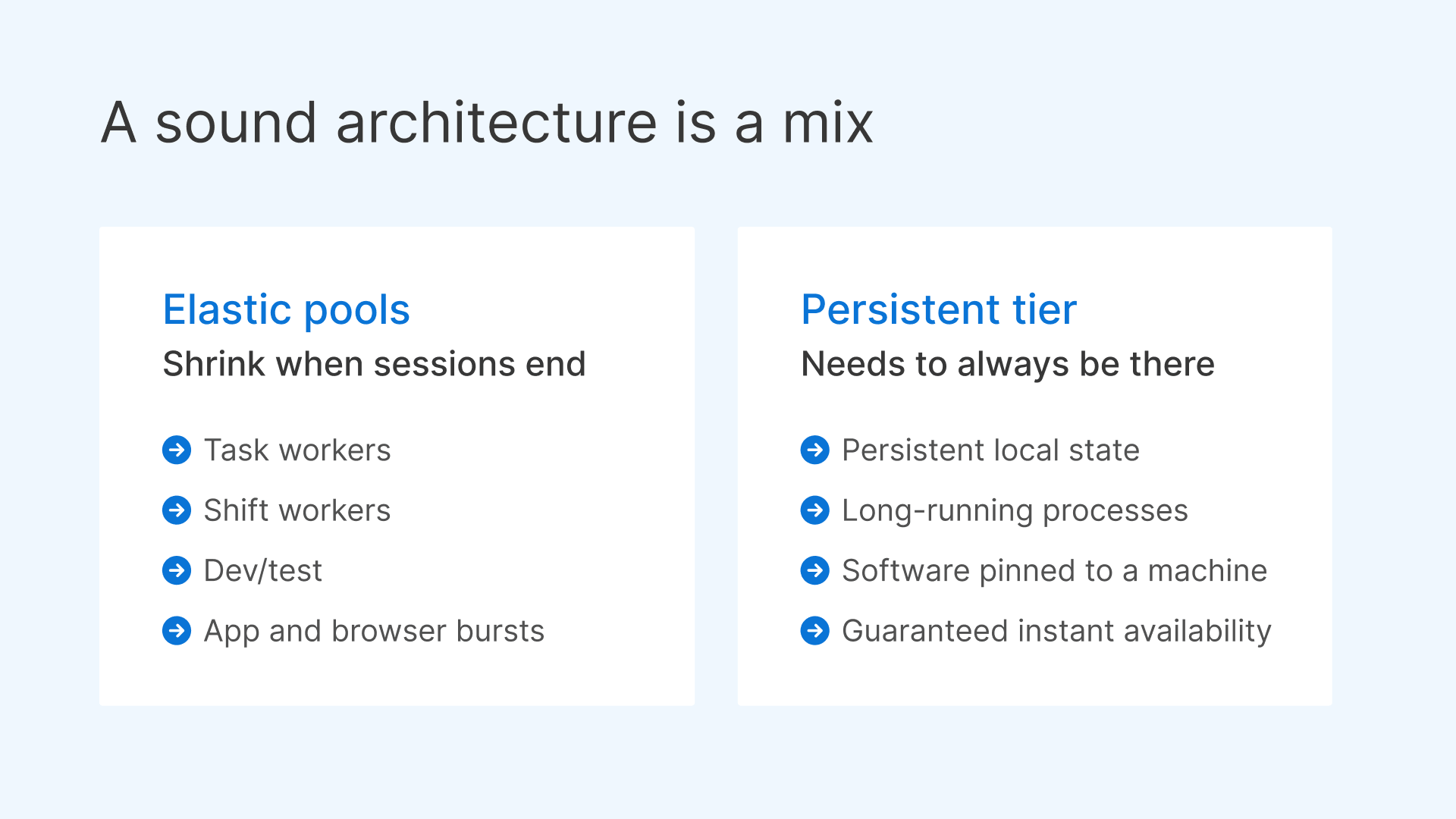
Some desktops should stay on. Users who need persistent local state, long-running processes, specialized or licensed software pinned to a machine, or guaranteed instant availability are poor candidates for aggressive scale-down. Forcing these into a non-persistent, scale-to-zero pattern trades a small compute saving for a real productivity and support cost. A sound architecture is a mix: elastic pools for task workers, shift workers, dev/test, and app or browser bursts, and a persistent tier for the users and workloads that genuinely need to always be there.
Right-sizing and scheduling still required
Elasticity does not remove the engineering work of sizing and scheduling; it changes it. You still need to right-size shapes to each persona, set sensible idle timeouts, define scaling schedules that match real shift and seasonal patterns, and tune warm-pool depth against arrival rate. Scale-to-zero in particular is a policy you configure in the autoscaling engine through schedules and automation, not a magic switch, and the exact behavior of stop, reclaim, and rebuild should be confirmed against your specific Thinfinity and OCI configuration. Treat the numbers you model as guidance and validate them with your own telemetry before committing budget.