

Summary
- Oracle MySQL Database Service is a fully managed MySQL on Oracle Cloud Infrastructure (OCI), and it is the only cloud MySQL built on MySQL Enterprise Edition, so provisioning, high availability across availability domains, automated backups with point-in-time recovery, patching, and security are handled by Oracle rather than by your team.
- Its integrated MySQL HeatWave accelerator runs real-time analytics directly on transactional data with no ETL to a separate warehouse, which means one service covers both online transaction processing (OLTP) and analytics (OLAP).
- Running a MySQL cluster yourself gives you full engine control but transfers the full operational burden to you: HA design, tested restores, failover, patching, hardening, monitoring, scaling, and on-call risk.
- Cybele runs the Thinfinity Workspace authentication database and its session and usage analytics on Oracle MySQL Database Service when a deployment lives on OCI, because co-locating the database in the same region and tenancy as the Thinfinity brokers delivers low-latency OLTP, strong HA, unified identity, in-region data residency, and lower egress.
- Oracle publishes strong price-performance benchmarks for HeatWave; we treat those as Oracle’s own figures to verify, not neutral facts, and we keep an honest section on when a self-managed cluster or another cloud’s managed MySQL is the better call.
Oracle MySQL Database Service on OCI is a fully managed MySQL service that pairs a production-grade transactional database with a built-in analytics engine, and it is the data layer Cybele reaches for first when a Thinfinity Workspace deployment runs on Oracle Cloud Infrastructure. For teams weighing whether to keep operating a MySQL cluster by hand or to adopt a managed service, the choice shapes reliability, security posture, compliance, and total cost of ownership for years. This article explains what Oracle MySQL Database Service and MySQL HeatWave actually provide, compares them fairly against a do-it-yourself cluster and against the other major clouds’ managed MySQL offerings, walks through the reference pattern Cybele uses to deploy it for Thinfinity on OCI, and is honest about the situations where a different choice makes more sense.
What is Oracle MySQL Database Service on OCI?
Oracle MySQL Database Service is Oracle’s fully managed MySQL offering on OCI. According to Oracle, it is the only cloud MySQL service built on MySQL Enterprise Edition, which is the difference that matters most for an authentication database: real ACID transactions, high concurrency, and a set of advanced security capabilities that the community edition does not include. Oracle operates the service, so provisioning, high availability, automated backups, patching, upgrades, and monitoring are delivered as part of the platform rather than assembled and maintained by your own engineers.
What does Oracle manage for you?
The service takes on the operational work that otherwise consumes a database team. Oracle handles provisioning; high availability across availability domains so a single failure does not take the database down; automated backups with point-in-time recovery; patching and upgrades; and monitoring. It also includes Autopilot, a set of machine-learning-driven automations for provisioning, indexing, and tuning that reduce the manual effort of keeping the database fast as workloads change. Because it is built on MySQL Enterprise Edition, it ships with enterprise security features such as encryption, data masking, MySQL Enterprise Firewall, and Transparent Data Encryption (TDE).
What is MySQL HeatWave and why does it matter?
MySQL HeatWave is an in-memory query accelerator integrated into the same service. Its defining benefit is that it runs real-time analytics on your transactional data without ETL to a separate analytics database, so OLTP and OLAP live in one service on one copy of the data. Beyond accelerated analytics, HeatWave adds Lakehouse for querying data in object storage, in-database AutoML for machine learning, and generative AI capabilities with a vector store. HeatWave is available on OCI, AWS, and Azure, though Oracle positions it as native and lowest-latency on OCI. For a product like Thinfinity Workspace, this means the same service that stores authentication and session records can also power usage analytics and reporting on that data in place.

MySQL HeatWave is the only fully managed MySQL database service that combines transactions, analytics, machine learning, and GenAI services, without ETL duplication.

What about the price-performance claims?
Oracle publishes aggressive price-performance benchmarks for HeatWave. According to Oracle’s own benchmarks, HeatWave Lakehouse query performance is roughly 15X faster than Amazon Redshift, roughly 18X faster than Databricks and Snowflake, and roughly 35X faster than Google BigQuery, and Oracle reports up to roughly 4X cost savings for an OLTP application versus Amazon Aurora. We present these as Oracle’s figures, not as neutral facts. Benchmark results depend heavily on workload, data size, configuration, and test date, and independent results vary. If price-performance is central to your decision, treat these numbers as a starting point to reproduce with your own workload and confirm against current published tests before you rely on them.
Why is running a self-managed MySQL cluster so demanding?
Running MySQL yourself, whether on a hypervisor such as VMware, Hyper-V, or KVM, or on raw cloud instances, gives you complete control of the engine. That control is real and valuable. The trade-off is that every responsibility a managed service absorbs becomes yours. You own the high-availability design, typically some combination of InnoDB Cluster or Group Replication with an async replica and a proxy or router such as MySQL Router. You own failover behavior, including the awkward failure modes: split-brain scenarios, replication conflicts, and quorum management that only surface under load or during a network partition.
You also own backups and, more importantly, tested restores. A backup that has never been restored is a hope, not a recovery plan. Add patching and upgrades, security hardening, capacity planning and scaling, monitoring, and performance tuning, and the picture is a standing operational commitment with on-call risk. The most common and costly failures we see are misconfigured HA that does not actually fail over cleanly, and backups that cannot be restored within the recovery objective. Analytics is a separate problem again: a self-managed OLTP cluster still needs a warehouse and an ETL pipeline to do serious reporting. None of this is a reason to avoid self-managing MySQL, but it is the honest cost of the control you gain.
Self-managed MySQL cluster vs Oracle MySQL Database Service
| Dimension | Self-managed MySQL cluster (DIY on VMs/IaaS) | Oracle MySQL Database Service on OCI |
|---|---|---|
| HA / failover | You design and operate InnoDB Cluster / Group Replication plus a router; you own split-brain and quorum edge cases | Managed HA across availability domains, configured and operated by Oracle |
| Backups / PITR | You script backups and, critically, test restores yourself | Automated backups with point-in-time recovery built in |
| Patching / upgrades | Your responsibility, including maintenance windows and rollback plans | Managed by Oracle |
| Security features | You harden the engine and add tooling; enterprise features require extra work or licensing | Built on MySQL Enterprise Edition: encryption, data masking, MySQL Enterprise Firewall, TDE |
| Analytics | Needs a separate warehouse and ETL pipeline | MySQL HeatWave runs analytics on the same data, no ETL |
| Scaling | Manual capacity planning and re-architecture | Managed scaling, with Autopilot assisting provisioning and tuning |
| Ops burden | High; standing team commitment with on-call risk | Low; Oracle operates the platform |
| TCO / risk | Hidden costs and misconfiguration risk (HA and backups) | Lower operational overhead; predictable managed service |
How does Oracle MySQL Database Service compare to other clouds’ managed MySQL?
Managed MySQL is not unique to Oracle. AWS offers RDS for MySQL and Aurora MySQL; Microsoft offers Azure Database for MySQL Flexible Server; Google offers Cloud SQL for MySQL. These are all solid, mature managed OLTP services, and if your organization is already standardized on one of those clouds, its managed MySQL is often the pragmatic default. Two differences matter when you compare them to Oracle MySQL Database Service.
First, analytics. On AWS, Azure, and Google Cloud, serious analytics on your MySQL data typically means moving it into a separate warehouse such as Amazon Redshift, Snowflake, or Google BigQuery, with an ETL pipeline to keep it current. Oracle MySQL Database Service keeps OLTP and analytics in one service through HeatWave, removing the separate warehouse and the ETL. Second, co-location. If your workload runs on OCI, as a Thinfinity deployment on Oracle Cloud does, then putting the database on a different cloud adds cross-cloud network latency, data egress cost, and a split security and identity model. Keeping the database native to OCI avoids all three.
Managed MySQL across clouds
| Dimension | Oracle MySQL Database Service / HeatWave (OCI) | AWS RDS / Aurora MySQL | Azure Database for MySQL (Flexible Server) | Google Cloud SQL for MySQL |
|---|---|---|---|---|
| Built-in analytics | HeatWave analytics on the same data, no ETL | Separate warehouse (e.g., Redshift) + ETL | Separate warehouse (e.g., Synapse/Fabric) + ETL | Separate warehouse (e.g., BigQuery) + ETL |
| Co-location with OCI workloads | Native to OCI; same region and tenancy as Thinfinity | Cross-cloud from OCI | Cross-cloud from OCI | Cross-cloud from OCI |
| Data residency / egress | In-region, including sovereign regions; no cross-cloud egress | Cross-cloud egress and residency to manage | Cross-cloud egress and residency to manage | Cross-cloud egress and residency to manage |
| Security / identity | Unified OCI IAM; MySQL Enterprise Edition security features | AWS IAM; strong RDS/Aurora security | Entra ID; strong Azure security | Google IAM; strong Cloud SQL security |
| Price-performance | Strong figures per Oracle’s own benchmarks (verify; independent results vary) | Vendor and third-party benchmarks vary | Vendor and third-party benchmarks vary | Vendor and third-party benchmarks vary |
Why does Cybele prefer it for Thinfinity’s authentication database and analytics?
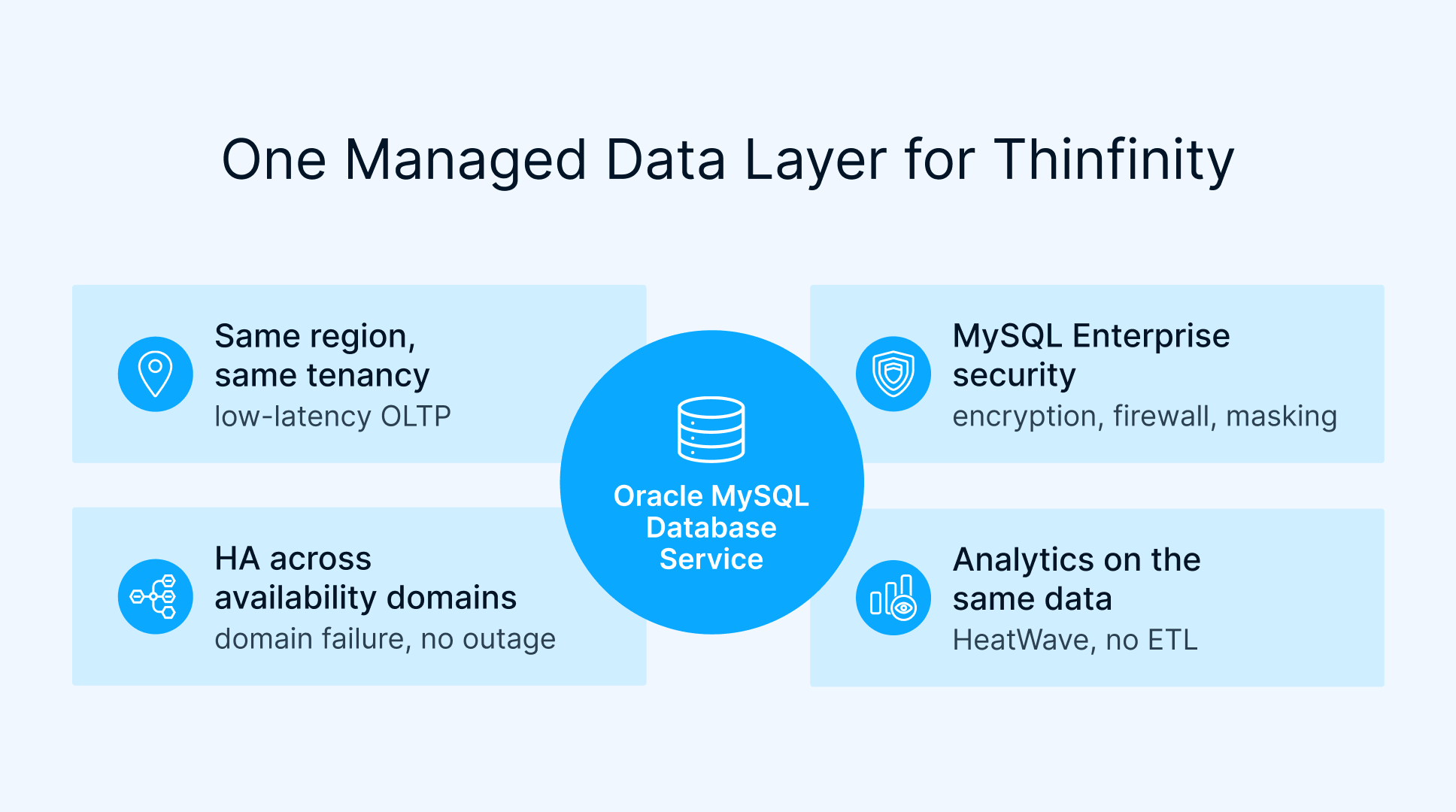
Thinfinity Workspace’s authentication database holds the records that must be reliable, secure, and fast: user management, identity-provider and cross-forest brokering metadata, role-based access control, and session and audit records. That is a low-latency OLTP workload with strong high-availability requirements. A managed MySQL Database Service co-located with the Thinfinity Gateway and brokers in the same OCI region delivers exactly that, with encryption, MySQL Enterprise Firewall, data masking, and automated backups with point-in-time recovery, and without placing a database-operations burden on Cybele or on the customer.
Analytics on that same data, covering session and usage analytics, monitoring, and reporting, runs through HeatWave in the same service. There is no separate analytics database and no ETL pipeline to build, secure, and keep in sync, which means real-time insight on the authentication and session data where it already lives. Because the database shares the tenancy and region with the rest of the deployment, we get in-region data residency and sovereignty, unified IAM, and simpler compliance, with lower cross-cloud egress. The net effect is reduced operational overhead and lower total cost of ownership, which we can pass through to customers. For teams evaluating cloud economics broadly, we cover the wider cost picture in our analysis of predictable-cost banking VDI on OCI versus Azure and AWS.
How does Cybele deploy Oracle MySQL Database Service for Thinfinity on OCI?
When we stand up Thinfinity Workspace on Oracle Cloud, the data layer follows a consistent reference pattern. The goal is a database that is secure, highly available, and physically close to the brokers, with analytics available on the same data. Here is the order we deploy it in:
- Provision the Oracle MySQL Database Service instance in the same OCI region and tenancy as the Thinfinity Gateway and broker tier, so the authentication database sits next to the components that query it.
- Enable managed high availability across availability domains, so a domain-level failure does not interrupt authentication or session brokering.
- Turn on the enterprise security controls: encryption, MySQL Enterprise Firewall, and data masking, aligned to the customer’s compliance requirements.
- Confirm automated backups with point-in-time recovery, and validate the restore path against the recovery objectives, not just the backup schedule.
- Use MySQL HeatWave for session, usage, and monitoring analytics directly on the authentication and session data, with no separate analytics database and no ETL.
- Bind access and administration to OCI IAM, so identity and policy for the database live in the same model as the rest of the Thinfinity deployment on OCI.
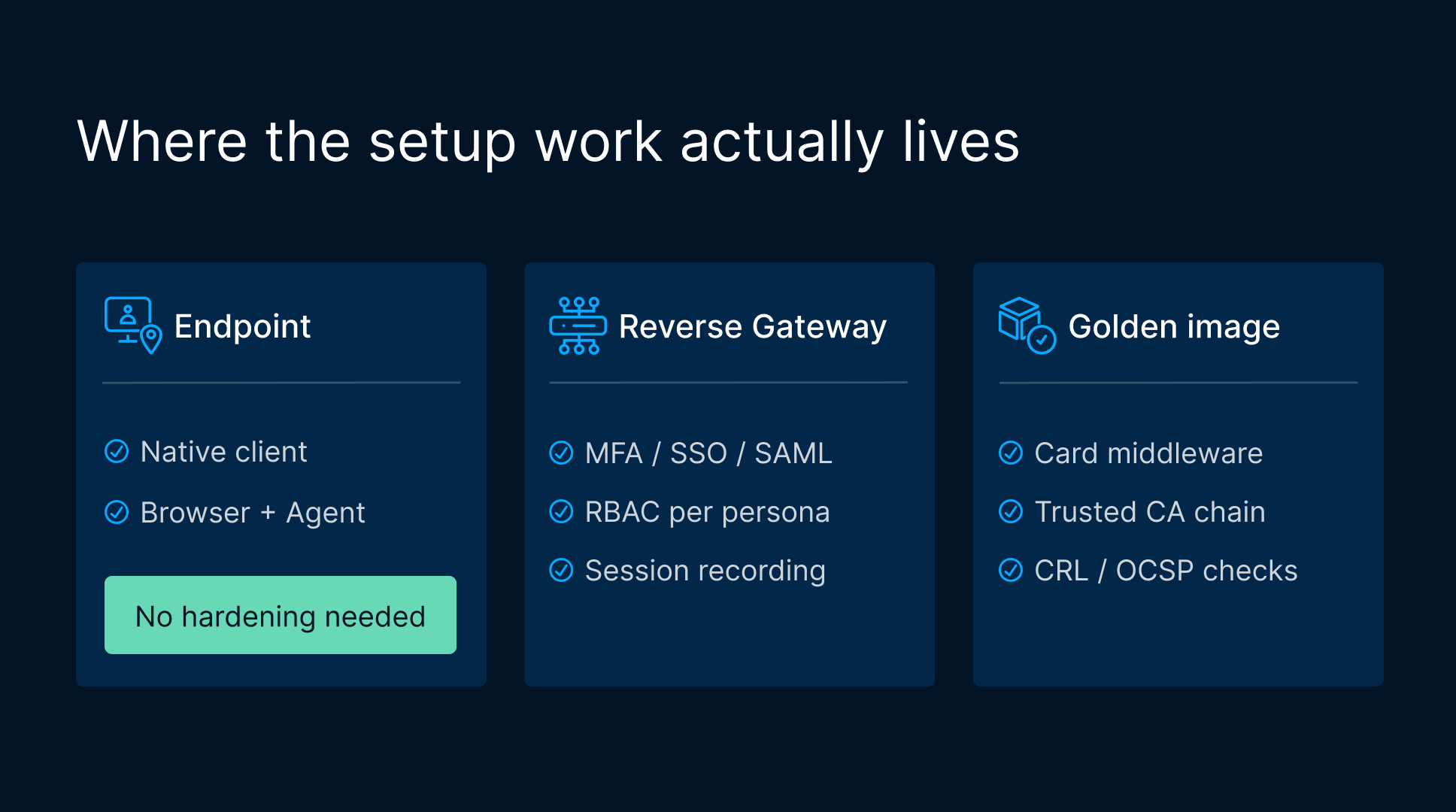
This pattern sits naturally alongside our native OCI VDI for enterprises architecture and our Universal ZTNA access model, so the database, the access plane, and the virtual desktops all share one region, one identity model, and one security boundary.
When a self-managed cluster or another cloud’s MySQL makes sense
Preferring Oracle MySQL Database Service for Thinfinity on OCI does not make it the right answer everywhere. If your organization is already standardized on AWS, Azure, or Google Cloud, and your Thinfinity deployment and its supporting systems live there, then that cloud’s managed MySQL is often the pragmatic choice. Co-location works in reverse too: the database should generally live where the workload lives, and forcing a cross-cloud database to chase a specific feature can cost you more in latency and egress than it returns.
A self-managed cluster still fits when you need full control of the engine, for example a specific MySQL version or build, custom plugins, storage-engine tuning, or configuration that a managed service intentionally does not expose. Teams with deep, in-house database operations expertise and a genuine requirement for that level of customization can run a cluster well. And if your analytics needs are modest, the built-in-analytics advantage of HeatWave may matter less than other factors in your stack. The honest rule is to match the platform to where the workload runs, how much control you truly need, and how much operational burden you want to own.