

TL;DR
- Banking data residency is about where regulated data is processed and stored, not merely where it is hosted; a browser-delivered VDI keeps that data inside the OCI region and streams only encrypted pixels to the endpoint.
- OCI offers commercial regions plus the EU Sovereign Cloud (Frankfurt and Madrid), operated by EU-incorporated legal entities with EU-resident-only operations at no sovereignty premium.
- GDPR and DORA in the EU, LGPD in Brazil, and the GLBA/FFIEC framework in the US each treat remote access and cross-border data flows differently, and this architecture maps cleanly to all three.
- Thinfinity Workspace deploys a DMZ reverse proxy with zero inbound ports, federated MFA/SSO/SAML, RBAC, and session recording to produce the audit evidence examiners expect.
- One reference architecture, replicated as region-pinned stacks, lets a single bank run isolated US, EU, and LATAM VDI under one operating model.
Banking data residency is no longer a checkbox on a vendor questionnaire. It is the architectural constraint that determines whether your virtual desktop program survives a DORA audit, an ANPD inquiry, or an FFIEC examination. For a CISO or compliance officer at a multinational or regional bank, the core question is deceptively simple: where does the regulated data physically live while an employee is working with it, and can you prove it stayed there? This guide explains how a browser-delivered VDI on Oracle Cloud Infrastructure (OCI) keeps regulated data in-region by design, how OCI’s region and sovereign-cloud options satisfy in-country residency, and how to map the resulting controls to what your auditors will ask for.
Key Takeaways
- Banking data residency is about where data is processed and stored, not just where it is hosted. A browser-delivered VDI keeps regulated data inside the OCI region and streams only encrypted pixels to the endpoint, so no customer data lands on the device.
- OCI offers both commercial regions and the EU Sovereign Cloud (Frankfurt and Madrid), operated by EU-incorporated legal entities with EU-resident-only operations, providing strong residency and sovereignty guarantees at no sovereignty premium.
- Three regulatory regimes drive most decisions: GDPR and DORA in the EU, LGPD in Brazil, and the GLBA/FFIEC framework in the US. Each treats remote access and cross-border data flows differently.
- Thinfinity Workspace deploys a DMZ reverse proxy with zero inbound ports, identity federation (MFA/SSO/SAML), RBAC, and session recording, producing the audit trail examiners expect.
- Per-jurisdiction deployment patterns let a single bank run isolated, in-country VDI stacks in the US, EU, and LATAM while maintaining one operating model.
Why Desktop and Data Location Matter for Banks
Regulators increasingly treat the remote desktop as part of the data-processing boundary. When a contractor in one country opens a customer record that legally must stay in another, the location of the desktop session, the temporary files, the clipboard, and the screen buffer all become regulated artifacts. Traditional fat-client and full-VPN models scatter those artifacts across endpoints, which is exactly what data-residency rules are written to prevent.
The European Union: GDPR and DORA
The GDPR does not impose a blanket data-localization mandate, but it restricts transfers of personal data outside the EU/EEA unless an adequacy decision or an approved safeguard such as Standard Contractual Clauses (SCCs) is in place. For banks, the practical effect is that customer and employee personal data should remain in-region wherever feasible, because keeping it in-region eliminates the transfer-mechanism burden entirely.
The Digital Operational Resilience Act (DORA), Regulation (EU) 2022/2554, entered into application on 17 January 2025 and now binds roughly 22,000 EU financial entities and their ICT third-party providers. DORA’s five pillars are ICT risk management, ICT-related incident management, digital operational resilience testing, ICT third-party risk management, and information sharing. It requires board-level accountability, classification and reporting of major incidents (initial notification within hours of detection), and threat-led penetration testing at least every three years for significant entities. A VDI platform that centralizes sessions, enforces access controls, and records activity directly supports the risk-management and testing pillars and simplifies the third-party register your supervisors now collect annually.

The Digital Operational Resilience Act, or DORA, is a European Union (EU) regulation that creates a binding, comprehensive information and communication technology (ICT) risk management framework for the EU financial sector.

Latin America: Brazil’s LGPD
Brazil’s Lei Geral de Proteção de Dados (LGPD) governs personal-data processing, and ANPD Resolution CD/ANPD No. 19/2024 formalized the cross-border transfer mechanisms: adequacy decisions, ANPD-approved SCCs, binding corporate rules, or case-by-case approval. The grace period for adopting the standardized SCCs ended on 23 August 2025, so transfers out of Brazil without a valid mechanism are now exposed. A notable 2026 development is the EU-Brazil mutual adequacy decision announced on 27 January 2026, which eases EU-Brazil flows; transfers to other jurisdictions, including the US, still require SCCs or another mechanism. Keeping Brazilian customer data on desktops that physically reside in a Brazil OCI region is the cleanest way to avoid relying on transfer instruments at all.
The United States: GLBA and FFIEC
The US has no single federal data-residency law. The Gramm-Leach-Bliley Act (GLBA) requires institutions to protect the confidentiality and security of customer information, and FFIEC examination procedures assess endpoint security, remote-access controls, encryption, MFA, and incident response. FFIEC guidance expects encrypted sessions, strong authentication, and continuous monitoring for remote users. A browser-delivered VDI satisfies all three natively: TLS-encrypted sessions, gateway-enforced MFA, and optional session recording, while keeping data inside a US OCI region to address state-level and contractual residency expectations.
How a Browser-Delivered VDI Keeps Data In-Region
The architectural principle is simple and powerful: pixels, not data. With Thinfinity Workspace, the published desktop or application runs inside the OCI region, and the user interacts with it through any HTML5 browser. What crosses the network to the endpoint is an encrypted stream of screen updates and input events, not files, records, or database rows.
Because no regulated data is written to the local device, the endpoint falls outside the data-residency boundary. A relationship manager working from a laptop in another country never holds the customer record locally; the record stays on the in-region virtual desktop. This collapses the residency problem from “every endpoint everywhere” to “the OCI region you chose,” which is the single most consequential simplification a residency program can make. Controls such as disabling clipboard transfer, file download, and local printing further guarantee that data cannot leak off the in-region session.
OCI Region and Sovereign Cloud Options for Residency
OCI gives banks a wide footprint to place workloads close to the data’s legal home. Customers can choose from a broad set of public cloud regions worldwide, and OCI’s realm concept keeps customer data within the physical and logical location selected.
OCI EU Sovereign Cloud
For the strictest EU requirements, the Oracle EU Sovereign Cloud operates as a separate realm with data regions in Frankfurt, Germany, and Madrid, Spain. It is run by Oracle-owned EU legal entities staffed by EU-resident personnel only, restricting physical and logical access and day-to-day operations to the EU. Oracle reports over 1,500 EU residents supporting the sovereign realm and access to the full portfolio of 200+ OCI services, at the same pricing as commercial regions with no sovereignty surcharge. For a bank that must demonstrate to a supervisor that neither data nor operational access leaves the EU, this realm is a strong, defensible foundation.
The EU Sovereign Cloud realm enables Oracle to restrict physical and logical access and limit day to day cloud operations and support to EU-resident personnel.
Dedicated and Distributed Options
Where law or contract demands data remain physically in-country or even on-premises, OCI’s distributed cloud options (including dedicated region deployments) place OCI infrastructure inside a customer-chosen or customer-owned data center while preserving the same APIs and services. This lets a bank run identical Thinfinity Workspace deployments across commercial regions, the EU Sovereign Cloud, and dedicated in-country footprints without re-architecting.
Reference Architecture for Compliant Banking VDI
A defensible deployment combines network isolation, federated identity, least-privilege access, and complete auditability. The pattern below is jurisdiction-agnostic; you replicate it per region.
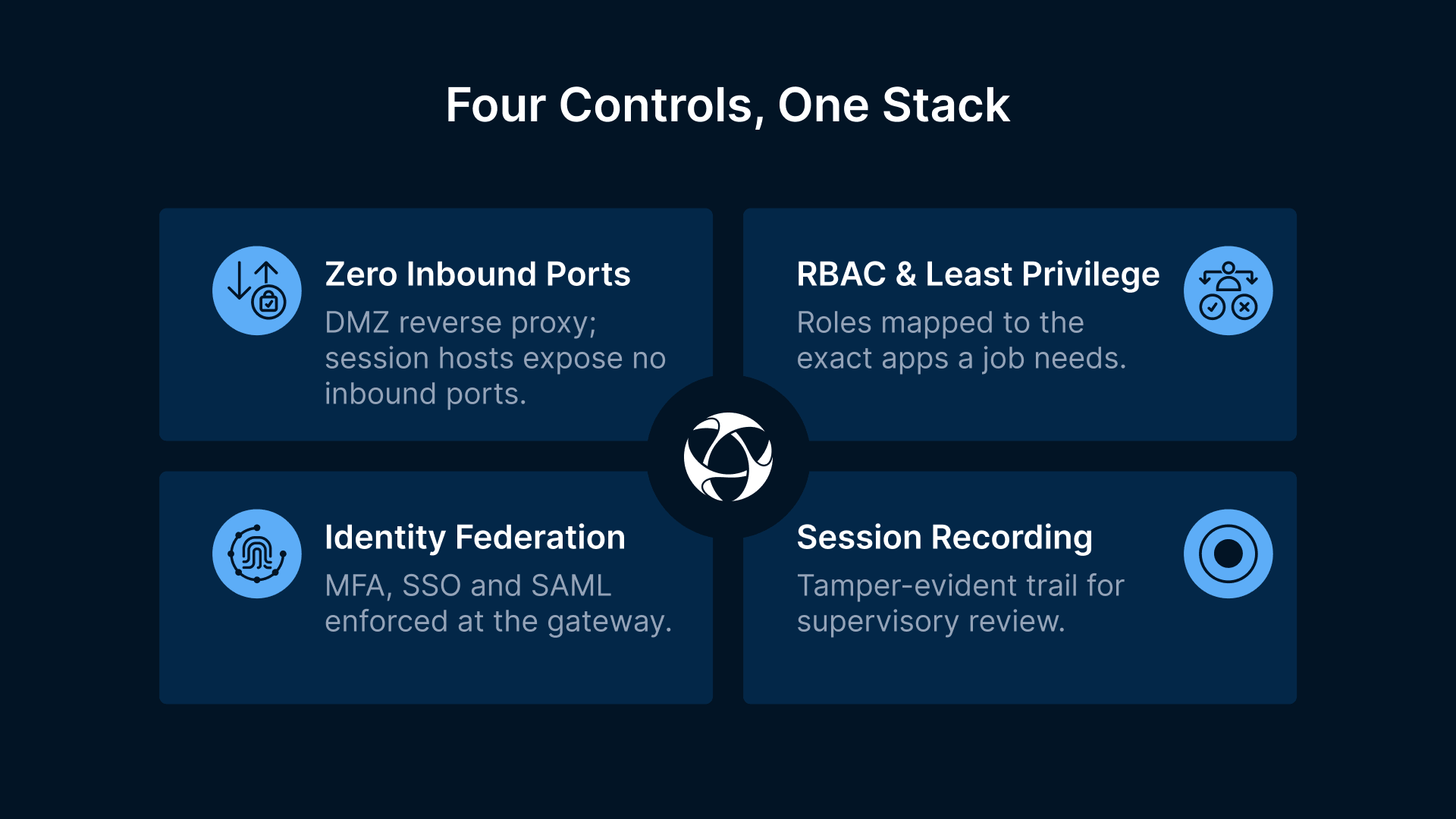
DMZ Reverse Proxy with Zero Inbound Ports
Thinfinity Workspace publishes its broker through a reverse proxy placed in the DMZ. The internal session hosts open no inbound ports to the internet; the proxy brokers connections outbound-initiated and terminates TLS at the edge. This reverse-proxy/DMZ model shrinks the external attack surface to a single hardened entry point and aligns with Universal ZTNA principles, where access is brokered per-session rather than granted at the network layer.
Identity Federation: MFA, SSO, and SAML
Authentication integrates with the bank’s existing identity provider via SAML and SSO, with MFA enforced at the gateway before any session is brokered. This keeps identity governance centralized and gives examiners a single, consistent authentication control to test across all jurisdictions.
RBAC and Least Privilege
Role-based access control maps users to the precise set of desktops and applications their role requires, supporting the segregation-of-duties expectations baked into both DORA and FFIEC. Access changes are policy-driven and logged.
Session Recording and Audit
Session recording captures privileged and high-risk activity, producing tamper-evident evidence for incident investigation and supervisory review. Combined with centralized authentication and access logs, this gives compliance teams a continuous, exportable audit trail rather than a reconstruction exercise after the fact.
Legacy Core Access Without a Separate Tool
Many banks still run core systems on mainframe or AS/400 (IBM i) platforms. Thinfinity is the only VDI and secure-access platform that also includes built-in terminal emulation (z/Scope) for legacy mainframe and AS/400 access, so tellers and back-office staff reach green-screen core applications through the same in-region, browser-delivered, audited channel as everything else, with no separate emulator to license, deploy, or secure.
Per-Jurisdiction Deployment Patterns
A multinational bank typically runs the same reference architecture as isolated stacks per jurisdiction, each pinned to a region whose location satisfies the local rule set.
United States Pattern
Deploy in a US OCI region with gateway-enforced MFA, TLS-encrypted sessions, and session recording for privileged roles. This addresses GLBA confidentiality obligations and the remote-access expectations in the FFIEC handbook while keeping US customer data on US soil.
European Union Pattern
Deploy in an EU commercial region for general workloads, or in the EU Sovereign Cloud (Frankfurt or Madrid) where supervisors expect EU-only operational access. Because the desktop and data never leave the EU, GDPR transfer mechanisms are not triggered, and the centralized access and recording controls feed directly into DORA risk-management and resilience-testing evidence.
Latin America (Brazil) Pattern
Deploy in a Brazil OCI region so that personal data processed by Brazilian staff stays in-country, minimizing reliance on LGPD cross-border mechanisms. Where EU-Brazil flows are needed, the 2026 mutual adequacy decision simplifies them; flows to other regions still use ANPD-approved SCCs. The browser-delivered model means a São Paulo back office and a global support team can both operate without copying regulated records onto endpoints.
Mapping Controls for Your Auditors
The table below maps the platform’s capabilities to the obligations examiners most often test. Use it as a starting point for your own control narrative.
| Regulatory Obligation | Architecture Control | Evidence Produced |
|---|---|---|
| Data residency (GDPR, LGPD, contractual) | In-region OCI deployment; pixels-not-data streaming; no local data persistence | Region/realm configuration; data-flow diagram showing no endpoint storage |
| Strong authentication (FFIEC, DORA) | SAML/SSO with gateway-enforced MFA | IdP federation config; MFA enforcement logs |
| Least privilege / segregation of duties | RBAC mapping users to desktops and apps | Role definitions; access-grant and change logs |
| Attack-surface reduction | DMZ reverse proxy with zero inbound ports; ZTNA brokering | Network topology; firewall rule set; penetration-test scope |
| Monitoring and incident evidence (DORA, GLBA) | Session recording and centralized access logging | Session recordings; exportable audit trail for incident reports |
| Operational sovereignty (EU supervisory expectation) | OCI EU Sovereign Cloud realm, EU-resident operations | Oracle sovereign-realm attestations; region selection records |