

TL;DR
- Citrix and Omnissa (the former VMware Horizon) both changed hands and pricing in 2026: Citrix moved to bundled subscriptions with reported renewal increases up to roughly 200% and ends file-based licensing on April 15, 2026, while Omnissa raised new-and-expansion prices by about +7% to +21% effective May 4, 2026.
- Evaluate any replacement on five dimensions: security and zero trust, regulatory compliance and data residency, total cost predictability, end-user performance, and vendor lock-in.
- Thinfinity Workspace on OCI delivers browser-based VDI with Universal ZTNA, zero inbound ports, MFA/SSO/SAML, RBAC, and session recording on a cloud with flat, region-consistent pricing.
- A phased assess, pilot, coexist, and cut over migration keeps the incumbent live for near-instant rollback, so no single wave can take desktops offline.
- Built-in z/Scope terminal emulation lets the same platform reach legacy mainframe and AS/400 (IBM i) cores, removing a common migration blocker.
Bank VDI migration has moved from a back-burner project to a board-level cost line. In 2026, banks and credit unions running Citrix or VMware Horizon (now Omnissa) are facing renewal quotes that no longer match the value delivered, bundles that force payment for unused components, and platform ownership changes that erode long-term predictability. This guide gives CIOs and IT Directors a practitioner’s view of why the incumbents have become expensive, what to evaluate in a replacement, and a phased, low-risk path to migrate a regulated banking desktop estate to Thinfinity Workspace on Oracle Cloud Infrastructure (OCI), secured by Universal ZTNA, delivered through any HTML5 browser, with zero inbound firewall ports.
Key Takeaways
- The cost trigger is real. Citrix moved to bundled “Universal” subscriptions, and industry reports describe renewal increases of up to roughly 200%; its file-based licensing reaches end of life on April 15, 2026, forcing a migration to the License Activation Service. Omnissa (the former VMware Horizon, now KKR-owned) announced new-and-expansion price increases effective May 4, 2026, reportedly in the range of +7% to +21% depending on bundle. (Figures attributed to vendor and industry sources; treat as directional.)
- Banks should evaluate five dimensions: security and zero trust, regulatory compliance and data residency, total cost predictability, end-user performance, and vendor lock-in.
- Thinfinity Workspace on OCI fits regulated workloads through browser-based access, a reverse-proxy/DMZ design that opens zero inbound ports, built-in MFA/SSO/SAML, RBAC, and session recording, on a cloud with flat, region-consistent pricing and strong compliance attestations.
- Migrate in four phases: assess, pilot, coexist, cut over, with rollback defined at every gate so you never bet the bank on a single weekend.
- Bonus for legacy core access: Thinfinity is the secure-access platform that also includes built-in terminal emulation (z/Scope) for mainframe and AS/400 (IBM i) connectivity, useful when teller and back-office staff still reach a legacy core.
Why are banks replacing Citrix and VMware Horizon in 2026?
The short answer: the economics and the ownership of both platforms changed, and regulated buyers dislike surprises. After Broadcom acquired VMware, the Horizon end-user computing business was divested and now operates as Omnissa under KKR ownership. Citrix sits inside Cloud Software Group, backed by Vista Equity, which in 2025 raised a multi-billion-dollar continuation fund to extend its hold, a signal that aggressive monetization is likely to continue.
For a CIO, three pressures compound. First, licensing structure. Citrix consolidated its catalog into bundled “Citrix Universal” subscriptions; buyers can no longer cherry-pick only the components they use, which raises total cost of ownership for banks that never touch every module in the bundle. Second, renewal magnitude. Industry commentary in 2025 to 2026 describes Citrix renewal increases reaching up to roughly 200% in some cases, and a hard cutover: file-based licensing reaches end of life on April 15, 2026, after which the License Activation Service becomes the only path to keep on-premises components running. Third, the Omnissa transition. Omnissa announced price adjustments for Horizon VDI SaaS and Term bundles effective May 4, 2026, reported around +7% for configurations including VMware vSphere Foundation and meaningfully higher (roughly +16% to +21%) for configurations without it.

After this date, LAS will be the exclusive method for activating and licensing Citrix on-premises components.

None of these numbers should be treated as a quote for your institution; they are directional figures drawn from vendor notices and industry analysis. The pattern, however, is consistent: rising cost, reduced flexibility, and a sense that the platform roadmap is now optimized for the owner’s returns rather than the bank’s predictability. That is what pushes a regulated buyer to evaluate a Citrix alternative for banking or a VMware Horizon migration in finance.
What should a bank evaluate before migrating VDI?
A defensible bank VDI migration decision rests on five dimensions. Evaluate each against your current platform and any candidate replacement using the same evidence standard your examiners would expect.
Security and zero trust
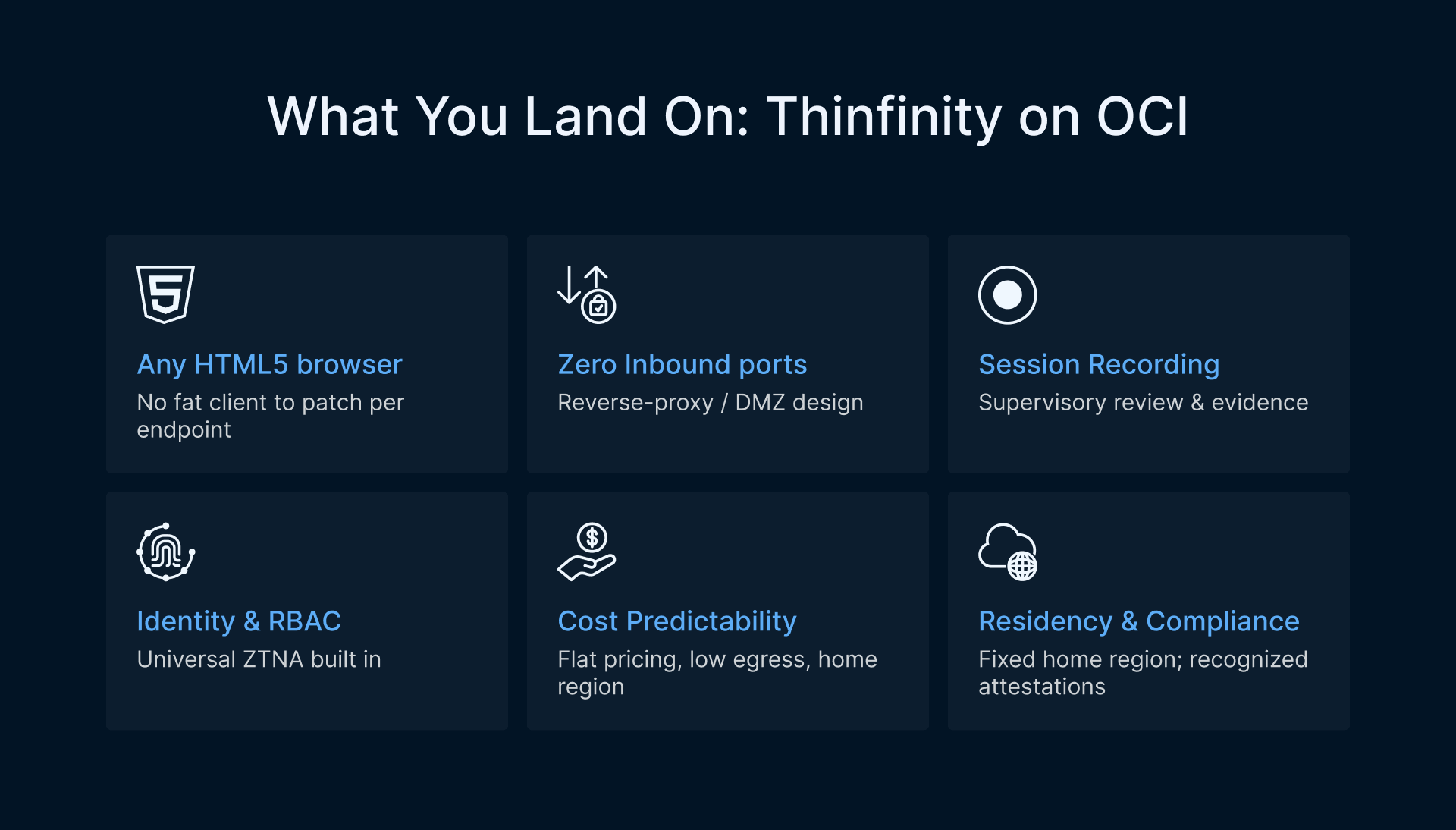
Look for an architecture that removes inbound attack surface rather than merely guarding it. Thinfinity Workspace uses a reverse-proxy/DMZ model that requires zero inbound firewall ports to the internal network, and layers Universal ZTNA, MFA, SSO/SAML, and role-based access control (RBAC) on top. Sessions reach users through a standard HTML5 browser, so there is no fat client to patch on every endpoint. Built-in session recording supports supervisory review and incident reconstruction.
Zero trust assumes there is no implicit trust granted to assets or user accounts based solely on their physical or network location (i.e., local area networks versus the internet) or based on asset ownership (enterprise or personally owned).
Regulatory compliance and data residency
Banks answer to examiners on where data lives and who can reach it. OCI carries broad attestations (including ISO 27001 and SOC 1/2/3, with PCI DSS relevance for cardholder environments) and lets you anchor workloads to a specific home region for data-residency control. Combined with Thinfinity’s RBAC and session recording, this supports the audit trail and segregation-of-duties expectations common in financial services.
Total cost predictability
Predictability often matters more than the lowest sticker price. OCI is notable for consistent pricing across commercial regions and comparatively low egress costs, which makes multi-year budgeting more reliable than usage models where data movement quietly inflates the bill. Pair that with Thinfinity’s simpler licensing and you remove the bundle-driven overpayment that frustrates banks on incumbent platforms.
End-user performance
Tellers, loan officers, and back-office staff judge VDI by responsiveness, not architecture diagrams. Validate session latency, application launch times, and peripheral support (printers, signature pads, smart-card readers) against real branch and remote conditions during the pilot, using OCI regions geographically close to your user base.
Vendor lock-in
Browser-based delivery and standards-based identity (SAML/SSO) reduce the switching costs that made the incumbents sticky. Favor platforms that keep your identity provider, your cloud contract, and your application packaging portable, so the next renewal is a negotiation rather than a hostage situation.
Why does Thinfinity on OCI fit regulated banking workloads?
Thinfinity Workspace delivers secure VDI, DaaS, and individual application publishing to any HTML5 browser, with Universal ZTNA built in. The reverse-proxy/DMZ design means no inbound ports are opened to the bank’s internal network, shrinking the externally reachable attack surface that examiners scrutinize. Identity integrates through SSO, SAML, and MFA; access is governed by RBAC; and session recording provides the evidentiary trail regulated institutions need.
Running that platform on OCI adds cost predictability and compliance depth: flat, region-consistent pricing, low egress, a fixed home region for data residency, and a recognized compliance footprint. For banks that still operate a legacy core, Thinfinity is also the secure-access platform that includes built-in terminal emulation through z/Scope, giving staff browser-based access to mainframe and AS/400 (IBM i) systems without a separate emulator deployment. It is a single bonus capability, not the headline, but it removes a common migration blocker for institutions tied to legacy transaction systems.
What does a bank VDI cost comparison look like?
The numbers below are illustrative only, modeled to show the shape of a comparison, not a quote for any institution. Use your actual renewal figures, user counts, and OCI shapes when you build a business case. The point is the pattern: bundle-driven overpayment and steep renewals on the incumbents versus simpler licensing and region-consistent cloud pricing on Thinfinity plus OCI.
| Dimension | Incumbent (Citrix or Horizon), illustrative | Thinfinity on OCI, illustrative |
|---|---|---|
| Licensing model | Mandatory bundle; pay for unused modules | Simpler, role-based; pay for what you use |
| Per-user annual software (500 users) | ~$70/user/yr under bundled subscription | ~$45/user/yr |
| Renewal trajectory | Reported increases up to ~200% in some cases | Flat, predictable multi-year |
| Cloud/infra cost behavior | Variable; egress and region pricing differ | Region-consistent pricing; low egress on OCI |
| Inbound firewall ports | Typically required for gateways | Zero (reverse-proxy/DMZ) |
| Legacy core access | Separate emulator product | Built-in z/Scope terminal emulation |
Even with conservative assumptions, the predictability gap is the headline finding: incumbents introduce budget volatility at renewal, while a Thinfinity-on-OCI model is designed to hold steady across a multi-year horizon.