

TL;DR
- Banking VDI cost is hard to forecast on Azure and AWS because metered egress, consumption-based compute, and stacked per-user licenses all move month to month.
- OCI removes the egress wildcard: as of early 2026 Oracle eliminated outbound data transfer charges across its commercial regions, zeroing out the most volatile VDI line item.
- Thinfinity Workspace on OCI pairs concurrent, browser-delivered licensing with universal credits and right-sized compute, turning a fluctuating bill into a defensible per-seat number.
- The reverse-proxy/DMZ design opens zero inbound ports and consolidates MFA, SSO, RBAC, and session recording, cutting both spend and GLBA/FFIEC audit scope.
- Illustrative modeling for 500 to 2,000 seats shows the cost gap widening as seat count grows, while the OCI figure stays steady.
For a bank or credit union, banking VDI cost is rarely about the headline per-seat sticker price. It is about variance, the unbudgeted line items that surface mid-quarter and turn a clean FinOps forecast into a board-level question. When you run regulated banking desktops on Azure Virtual Desktop (AVD) or Amazon WorkSpaces, three forces, metered egress, consumption-based compute, and stacked per-user licensing, make your monthly bill genuinely hard to predict. Running secure VDI on Oracle Cloud Infrastructure (OCI) with Thinfinity Workspace changes that math: flat or zero egress, universal credits, simpler concurrent licensing, and right-sized compute produce a per-seat cost you can actually defend in a budget review. This article gives CIOs and IT-finance leaders a practitioner-level cost comparison, with clearly labeled illustrative figures, so you can model the difference for 500 to 2,000 seats.
Key Takeaways
- Banking VDI cost on Azure and AWS is unpredictable mainly because of three variable forces: metered internet and inter-region egress fees, consumption-based compute that floats with usage, and per-user license stacking on top of infrastructure.
- OCI removes the egress wildcard. As of early 2026, Oracle eliminated outbound data transfer charges across its commercial regions, so the network line item that inflates AVD and WorkSpaces bills effectively disappears.
- Thinfinity Workspace simplifies licensing. A concurrent, browser-delivered access model avoids the per-named-user license stacking that drives up cloud VDI for banks.
- Predictability is the real win. Universal credits, right-sized OCI compute, and autoscaling let a FinOps team forecast a defensible per-seat-per-month number rather than reconcile surprises.
- Security architecture avoids cost, too. Zero inbound ports via a reverse-proxy/DMZ design and fewer security appliances reduce both spend and audit scope under GLBA and FFIEC.
- Illustrative modeling below (clearly labeled, not a quote) shows how the gap widens at 500 to 2,000 seats once egress and license stacking are included.
Why Is Banking VDI Cost So Unpredictable on Azure and AWS?
The problem is not that AVD or Amazon WorkSpaces are expensive in isolation. It is that the parts of the bill that move are exactly the parts a regulated institution cannot fully control: how much data leaves the cloud, how long desktops run, and how many license SKUs you end up stacking.
Egress Fees: The Line Item Nobody Forecasts Accurately
Virtual desktops are, by definition, data-out workloads. Every screen refresh, file download, document render, and remote print streams pixels and data to the user. On the hyperscalers, that outbound traffic is metered. Industry reference rates put AWS internet egress around $0.09 per GB and Azure around $0.087 per GB after small free tiers, and both charge again for inter-region transfer when you run multi-region for disaster recovery.
For a bank, the variance is the killer. A heavy reporting week, a quarter-end document push, or a DR failover test can move egress materially, and FinOps only sees it after the fact. You are budgeting a number you do not control.

While cloud services such as virtual machines and storage have fixed pricing, the cost to move data out of the cloud is variable and often unpredictable.

Consumption-Based Compute That Floats With Behavior
AVD in particular bills Azure infrastructure, compute, storage, and networking, by consumption. Microsoft’s own guidance is explicit that the AVD bill moves with what you run. Per-user economics commonly cited for 2026 range from roughly $9 per month for aggressively autoscaled task workers to $170 or more for dedicated power-user VMs. That spread is the point: actual spend depends on session length, idle policy, and VM sizing, all of which drift over time.
Azure resource consumption costs are the sum of all Azure resource usage charges that provide users desktops or apps from Azure Virtual Desktop.
Per-User License Stacking
The sticker price is rarely the whole price. Amazon WorkSpaces, for example, adds a Windows RDS Subscriber Access License at about $4.19 per user per month, charged in full and not pro-rated regardless of usage. Windows 365 entry configurations start around $31 per user per month and climb past $120 for larger machines. Layer in management tooling, security add-ons, and per-user access charges, and the effective per-seat cost is meaningfully higher than the line a vendor calculator first shows.
How Does Thinfinity Workspace on OCI Change the Math?
Thinfinity Workspace is secure VDI, DaaS, and application delivery with Universal ZTNA, delivered through any HTML5 browser. Running it on Oracle Cloud Infrastructure attacks each source of variance directly.
Low or Zero Egress Removes the Biggest Wildcard
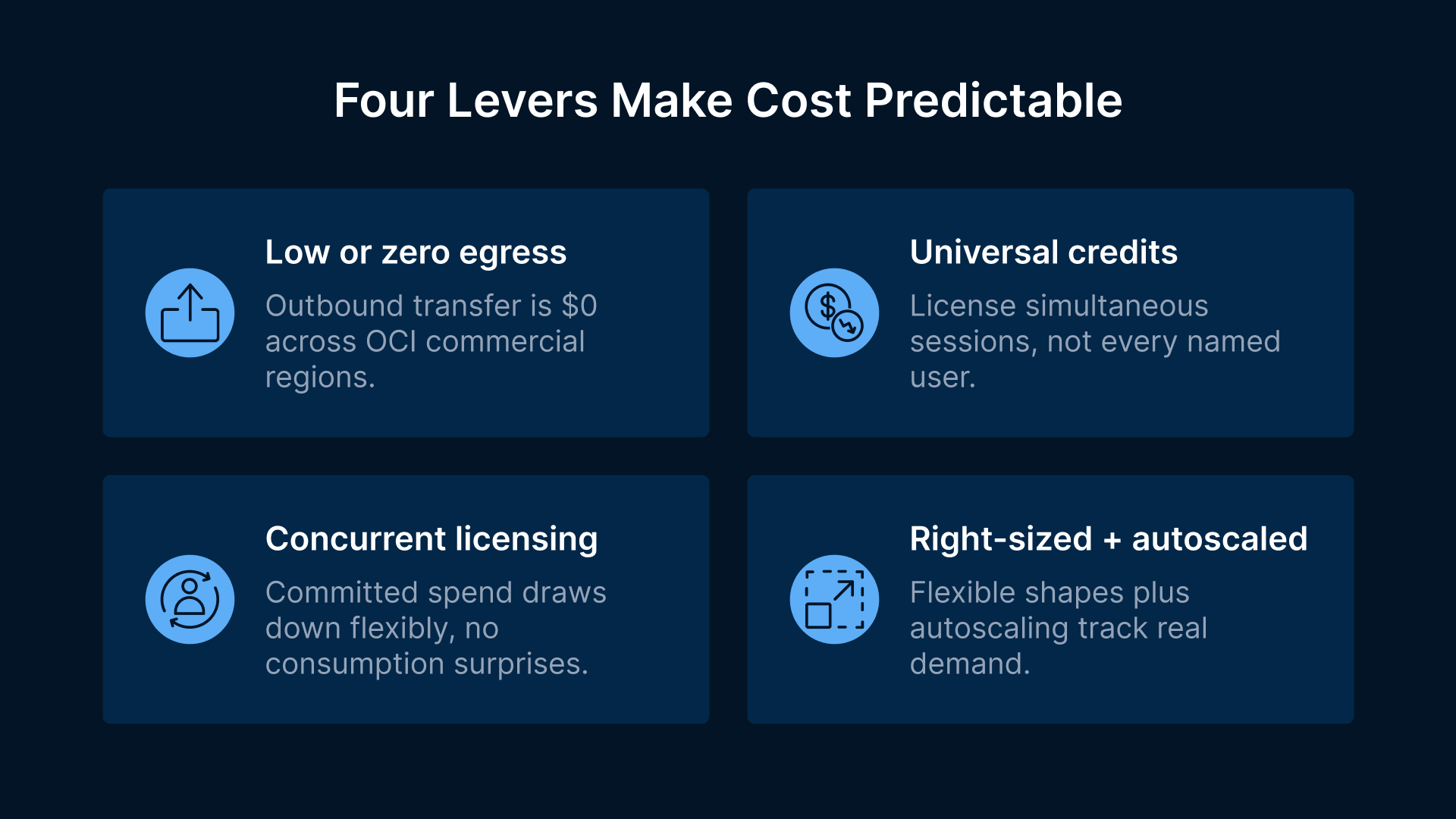
OCI’s defining cost advantage is network. Oracle has long offered dramatically lower egress than its peers, and as of early 2026 eliminated outbound data transfer charges across its commercial regions. For a streaming, data-out workload like VDI, this is decisive: the most volatile line on an AVD or WorkSpaces invoice effectively goes to zero. Your forecast stops depending on user behavior you cannot predict.
Universal Credits and Committed-Use Pricing
OCI’s universal-credits and committed-use model lets a bank commit spend and apply it flexibly across compute, storage, and networking. Combined with OCI’s strong price-performance on compute shapes, this turns a fluctuating consumption bill into a planned, drawn-down commitment, the kind of predictability a FinOps function and an audit committee both want.
Concurrent, Browser-Delivered Licensing
Because Thinfinity Workspace is delivered through the browser with a concurrent access model, you license for simultaneous sessions rather than stacking per-named-user SKUs across every employee who might occasionally connect. For institutions with shift-based tellers, part-time staff, and seasonal load, concurrency typically maps far more efficiently to real usage than per-seat licensing, and it removes a whole category of license-stacking surprises.
Right-Sized Compute and Autoscaling
OCI offers flexible compute shapes, including GPU bare-metal for graphics-heavy roles, so you size desktops to the role instead of overprovisioning. Autoscaling spins capacity down outside branch hours. The result is a compute bill that tracks genuine demand without the manual right-sizing toil that AVD optimization usually demands.
Illustrative TCO Comparison: 500 to 2,000 Seats
Important: the figures below are illustrative example math, not quotes or guaranteed pricing. They use publicly referenced rate models to show how the cost structure behaves, not what any specific institution will pay. Your actual numbers depend on seat mix, session profiles, regions, DR posture, and negotiated commitments. Treat this as a directional model to validate with a real estimate.
| Cost Element (illustrative model) | AVD / WorkSpaces pattern | Thinfinity on OCI pattern |
|---|---|---|
| Base compute (per seat/mo) | Consumption-based, floats with usage; commonly modeled $35-$60 for standard knowledge-worker desktops | Right-sized shapes on committed credits; modeled lower and flatter for an equivalent profile |
| Egress / data transfer | Metered (~$0.087-$0.09/GB after free tier) plus inter-region DR transfer; variable and hard to forecast | Effectively $0 outbound across OCI commercial regions |
| Per-user licensing | Stacked SKUs (e.g., RDS SAL ~$4.19/user, W365 from ~$31/user), per named user | Concurrent access model; license to simultaneous sessions, not every named user |
| Security appliances / network ingress | Additional gateways, WAF, and inbound exposure to manage and pay for | Zero inbound ports via reverse-proxy/DMZ design; fewer appliances |
| Forecast variance | High, several line items move month to month | Low, predictable per-seat figure for budgeting |
The pattern to take away: at 500 seats the difference may be moderate, but as you scale toward 2,000 seats the compounding effect of zero egress, concurrency-based licensing, and right-sized compute widens the gap, and just as importantly, the OCI number stays steady from month to month while the hyperscaler number keeps moving.
Security and Compliance Cost Avoidance
The cheapest dollar is the one you never spend. Thinfinity Workspace’s architecture removes spend and shrinks audit scope at the same time, which matters under GLBA and FFIEC examination.
- Zero inbound ports. The reverse-proxy/DMZ architecture means no open inbound ports to the desktop estate, cutting both the attack surface and the count of edge security appliances you license and maintain.
- Fewer appliances, fewer audits. Built-in MFA, SSO/SAML, RBAC, and session recording consolidate controls that banks otherwise buy and integrate separately, which also reduces the number of systems an examiner must review.
- No NPI on the endpoint. Browser-delivered, server-side desktops keep nonpublic information off branch and remote devices, simplifying the GLBA Safeguards story and reducing data-residency findings.
- Sovereign and global OCI regions support data-residency requirements without bolt-on infrastructure, and multi-region DR is far cheaper to operate when inter-region egress is not metered.
For institutions still running legacy core systems, it is worth noting that the same platform also covers mainframe and AS/400 access through built-in terminal emulation (TN3270/TN5250/VT/SSH), so legacy core access and modern VDI live under one secured, audited front door rather than a separate stack.
What Does Migration Actually Involve?
Migration is more incremental than most cost-conscious teams expect. Because Thinfinity Workspace is browser-delivered, there is no agent rollout to thousands of endpoints, users reach their desktops and apps through a URL with MFA. A typical path is to stand up a pilot department on OCI, validate the per-seat cost model against the real workload, then expand by branch or business unit. Existing identity providers plug in through SSO/SAML, and the reverse-proxy front door means network changes are concentrated at the DMZ rather than spread across the estate. The cost story and the migration story reinforce each other: you can prove the savings on a pilot before committing the full seat count.