

Summary
- Thinfinity Workspace is a strong Parallels alternative for partners: one cloud-agnostic platform delivering VDI, DaaS, application delivery, and Universal ZTNA through any HTML5 browser, with white-labeling built in.
- Its concurrent, single-license model gives resellers more predictable costs and margins than per-named-user pricing or Azure-consumption billing.
- Thinfinity runs on-premises, hybrid, or on any cloud (with a strong Oracle Cloud Infrastructure partnership), while Parallels DaaS requires a customer-supplied Microsoft Azure subscription and Microsoft Entra ID.
- One Thinfinity deployment covers persistent and non-persistent desktops, ZTNA, and even legacy terminal emulation, where Parallels partners often combine RAS, DaaS, and Parallels Secure Workspace.
- Parallels keeps real strengths (AVD simplification, browser Zero Trust, and multi-tenancy); this guide credits them while focusing on partner economics.
If you are an MSP, MSSP, ISV, VAR, or CSP searching for a Parallels alternative to resell secure personal and virtual desktops, the decision comes down to more than feature checklists. It comes down to your margins, your cloud freedom, and whether you can brand the platform as your own. This guide compares Thinfinity Workspace by Cybele Software against Parallels DaaS and Parallels Secure Workspace, presents each product’s real strengths fairly, and then makes the case for why partners increasingly choose Thinfinity to build a durable, higher-margin desktop practice.
Both vendors deliver secure browser-based access to Windows apps and desktops. The difference that matters for your business is the model underneath: Thinfinity uses a single, cloud-agnostic platform with concurrent licensing and native white-labeling, while Parallels splits its capabilities across multiple products, with its flagship DaaS offering built directly on Microsoft Azure Virtual Desktop.
This partner-economics guide has a companion written for IT and infrastructure buyers who care most about simplicity, reliability, and a predictable roadmap: Awingu alternative: simplicity, reliability, and a predictable roadmap for IT teams.
What Are We Actually Comparing?
Thinfinity Workspace is a single platform for secure desktop and application delivery. Parallels is a portfolio, so a fair comparison has to name the specific products a partner would evaluate.
Thinfinity Workspace (Cybele Software)
Thinfinity Workspace delivers secure VDI, DaaS, and application delivery plus Universal ZTNA through any HTML5 browser, with no client software to install. Its reverse-proxy and DMZ architecture requires zero inbound ports, and it includes MFA, SSO, SAML, RBAC, and session recording. It supports both persistent (true personal) and non-persistent desktops, and it is cloud-agnostic: deploy on-premises, hybrid, or on any cloud, backed by a strong Oracle Cloud Infrastructure (OCI) partnership. Uniquely, it also includes built-in terminal emulation (TN3270, TN5250, VT, and SSH) for legacy mainframe and AS/400 access, and Thinfinity VirtualUI lets ISVs web-enable legacy Windows apps.
Parallels DaaS
Parallels DaaS is a cloud-native Desktop-as-a-Service offering that is built on and requires Microsoft Azure Virtual Desktop (AVD). Customers bring their own Microsoft Azure subscription, and Microsoft Entra ID is the core identity and authentication layer, with the best experience delivered through the Microsoft Windows App. Its clear strength is simplifying AVD: it emphasizes non-persistent desktops that present a pristine desktop at each logon, along with autoscaling, VM scheduling, and profile management. For partners already committed to Azure, this is a genuine advantage.
Parallels Secure Workspace (formerly Awingu)
Parallels Secure Workspace is a browser-based Zero Trust workspace that uses proprietary RDP-to-HTML5 technology to aggregate RDP apps and desktops, file servers, web apps, and SaaS single sign-on into one browser portal. On 2023-10-31, Alludo announced that Awingu was rebranded to Parallels Secure Workspace, with the product itself stated to be unchanged. It includes built-in MFA (TOTP/HOTP), external IdP support via SAML and OpenID, session recording, granular controls, SIEM integration, virtual printing, and multi-monitor support. It is multi-tenant by design, can run from as little as one Linux VM (scaling up to roughly 500 concurrent app sessions), and markets up to 81% TCO savings as its own claim. Its strengths are browser Zero Trust and multi-tenancy; by design it centers on aggregating existing RDP backends.

As Awingu transitions to Parallels Secure Workspace, the product itself will remain unchanged, ensuring a smooth experience for all users without any required actions.

Parallels RAS
Parallels RAS delivers on-premises and hybrid app and desktop publishing under a single-license model. It is the most direct analog to traditional VDI in the Parallels lineup, but it is a separate product from DaaS and Secure Workspace, which is why partners often end up combining SKUs.
How Do the Platforms Compare Side by Side?
The table below summarizes the dimensions that matter most to partners. Where a Parallels capability lives in a specific product, that product is named.
| Dimension | Thinfinity Workspace | Parallels DaaS | Parallels Secure Workspace |
|---|---|---|---|
| Licensing model | Concurrent, single-license; no per-named-user or hidden charges | Tied to Azure consumption plus per-user; costs vary with Azure usage | Per-user subscription; VIPP program for MSP/ISV |
| Cloud / lock-in | Cloud-agnostic: on-prem, hybrid, or any cloud incl. OCI | Requires customer Microsoft Azure subscription and AVD | Runs on most hypervisors and clouds; centers on RDP backends |
| Desktop model | Persistent (personal) and non-persistent | Primarily non-persistent (pristine desktop each logon) | Aggregates published RDP desktops and apps |
| Identity / auth | MFA, SSO, SAML, RBAC | Microsoft Entra ID as core identity | Built-in MFA; SAML/OpenID external IdP |
| Security architecture | Reverse-proxy/DMZ, zero inbound ports, ZTNA, session recording | Azure-native security controls; Entra ID | Browser Zero Trust, encrypted traffic, session recording, SIEM |
| White-label / multi-tenancy | Native white-labeling; brand as your own | Limited partner branding within Azure model | Multi-tenant by design; partner program |
| Management | Single pane of glass; simple deploy/configure/manage | Managed via Parallels portal on top of Azure | Web-based admin; lightweight footprint (from 1 Linux VM) |
| Partner economics | Concurrent single license; higher, predictable margins; lowest-TCO positioning | Margin exposed to Azure cost variability | Claims up to 81% TCO savings; per-user margins |
| Terminal emulation | Built in (TN3270/TN5250/VT/SSH) | Not included | Not included |
Why Do Partner Economics Favor Thinfinity?
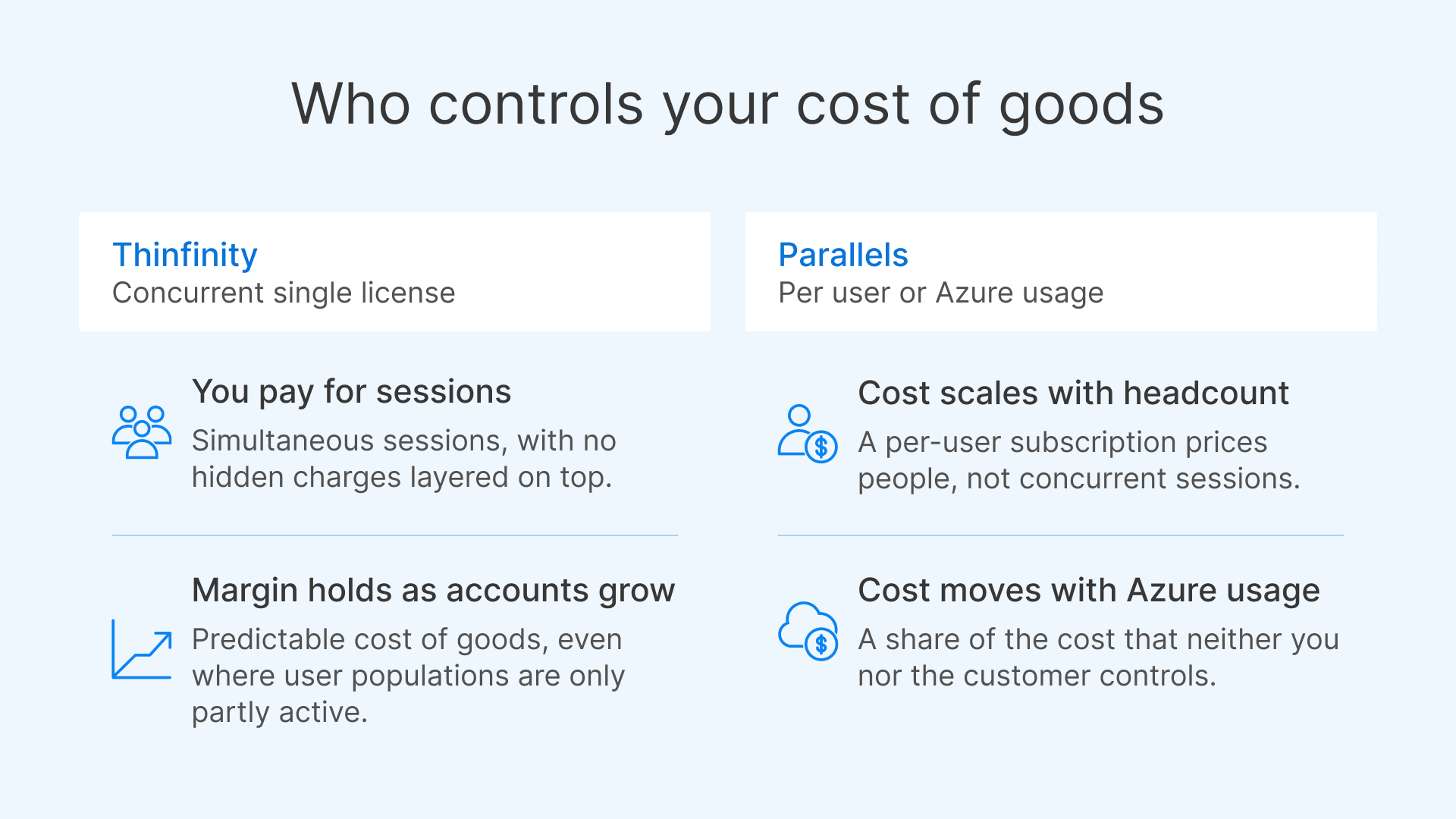
For a reseller, the license model is the business model. Thinfinity uses concurrent, single-license pricing: you pay for simultaneous sessions rather than every named user, and there are no hidden charges layered on top. That makes your cost of goods predictable, lets you serve customers with large but partially active user populations efficiently, and protects your margin as accounts grow.
Parallels DaaS ties economics to Microsoft Azure. Because customers bring their own Azure subscription and consume AVD, a meaningful share of the cost, and its variability, sits in Azure consumption that neither you nor your customer fully controls month to month. That can complicate fixed-price managed offerings and compress margins when Azure costs move. Parallels Secure Workspace markets aggressive TCO savings and runs a partner program, but its per-user subscription still scales cost with headcount rather than concurrency.
The practical result: with a concurrent single license, a partner can package a flat, branded monthly service and keep the spread between wholesale cost and retail price stable. That predictability is the foundation of a repeatable, higher-margin desktop practice.
How Much Does Cloud Freedom Matter for Partners?
Cloud freedom is strategic, not just technical. Thinfinity is cloud-agnostic, so you can deploy the same platform on-premises for a regulated customer, in a hybrid model for another, and on OCI, AWS, Google Cloud, or Azure for a third, without changing products or retraining your team. Cybele’s strong OCI partnership is particularly useful for partners pursuing cost-sensitive or sovereignty-conscious workloads outside the Azure ecosystem.
Parallels DaaS, by contrast, is intentionally Azure-centric. That is the right choice for an Azure-first customer and a real strength of the product. But it means a partner’s DaaS practice is anchored to Microsoft: the identity layer is Entra ID, the desktops live in the customer’s Azure subscription, and the best client experience runs through the Microsoft Windows App. If a customer wants to leave Azure, or never wanted to be on it, that Parallels path does not follow them. Thinfinity does.
Is One Platform Really Simpler Than Multiple SKUs?
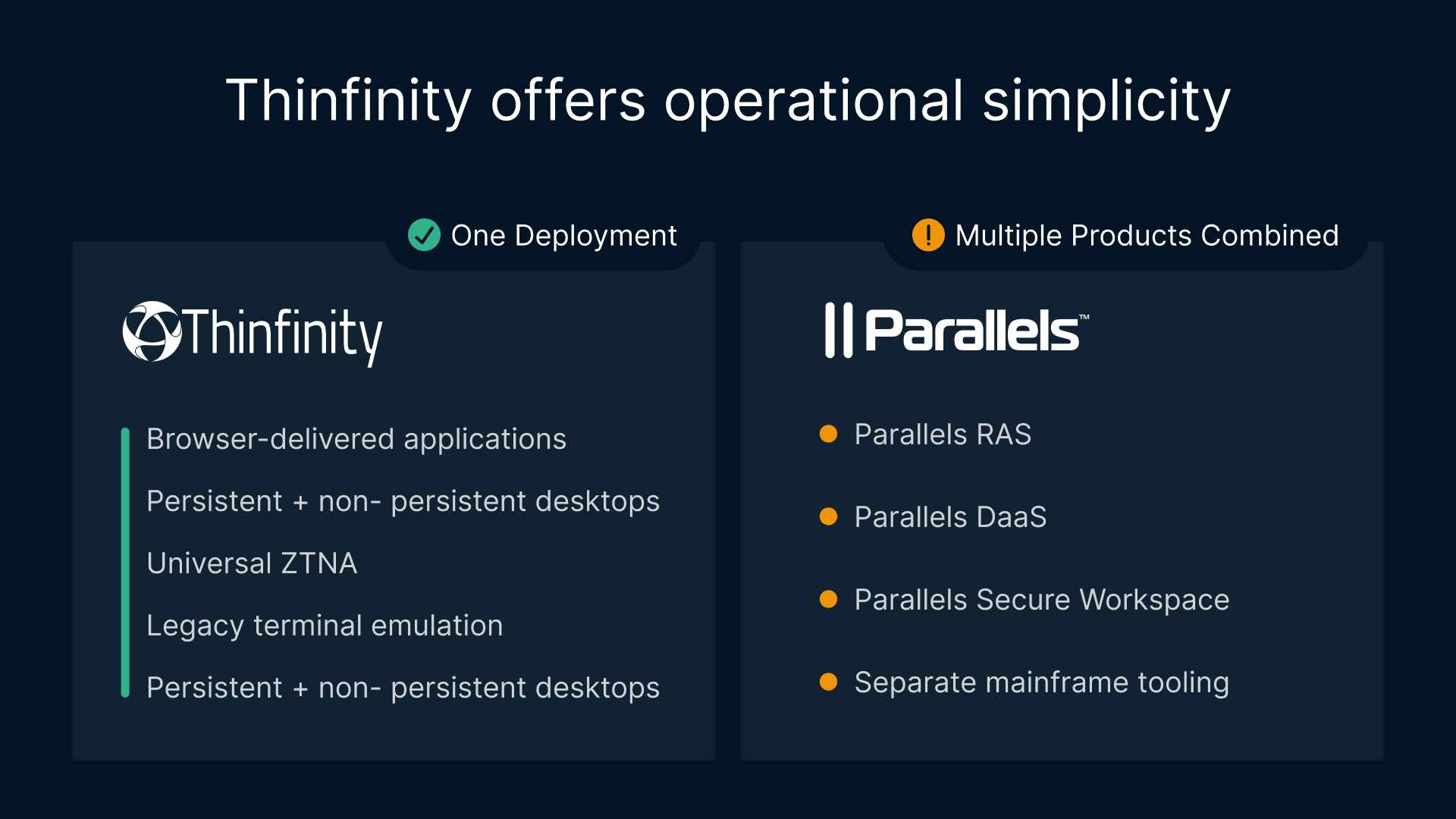
Yes, and the simplicity compounds for partners. A single Thinfinity Workspace deployment covers browser-delivered apps, persistent and non-persistent desktops, Universal ZTNA, and legacy terminal emulation. Your engineers learn one product, your NOC monitors one platform through a single pane of glass, and your sales team pitches one story.
With Parallels, matching that breadth typically means combining products: RAS for on-prem/hybrid publishing, DaaS for Azure-based cloud desktops, and Secure Workspace for browser Zero Trust aggregation, plus separate tooling for anything mainframe-related. Each is capable in its lane, but every added SKU adds licensing, training, and support surface. For a lean MSP or ISV, consolidating onto one platform reduces operational overhead and shortens time to revenue.
What About Security Architecture and Enablement?
Thinfinity’s reverse-proxy and DMZ design exposes zero inbound ports, which materially shrinks the attack surface you have to defend on behalf of customers. Combined with Universal ZTNA aligned to NIST SP 800-207, MFA/SSO/SAML, RBAC, and session recording, it gives MSSPs a defensible security story out of the box. Parallels also brings strong security: Secure Workspace is built around browser Zero Trust with encrypted traffic and SIEM integration, and DaaS inherits Azure and Entra ID controls. All three are credible on security; Thinfinity’s differentiator is delivering that posture from a single, cloud-agnostic platform with no inbound ports.
Enterprise resources do not accept arbitrary incoming connections from the internet. Resources accept custom-configured connections only after a client has been authenticated and authorized.
On enablement, Cybele backs partners with a single-pane-of-glass management model, fast deployment, dedicated pre- and post-sales support, and free online training and certification. That lowers the cost of standing up a new practice and helps smaller partners punch above their weight.
When Is Parallels the Better Fit?
Parallels is a mature portfolio with genuine strengths, and it is fair to name where it leads. For Azure-first customers, Parallels DaaS is an excellent way to simplify Azure Virtual Desktop, and Parallels Secure Workspace delivers solid browser Zero Trust with multi-tenancy. Parallels is a well-regarded, established vendor with real market presence and execution in the DaaS space. If a customer’s environment is committed to Microsoft Azure and Entra ID, those Parallels products deserve a serious look.