

TL;DR
- Microsoft cut Windows 365 Business pricing by roughly 20% in May 2026, the first meaningful DaaS price move in two years, landing right as banks enter mid-year budget reviews.
- A teller is the textbook task worker, which makes pooled multi-session the cheapest way to deliver the seat and per-user list pricing the most expensive.
- Priced across a 50-branch, 300-teller bank: roughly $25–34/seat fixed on Windows 365, $14–28 on well-managed pooled AVD, and typically lower again on self-hosted Thinfinity on OCI.
- The savings come from the idle-hour line, not the license line: branches need desktops only about 36% of the week, so pools that scale to branch hours win.
- Pooled VDI also keeps customer data off branch endpoints, adds a near-zero-cost DR posture, and cuts endpoint energy by 65–80 MWh/year with thin clients.
Microsoft Just Cut Cloud Desktop Prices 20%. Time to Redo the Branch Math.
In May 2026 Microsoft trimmed Windows 365 Business pricing by roughly 20% — the first meaningful price move in the DaaS market in two years, landing exactly as banks enter mid-year budget reviews. Branch teller and platform seats are the highest-volume desktop type in banking IT, and retail/commercial banking already accounts for over 60% of desktop-virtualization spend.
So what does a teller seat actually cost now? Vendor list prices answer the wrong question. A teller is the textbook task worker — six to ten apps, predictable hours, no GPU — which makes the seat ideal for pooled, multi-session delivery, and makes per-user list pricing the most expensive way to buy it. Below: the same 50-branch, 300-teller bank priced three ways, including the lines that don’t appear on pricing pages.

analysts expect little impact on uptake of the Desktop-as-a-Service (DaaS) platform

The Scenario
- Fleet: 50 branches, 300 teller/platform seats, ~270 peak concurrent users, branch hours Mon–Sat (≈60 operating hours/week, 36% of the 168-hour week).
- Workload: Core banking client, teller app, document imaging, browser, Office web. No GPU, light CPU/RAM profile (2 vCPU / 8 GB equivalent per concurrent user in pooled mode).
- Endpoints: Aging branch PCs eligible for thin-client replacement (10–15 W) vs desktop refresh (80–100 W).
Three Ways to Buy the Same Seat (List-Price Estimates, June 2026)
| Cost line (per seat/month) | Windows 365 (post-cut) | AVD pooled (reserved) | Thinfinity on OCI (pooled multi-session) |
|---|---|---|---|
| License / platform | ~$25–34 (2vCPU/8GB tier) | M365/AVD entitlement (often owned) | Thinfinity subscription |
| Compute | Included (fixed, per-user) | ~$26–38 reserved; ~$9–14 with aggressive autoscaling | OCI flex compute, pooled; scales with concurrency, not headcount |
| Profile/storage (FSLogix etc.) | Included | +$2–5 | +$2–4 (OCI block/file) |
| Mgmt tooling | Included | Nerdio/native (+$3–6) | Included (Cloud Manager + autoscaler) |
| Idle-hour waste | High — fixed per-user 24/7 | Low if autoscaled correctly | Low — pools scale to branch hours |
| Indicative total | ~$25–34 fixed | ~$14–28 well-managed | Typically lowest at task-worker density; see 40% TCO study |
Ranges are list-price estimates as of June 2026 and vary by region and discounting; the methodology follows our AVD/Nerdio vs Thinfinity on OCI TCO benchmark (up to 40% savings).
The Lines Vendors Leave Out
- Idle hours: A branch desktop is needed ~36% of the week. Fixed per-user pricing bills you for the other 64%. Pooled hosts that scale to zero on Sundays are where branch math is won — our autoscaling engine exists for exactly this curve (see Thinfinity Cloud Manager autoscaling deep-dive).
- Endpoint energy: A thin client draws 10–15 W vs 80–100 W for a desktop. Across 300 endpoints x 60 h/week, that’s roughly 65–80 MWh/year saved — call it $8–12k/year at commercial rates, plus a longer refresh cycle (7–10 years vs 4–5).
- Egress and imaging traffic: Document imaging is the branch bandwidth hog. Keeping images in-region on OCI and sending pixels to the branch typically beats hauling files over branch WAN links.
- The compliance dividend: Pooled VDI keeps customer data out of the branch entirely — no NPI on teller endpoints, which simplifies the GLBA Safeguards story and shrinks exam scope (see Banking VDI on OCI: GLBA & FFIEC architecture).
Profile Design: The Difference Between Pooled and Painful
Pooled multi-session economics only materializes if any teller can land on any host with their environment intact. That’s a profile-architecture problem. FSLogix profile containers (or the OCI-native equivalent) should hold the user layer — teller app settings, printer mappings, signature pads — on file storage in the same region as the hosts, sized at 2–5 GB per user for a task-worker profile. Keep the golden image thin: core banking client, imaging client, browser, and nothing user-specific. Image updates then become a rebuild-and-redeploy operation on 23 hosts instead of a patch cycle across 300 branch PCs, which is where a large share of the operational savings actually comes from.
Peripherals deserve early attention because branches are full of them: receipt printers, check scanners, signature pads, cash recyclers. Test redirection for each device class during the pilot branch rollout — printer redirection and scanner support are solved problems in mature HTML5 delivery, but every bank has one legacy USB device that needs a workaround, and you want to find it in branch #1, not branch #38.
The DR Story Nobody Prices In
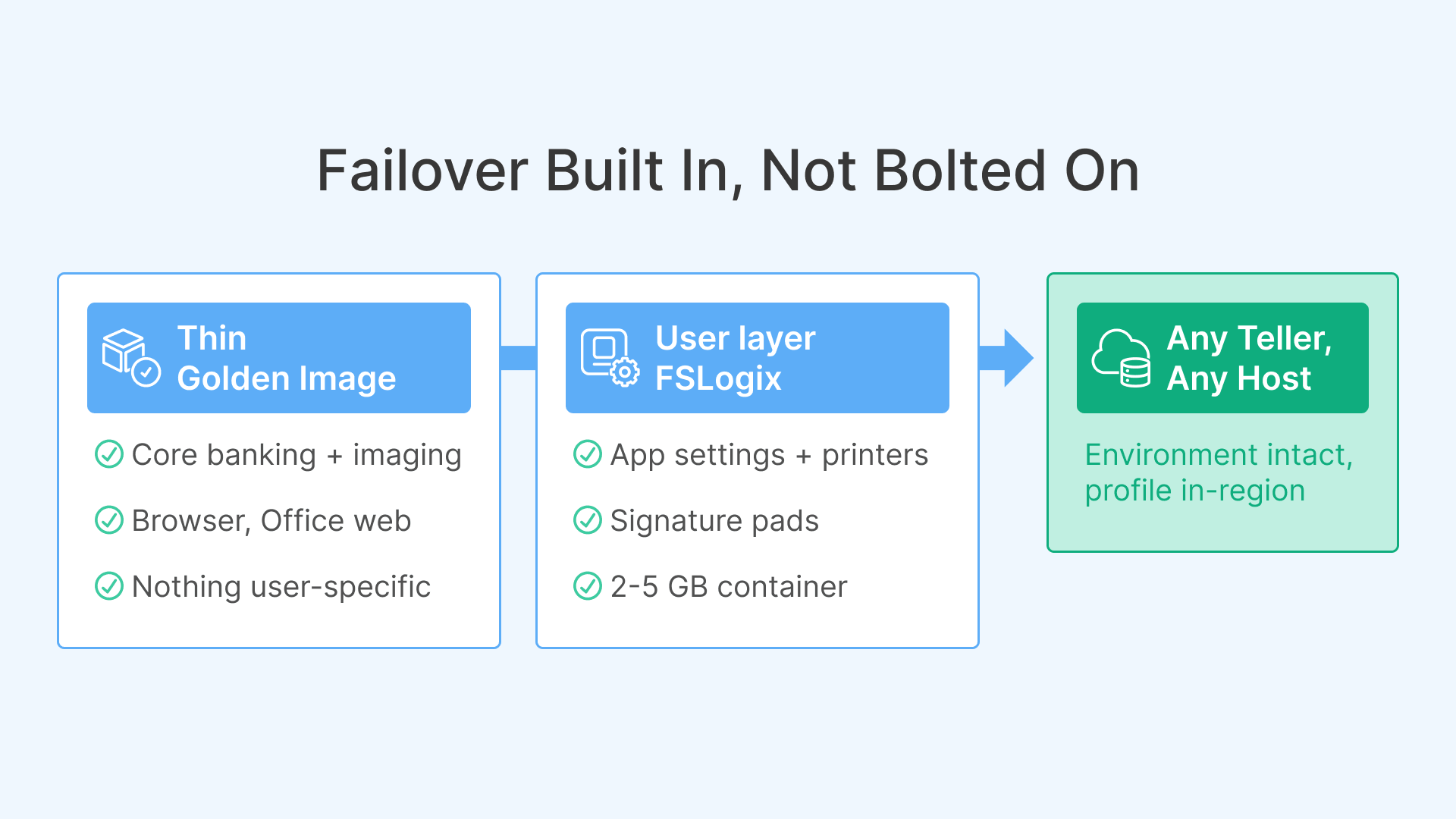
A branch desktop fleet on pooled VDI changes your continuity posture in two directions. Branch-down: if a branch floods, burns, or loses its WAN, tellers walk to the nearest branch (or home, with MFA) and their entire environment is waiting — recovery time is a commute, not a hardware order. Datacenter-down: pooled hosts in a second OCI region, normally scaled to zero, can absorb the full 270-concurrent load within minutes at standby cost near zero. Compare that against the implicit DR plan of 300 physical branch PCs — which is to say, against no plan — and the VDI business case picks up a line that most cost models omit entirely.
Decision Rules
- Under ~50 seats or no cloud team: W365’s fixed price buys simplicity; the 20% cut makes it defensible at small scale.
- Microsoft-committed with strong ops: AVD pooled + disciplined autoscaling is competitive — the discipline is the product.
- 300+ task-worker seats, cost-driven: Self-hosted pooled delivery (Thinfinity on OCI) wins on idle-hour economics and per-concurrent rather than per-named pricing — and the browser-only client means tellers work from any endpoint, including the thin clients that fix your energy line.
Run This Model on Your Own Branch Network
Send us your branch count, seat count and operating hours — we’ll return a seat-by-seat TCO model for Thinfinity on OCI, including autoscaling schedules and storage, benchmarked against your current W365/AVD spend.