

TL;DR
- Zero trust banking VDI grants access per session based on verified identity, device, and context, following NIST SP 800-207, never on the basis of network location.
- Legacy VPN-plus-VDI fails the per-session test: one login grants broad network reach and leaves inbound gateway ports exposed at the perimeter.
- Thinfinity Workspace on OCI enforces zero trust at a DMZ reverse proxy with zero inbound ports, layering IdP brokering, MFA/SSO/SAML, per-resource RBAC, and session recording.
- OCI network services (VCN segmentation, Network Security Groups, WAF, Vault, Cloud Guard) add microsegmentation so a compromise in one tier cannot move laterally to desktops or data.
- The architecture maps directly to NYDFS 23 NYCRR Part 500 (universal MFA, effective November 1, 2025) and FFIEC layered authentication, producing a clean control-mapping evidence package.
A zero trust banking VDI built on Oracle Cloud Infrastructure (OCI) replaces perimeter trust with continuous, per-session verification of identity, device, and context before any virtual desktop or application is delivered. For a bank, that means every connection to a teller workstation, loan-origination app, or back-office desktop is brokered through an identity provider, evaluated against dynamic policy, and enforced at a reverse proxy that exposes zero inbound ports to the internet. This article presents a layer-by-layer reference architecture for deploying Thinfinity Workspace on OCI in alignment with NIST SP 800-207, and maps each layer to the access controls that examiners under FFIEC and NYDFS expect to see.
Key Takeaways
- Zero trust banking VDI verifies every session, not the network. Under NIST SP 800-207, access is granted per-session based on identity, device posture, and dynamic policy, never on the basis of being inside a corporate or VPN-connected network.
- Legacy VPN-plus-VDI models fail the per-session test. A VPN grants broad network reach after one authentication, creating lateral-movement risk that examiners increasingly flag.
- Thinfinity Workspace on OCI enforces zero trust at a reverse proxy in the DMZ with zero inbound ports open to backend desktops. Identity brokering, MFA/SSO/SAML, per-resource RBAC, and session recording are layered on top.
- The architecture maps cleanly to regulator expectations. NYDFS 23 NYCRR Part 500 (as amended, effective November 1, 2025) requires MFA for any user accessing any information system; FFIEC authentication guidance expects layered, risk-based access controls.
- Browser-delivered access removes the endpoint as a trust anchor. Users reach desktops and apps through any HTML5 browser, so no data or open inbound path lands on the device.
What Is Zero Trust for Banking VDI?
Zero trust for banking VDI is an access model in which no user, device, or session is trusted by default, and every request to reach a virtual desktop or application is authenticated, authorized, and continuously evaluated before and during delivery. It applies the principles of NIST Special Publication 800-207 to the specific problem of giving bank employees, contractors, and third parties access to Windows desktops and line-of-business applications without exposing those systems to the open internet or to a flat internal network.
NIST SP 800-207 defines seven tenets, but three drive desktop and application access most directly: all communication is secured regardless of network location; access to individual resources is granted on a per-session basis; and access is determined by dynamic policy that includes identity, application state, and the requesting asset’s posture. Translated to a bank, this means a loan officer connecting from a branch and the same officer connecting from a managed laptop at home should both be evaluated freshly, against the same policy engine, for the single application they actually need.

Zero trust assumes there is no implicit trust granted to assets or user accounts based solely on their physical or network location (i.e., local area networks versus the internet) or based on asset ownership (enterprise or personally owned).

How does zero trust differ from a traditional VPN plus VDI?
A traditional VPN authenticates a user once and then places their device on the network, where it can often reach far more than the one or two applications the job requires. VDI behind that VPN inherits the same weakness: the broker, gateway, and desktop pool are reachable across the tunnel. Zero trust inverts this. There is no network placement. The user is granted a brokered, per-session connection to a specific resource, and nothing else on the network becomes reachable. This is the practical meaning of ZTNA banking, and it is why VPN-plus-VDI architectures are aging out of examiner-approved designs.
Why Legacy Access Models Fall Short for Banks
Three failure modes recur in bank environments. First, implicit trust after authentication: once a VPN session is established, lateral movement to the VDI control plane and adjacent systems is constrained only by internal firewall rules that are often coarse. Second, inbound exposure: published VDI gateways and RD Gateways typically require inbound ports open at the perimeter, which become scanning and exploitation targets. Third, endpoint as trust anchor: when a desktop client caches credentials or data, the security of the bank’s environment becomes contingent on the security of every laptop, including contractor and BYOD devices.
Regulators have responded to exactly these gaps. The NYDFS Cybersecurity Regulation, 23 NYCRR Part 500, was amended so that, effective November 1, 2025, covered entities must require multi-factor authentication for any individual accessing any information system, not only systems holding nonpublic information. NYDFS has publicly characterized MFA deficiencies as the most exploited gap behind breaches. FFIEC authentication guidance, in parallel, expects layered, risk-based controls and discourages single-factor access to systems handling sensitive customer data. A zero trust banking VDI is the architecture that satisfies these expectations by construction rather than by exception.
MFA weaknesses are the most common cybersecurity gap exploited at financial services companies.
The Thinfinity-on-OCI Zero Trust Reference Architecture, Layer by Layer
The reference architecture below describes how Thinfinity Workspace deploys on Oracle Cloud Infrastructure to deliver secure virtual desktops and applications to a bank under a zero trust model. It is organized as layers that correspond to NIST 800-207’s logical components: a policy decision plane (identity and policy), a policy enforcement plane (the reverse proxy), and the protected resources (desktops, apps, and data) behind microsegmented OCI networking.
Layer 1: Identity, IdP Brokering, and MFA/SSO/SAML
The first layer is identity. Thinfinity Workspace acts as an identity broker, federating with the bank’s existing identity provider over SAML, OpenID Connect, or LDAP, and integrating Azure Entra ID, Okta, Active Directory Federation Services, or similar. Authentication is enforced with MFA and delivered through single sign-on so that one strong, verified identity governs access to all entitled desktops and applications. In NIST terms, the identity layer feeds the Policy Engine the subject attributes it needs to make a per-session decision. Because brokering is centralized, the bank can enforce token-based MFA uniformly, which aligns with NYDFS guidance favoring token-based factors over SMS or push to reduce SIM-swap and prompt-fatigue risk.
Layer 2: Reverse Proxy in the DMZ with Zero Inbound Ports
The second layer is the Policy Enforcement Point. Thinfinity Workspace’s reverse-proxy component is deployed in an OCI DMZ subnet and is the only component that terminates client connections. Critically, backend desktops, application servers, and the broker sit in private subnets with zero inbound ports open from the internet; the reverse proxy reaches them through outbound-initiated or tightly scoped internal paths. Users connect over HTTPS from any HTML5 browser, and the proxy enforces the policy decision before brokering the session. This eliminates the published-gateway attack surface that legacy VDI carries and is the structural heart of a zero trust banking VDI: the protected resources are never directly addressable.
Layer 3: Per-App, Per-Resource Access and RBAC
The third layer is authorization. Access is granted per application and per resource, not per network. Role-based access control (RBAC) ties each user, through their brokered identity, to the precise set of desktops and applications their role requires, and nothing more. A teller sees the teller application; a treasury analyst sees treasury tools; a third-party auditor sees a single read-only desktop for the duration of the engagement. This per-resource granularity satisfies NIST 800-207’s per-session, least-privilege intent and gives examiners a clean, demonstrable mapping from job role to system entitlement.
Layer 4: Session Recording, Audit, and Continuous Visibility
The fourth layer is observability. Thinfinity Workspace provides session recording and detailed audit logging, capturing who accessed which resource, when, from where, and what occurred during privileged sessions. These telemetry streams feed both the policy plane, supporting continuous evaluation and adaptive policy, and the bank’s SIEM for retention and examiner evidence. NIST 800-207 explicitly calls for the enterprise to monitor asset integrity and security posture and to make policy data-driven; session recording and audit logging operationalize that tenet for desktop and application access.
Layer 5: OCI Network Security Services and Microsegmentation
The fifth layer is the cloud network fabric. On OCI, the architecture uses a Virtual Cloud Network (VCN) segmented into DMZ and private subnets, with Network Security Groups and security lists providing microsegmentation between the reverse proxy, broker, and resource tiers. OCI Web Application Firewall fronts the proxy, the OCI Bastion service and Vault manage privileged access and secrets, and Cloud Guard provides posture monitoring. Microsegmentation ensures that even if one tier were compromised, lateral movement to the desktop pool or data tier is blocked by default-deny network policy, reinforcing the zero trust principle that being on the network grants nothing.
Putting the Layers Together: The Request Flow
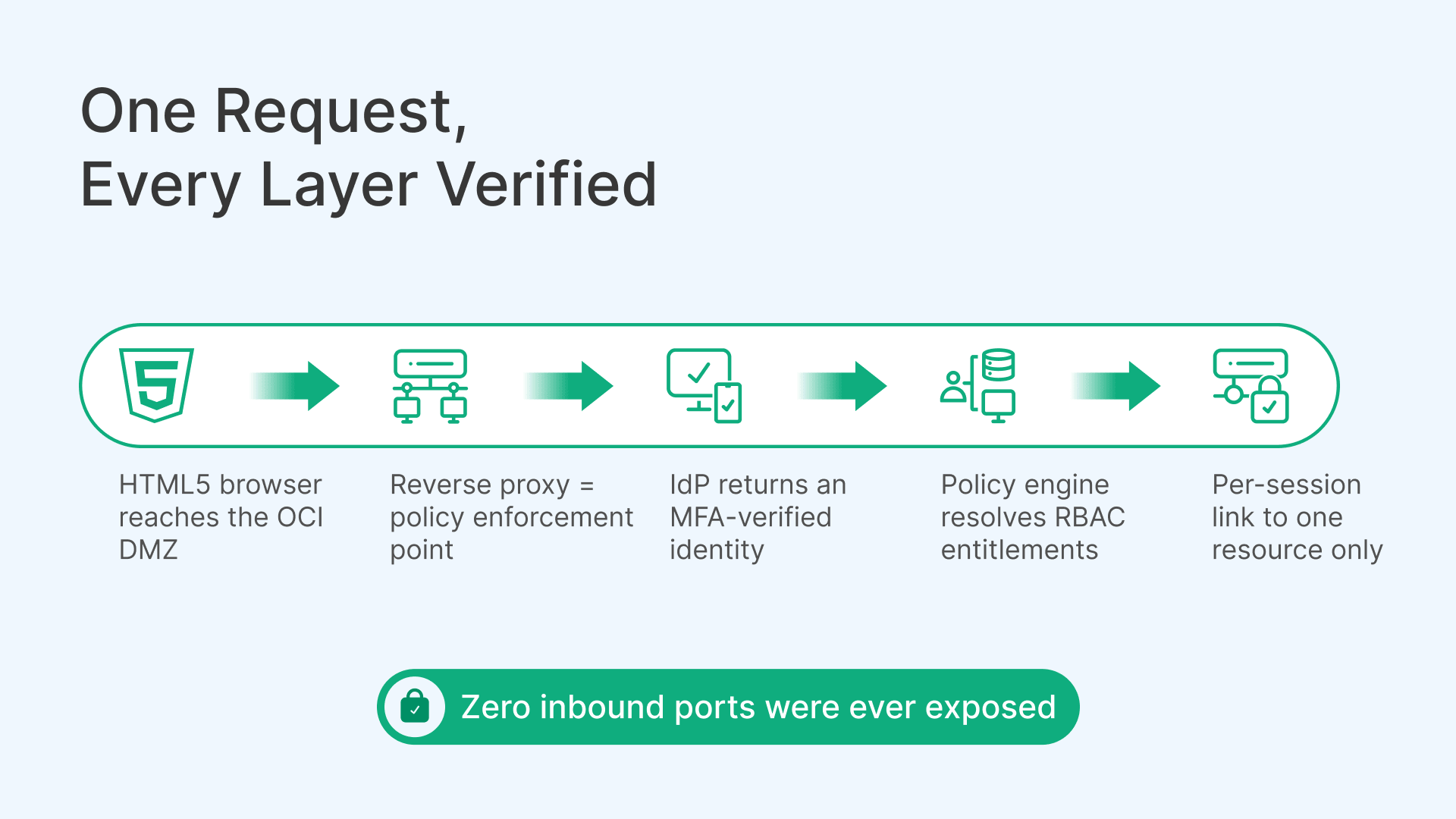
A single access request traverses the layers as follows. A user opens an HTML5 browser and reaches the Thinfinity reverse proxy in the OCI DMZ. The proxy redirects authentication to the brokered IdP, which enforces MFA and returns a verified identity over SAML or OIDC. The policy plane evaluates identity, device posture, and context against dynamic policy and resolves the user’s RBAC entitlements. Only then does the proxy broker a per-session connection to the one private desktop or application the user is authorized for, while OCI microsegmentation keeps every other resource unreachable and session recording captures the activity. No inbound port to the backend was ever exposed, and no trust was extended to the network or the endpoint.
Mapping the Architecture to Controls and Regulators
The table below maps each architectural layer to the NIST 800-207 component it implements and to the regulatory expectation it helps satisfy. This mapping is what turns a technical design into an evaluation-stage artifact a CISO can take to risk and audit committees.
| Architecture Layer | NIST 800-207 Component | Regulatory Alignment |
|---|---|---|
| Identity / IdP brokering / MFA / SSO / SAML | Policy Engine inputs (subject identity) | NYDFS 500.12 MFA for any user/any system; FFIEC layered authentication |
| Reverse proxy in DMZ, zero inbound ports | Policy Enforcement Point | FFIEC access controls; attack-surface reduction |
| Per-app/per-resource access and RBAC | Per-session, least-privilege access | Least privilege; segregation of duties expectations |
| Session recording and audit | Continuous monitoring and telemetry | FFIEC logging/monitoring; NYDFS audit trail (500.06) |
| OCI microsegmentation and network security services | Secured communication regardless of location | Lateral-movement containment; defense in depth |
For institutions that still depend on mainframe or IBM AS/400 (IBM i) systems for core banking, the same Thinfinity platform includes built-in terminal emulation through z/Scope, so legacy host access can be delivered under the identical zero trust controls rather than through a separate, lightly governed emulation client.